
11 min
What a Sauna and Cold Plunge Cost Across Africa in 2026
An honest continental price breakdown: what a sauna and cold plunge cost in eight African countries, what move…
Read more →We sell fewer chillers per plunge in South Africa than in any other market we work in. This is the article explaining why, and it will cost us money to publish.
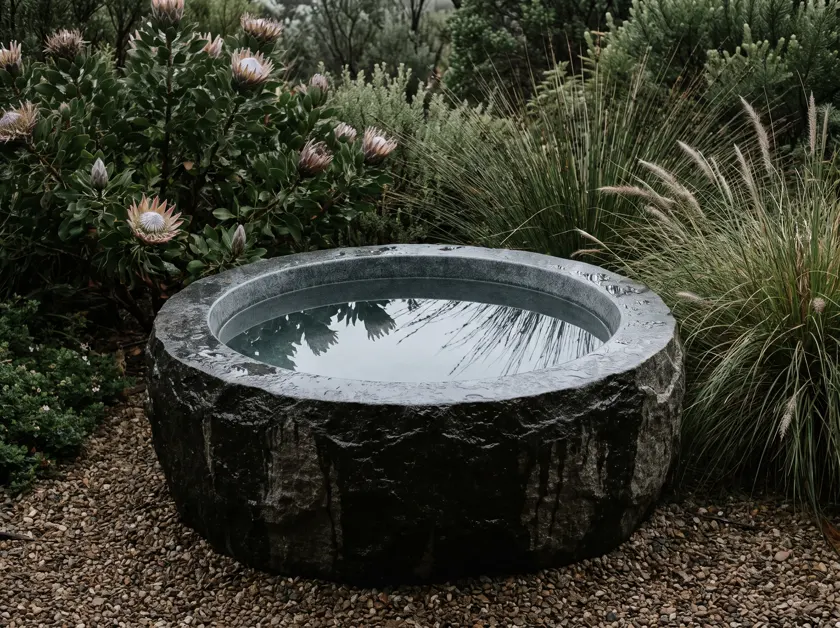
A chiller removes heat that keeps arriving: from the air around the tub, from the sun on its surfaces, from evaporation off the open water, and from the people getting in.
In a tropical market every one of those is working against you all year. In a Cape or Highveld winter, three of the four are close to neutral and the fourth — the people — is intermittent. There is very little heat to remove.
Municipal water in a Cape winter arrives cold. Night air in June and July on both the Cape and the Highveld drops low enough to pull a tub down overnight rather than warming it.
Put those together with an insulated shell, an insulated base, a fitted lid and a shaded position and the tub sits in the low teens from May to September without anything plugged in. For a great many households, that is exactly the product they wanted.
Insulation is not a refinement, it is the mechanism. A tub with closed-cell insulation in the wall cavity and under the base presents a fraction of the heat load of an uninsulated one, and in a climate that is already helping you, that fraction is the difference between needing a machine and not.
The lid is the cheapest component in the system and the one that saves the most. It stops evaporation, which is the largest single heat-loss route from open water, and it keeps the sun off. Almost everyone stops using theirs within a month because it is too heavy, which is why we make ours light enough to lift with one hand.
A tub in full Cape summer sun is a different object from the same tub under an oak. Shade for the hottest six hours is worth more than a size of compressor and costs less.
We site plunges on the shaded side, under existing trees where there are any, and where a screen or wall can be added cheaply if there are not. It is a layout decision that has to be made at drawing stage, because moving a tub afterwards is not a small job.
Year-round consistency at 8 °C or below. Athletes and clubs who want 4-6 °C on demand. Any shared tub where the temperature has to be predictable for everyone who books a slot. And the entire KZN coast, where the ambient never really drops and the Cape argument simply does not apply.
For those cases the sizing is 1 HP to about 260 litres, 2 HP to about 570, 4 HP to about 1,200, stepped up for full sun, a 4 °C target or back-to-back squad use.
Build the tub properly now — insulated shell, insulated base, good lid, shaded position, drain, circulation and filtration — and leave the chiller out. Run it for a winter. If you find you want cold water in February as well, add the machine then.
Adding a chiller to a well-built tub later is straightforward: it is a cabinet, two hoses and a circuit. Adding insulation to a badly built tub later is not — it is a rebuild.
So the honest sequence is to spend the money on the parts that cannot be retrofitted and defer the part that can.
The calculation changes when the tub is shared. Guests and members expect a stated temperature, and a tub that is eleven degrees in July and eighteen in February generates complaints rather than loyalty.
For commercial installations we specify the chiller and then use the climate to size it down rather than out: a Cape club needs a smaller machine than an equivalent club in Durban, and both need one.
And in both cases the chiller goes on a battery-backed circuit, so the water never drifts during an interruption. Pulling a shared tub back down from ambient costs far more than holding it did.
If you already have any tub, a bath or a wheelie bin, fill it, put it where the plunge would go, cover it and leave it overnight in June. Take the temperature in the morning and again at four in the afternoon.
Those two numbers tell you almost everything. If the morning reading is where you want it and the afternoon reading has not climbed much, a properly insulated tub in that position will behave the same way and better, because ours has a closed-cell cavity and yours has none.
If the afternoon reading has climbed several degrees, look at the shade before you look at machinery. Nine times out of ten in the Cape the answer is a screen or a different corner of the garden rather than a compressor.
A tub with no chiller still needs the rest of the system. Circulation so the water is not standing, cartridge filtration, and ozone or UV on anything more than one household uses. Cold water does not sanitise itself and it hides nothing.
Without a chiller you will also be topping up and changing water more deliberately, because you are using the mains supply as part of the cooling. That is a habit rather than a cost, and it suits a household that uses the tub in the morning.
And you keep the option open. A well-built tub takes a chiller later in an afternoon: a cabinet, two hoses and a circuit. That is the whole argument for spending on the tub now and deciding about the machine after a winter of using it.
One more practical point. Without a compressor there is no fan, no condenser and no refrigerant circuit, which means there is nothing to service except the filter and the water. A chillerless tub is the lowest-maintenance thing we build, and for a holiday house that stands empty for months at a time that is worth as much as the saving on the machine itself.
It is also silent, which on a small Cape property with close neighbours is not a trivial consideration. The most common complaint we hear about somebody else's installation is not the cost of the chiller. It is the noise of it at six in the morning.
Want this checked against your own room? Send us the dimensions and a photograph and we will come back with a drawing.
An honest continental price breakdown: what a sauna and cold plunge cost in eight African countries, what move…
Read more →
An honest breakdown of sauna and cold plunge prices in South Africa: what sits inside R60,000, what pushes a p…
Read more →
From Nairobi at 1,795 m to the Ngorongoro rim: why African highland saunas need a bigger heater, and why the s…
Read more →