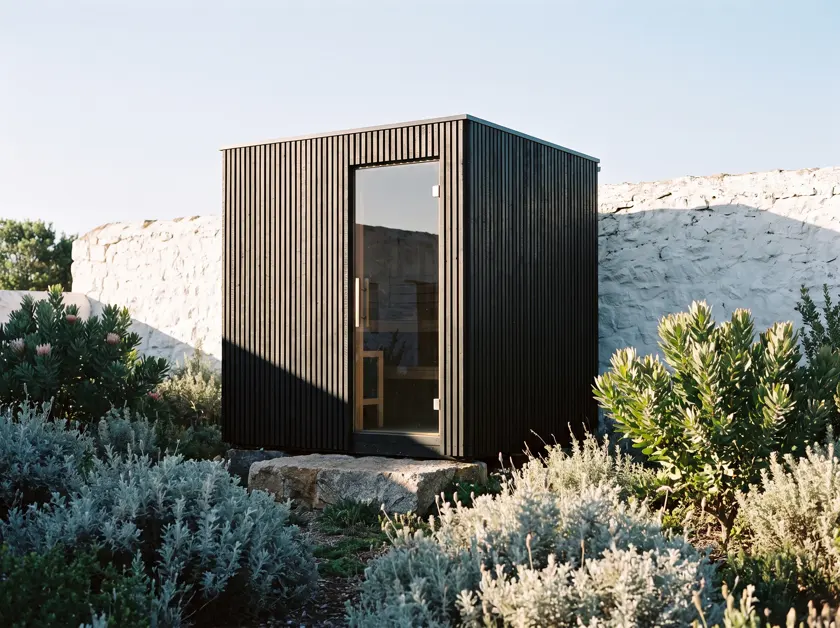
Saunas
A cabin for a Camps Bay winter, a cabin for a Highveld hailstorm and a cabin for Umhlanga humidity are three d…
Read more →Load shedding has ended — South Africa has now gone more than 475 days without it, and passed a full year without a single second in May 2026. What remains is a country with more installed inverter, battery and solar capacity than anywhere else on the continent, and that turns out to be very useful.
Indicative band: 12 – 78 thousand ZAR, supplied and installed in South Africa.
Across the continent: Power & off-grid integration in all eight countries →
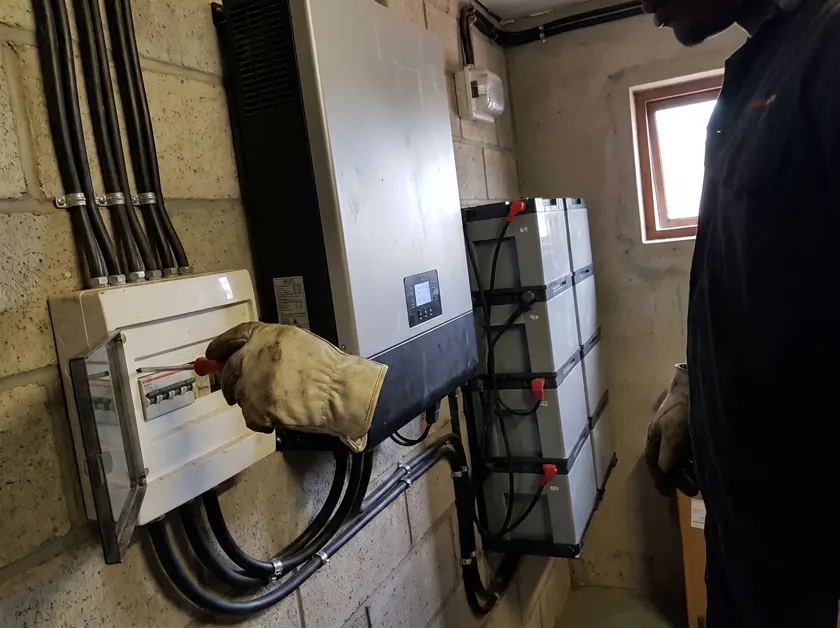
Households here spent ten years buying inverters, batteries and rooftop solar. The grid has recovered — Eskom reports unplanned outages at their lowest in nine years and roughly R26.9 billion saved on diesel over three years — but the hardware is still on the wall.
That hardware is close to ideal for a wellness installation. A chiller is a small, steady load that a battery handles comfortably. A sauna heater is a large, brief load that is perfect for scheduling into the middle of a sunny day when your own generation is at its peak and grid electricity is at its most expensive.
We put the plunge chiller on a backed circuit so the basin holds temperature through any interruption, planned or not. It is a small circuit — the compressor is not a geyser — and it means the one piece of equipment that suffers most from an outage never notices one.
For a club or a hotel this is not a comfort feature. A tub that drifts to twenty degrees and has to be pulled back down costs far more in electricity than keeping it cold did.
A timer and a relay, wired so the cabin does its heat-up window when your panels are producing. On a household with a decent array this shifts the single largest load in the installation off the grid entirely for most of the year.
It is cheap to do at build time — a few thousand rand — and almost annoying to retrofit, which is why it goes in the first drawing.
More than 475 days without it and a full year unbroken as of May 2026 (South African Government). We plan for reliability rather than crisis, and we use the backup hardware for efficiency instead.
Almost certainly. A plunge chiller is a modest continuous load. We check the actual figures against your system rather than assuming.
Its heat-up window can, scheduled into the middle of the day. Running a 9 kW heater off batteries in the evening is possible but rarely worth the battery.
A cabin for a Camps Bay winter, a cabin for a Highveld hailstorm and a cabin for Umhlanga humidity are three d…
Read more →
South Africa is the only market we work in where we regularly talk clients out of a chiller, and it is worth u…
Read more →Cape Town builds on mountainsides and Johannesburg builds on flat ground that gets hailed on. The cabin is the…
Read more →