
11 min
What a Sauna and Cold Plunge Cost Across Africa in 2026
An honest continental price breakdown: what a sauna and cold plunge cost in eight African countries, what move…
Read more →Most countries we work in have one climate to design for. South Africa has three, and a cabin built for the wrong one fails in a way that looks like bad workmanship.
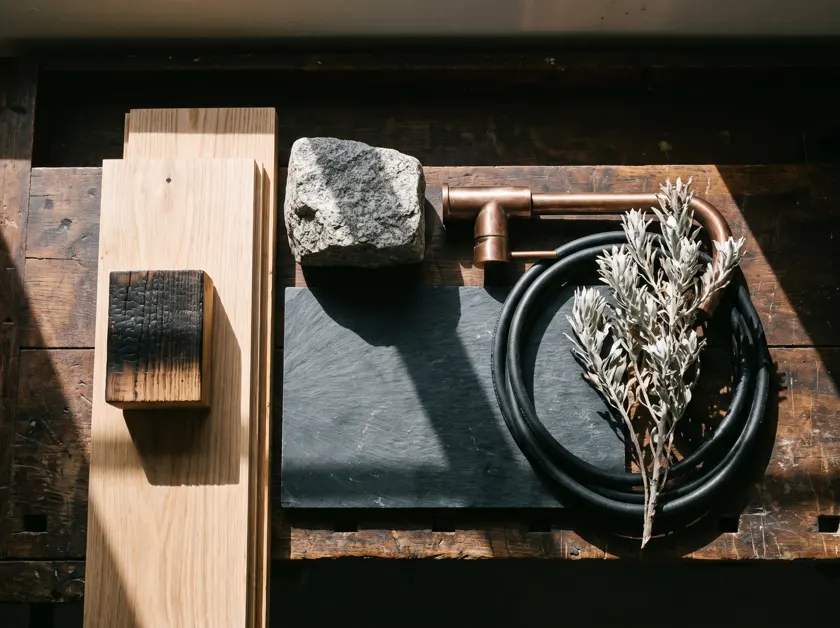
From May to September the Cape gets driving rain off the Atlantic with wind behind it. Water does not fall, it arrives horizontally, and it finds any gap in a cladding system.
So the specification is a deep ventilated rainscreen cavity, drained at the bottom, behind charred or thermo-treated cladding. Stainless fixings throughout because the same wind carries salt. Drainage under the cabin, because standing water under a timber structure in a Cape winter is how rot starts.
The compensation is that the climate sells the product. A sauna in a Cape winter is used constantly, and the plunge outside it needs no machine for half the year.
Johannesburg and Pretoria sit high — about 1,750 metres — dry, and subject to severe summer hail. Three consequences follow.
Altitude goes into the heater calculation. Thinner air carries less heat per kilowatt, so a heater sized from a sea-level chart underperforms, and we size up accordingly, showing the correction as its own line in the quote.
Hail goes into the roof and glass specification. Heavier gauge sheeting with a proper fall, impact-rated glass where it faces upward, and nothing fragile left exposed. We have replaced other people's polycarbonate roofs after one storm.
And the dry air is kind to timber. Inland cabins age more slowly than coastal ones, and the service interval is six months rather than three.
Durban, Umhlanga and Ballito are warm, humid and salty all year. This is the climate most like the tropical markets we work in elsewhere, and it needs that discipline.
Nothing dries by itself. Mechanical extract on a humidistat rather than a timer, ducted out, on every enclosed hot or wet room. Continuous vapour barrier on the warm side with every penetration sealed — a gap traps moisture inside the wall, which is worse than no barrier.
A4 stainless everywhere, sealed end grain, deeper drained cavities, sealed plant enclosures near the beach. Quarterly service with a corrosion inspection of every fixing, hinge and latch.
And unlike the Cape, the chiller is not optional. The ambient never drops far enough to do the work for you.
Lodges in the bushveld face neither salt nor damp but dust, and dust is a different failure mode: it blankets a condenser until the chiller cannot reject heat, no matter how large the compressor.
Washable pre-filters, shaded and ventilated siting with real clearance, and a three-month interval in the dry season. Plus off-grid load sequencing, because heater and chiller must never start together on a generator.
A national supplier quoting the same cabin for Camps Bay, Sandton and Umhlanga is quoting the wrong cabin for at least two of them. The differences are not cosmetic and they are not expensive to get right at build time.
Ask specifically: what cladding and cavity, what fixing grade, what ventilation control, what heater correction, and what service interval — for my location. A builder who has worked in all three will answer without hesitating.
The cost difference between the correct specification and the generic one is a single-digit percentage of the project. The cost of getting it wrong is a rebuild.
South Africans move between these climates more than most, and we are regularly asked to relocate a cabin from Johannesburg to the coast or the other way.
It is usually possible if the cabin was built on a bolted frame, but the specification has to change: coastal fixings, a deeper cavity and a ventilation strategy going one way; a heavier roof and an altitude heater correction going the other.
We survey before promising, and we would rather tell you a relocation is not worth it than hand you a cabin that will disappoint in its new climate.
Cladding. Charred or thermo-treated in the Cape and on the coast; either is fine inland, where the dry air is forgiving. Untreated softwood is wrong everywhere and merely fails more slowly on the Highveld.
Fixings. A4 stainless within reach of either coast, including the ones nobody sees. A2 inland is acceptable; plated steel is not, anywhere.
Ventilation control. A humidistat on the KZN coast, a run-on timer inland and in the Cape. The humidistat costs a little more and it is the difference between a room that dries and one that smells.
Roofing. Heavier gauge and a proper fall on the Highveld because of hail; a deeper drained cavity in the Cape because of driving rain; both at the coast, plus sealed plant enclosures.
The physics of the heater: roughly 0.85 kW per cubic metre of insulated cabin, plus capacity for glazing, plus an altitude correction where it applies. That sum does not care which province it is in.
The insulation standard, which is the single highest-return decision in every climate for different reasons — heat retention inland, heat exclusion at the coast, and the ability to skip a chiller in the Cape.
The wet-room fundamentals: membrane, falls, a pitched ceiling, a serviceable plant position and a drain that lifts and rods.
And the discipline of turning the stones, descaling the generator and cleaning the condenser. The interval changes by climate; the necessity does not.
The other constant is the access question. Whether the obstacle is a Clifton stairway, a Constantia gate, an estate's contractor rules in Pretoria or a four-hour drive to a bushveld lodge, the method is the same: measure the tightest point on the route before quoting, size the panels to it, prefabricate everything that can be prefabricated, and price the carry as its own line rather than hiding it.
We have never regretted spending an extra twenty minutes on a site visit photographing a route. We have regretted not doing it, and so has the client, because the surprise always lands in week two when the panels are already on the truck.
If you take one thing from this article, take the checklist. Cladding and cavity for your rain. Fixing grade for your salt. Ventilation control for your humidity. Roof gauge for your hail. Heater correction for your altitude. Service interval for your dust. Six questions, one location, and any builder who has genuinely worked across this country will answer all six without pausing.
Want this checked against your own room? Send us the dimensions and a photograph and we will come back with a drawing.
An honest continental price breakdown: what a sauna and cold plunge cost in eight African countries, what move…
Read more →
An honest breakdown of sauna and cold plunge prices in South Africa: what sits inside R60,000, what pushes a p…
Read more →
From Nairobi at 1,795 m to the Ngorongoro rim: why African highland saunas need a bigger heater, and why the s…
Read more →