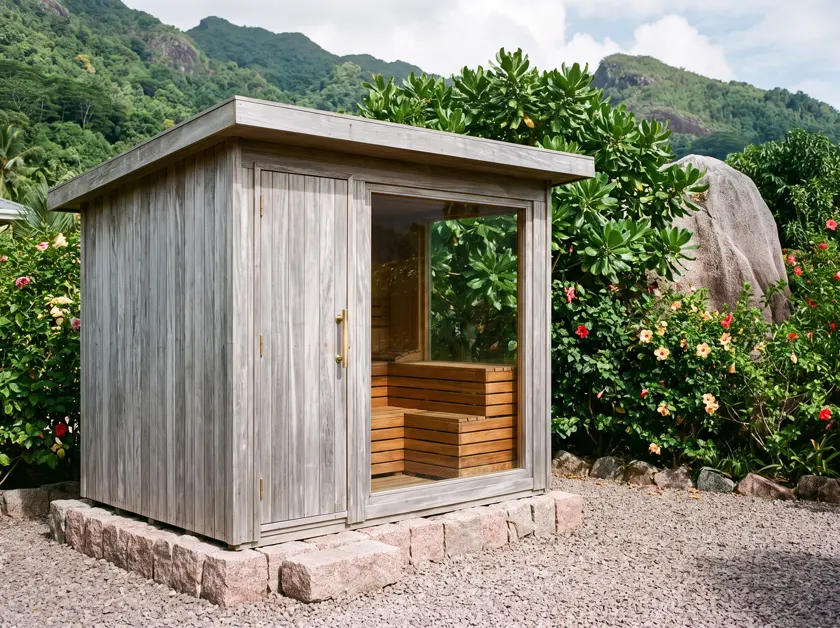
Saunas
A sauna is the simplest room we build and the one most often specified wrongly, because almost every sizing ch…
Read more →This is the one thing we make that could not be made anywhere else, because the block comes out of the ground near where it ends up.
Indicative across Africa: USD 7 000 – 13 000, supplied and installed. Local currency on each country page.
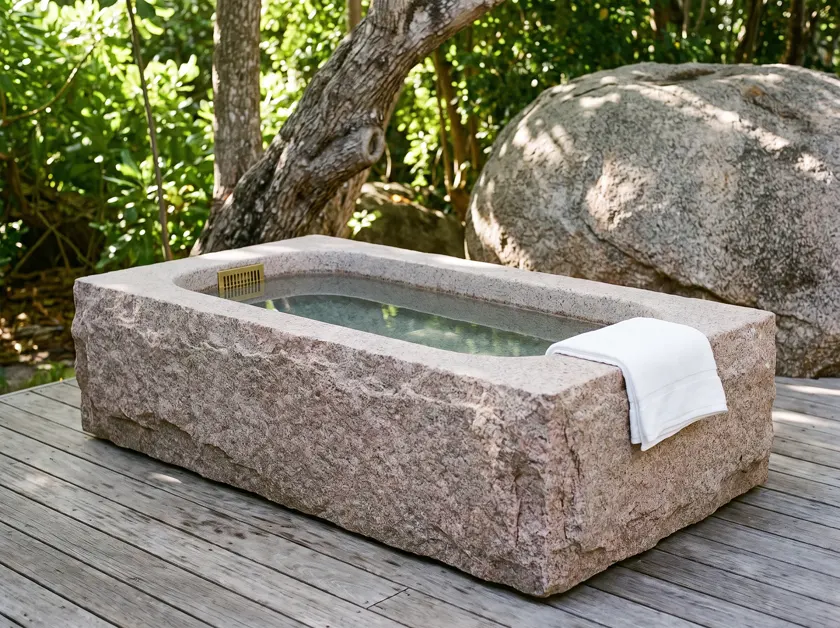
Pink-grey granite in the Seychelles, where the Inner Islands are the only granitic ocean islands on earth and the boulder is already on your plot. Dense black volcanic basalt in Mauritius and Kenya. Pale porous coral rag on Zanzibar, which has been used in that architecture for centuries. Creamy alabaster in Egypt, where the quarrying tradition is older than almost anything else in this business. Cast indigo terrazzo in Lagos, which is not quarried but is unmistakably of the place.
Each behaves differently in water and each is honed differently. What they share is mass, chemical stability and complete indifference to salt air, which is close to ideal for African coasts.
The block is split, the inner bowl cut and worked to a finish smooth enough to sit against for ten minutes, and the outer faces left raw. That contrast is the whole design: from outside it reads as the boulder it came from, inside it is precise. Polishing the outside would make it look like a worktop and lose the point.
The bowl gets a profile rather than a bucket shape, so an adult sits with shoulders under water and shins comfortable. Getting that right takes longer than the rough cutting, which is why we would rather you sat in one before ordering.
Stone has enormous thermal mass and is not an insulator. A basin with cold water in it and nothing behind it bleeds heat into the ground and the air continuously, and the chiller pays for that every hour.
So behind the stone there is rigid insulation and a waterproof backing doing the thermal and structural work. The stone is the finish and the mass. Done that way the mass becomes an advantage: the basin holds temperature beautifully overnight under a lid, and run properly it is cheaper than a clad tub rather than dearer.
A carved basin is measured in tonnes before any water goes into it. On a ground-level terrace over rock that is a non-issue. On a suspended slab, a balcony, a tower terrace or a timber deck it is a structural question with a real answer, and we get an engineer's opinion before quoting rather than after.
This is one of very few things we refuse outright: a stone basin on a structure nobody has assessed. Where the structure will not take it, the honest alternative is an insulated clad tub — lighter, cheaper, and it works extremely well. It simply is not carved from the island.
Where each stone comes from, and what a basin costs there:
Basalt, coral rag and terrazzo basins are quoted inside the cold plunge page in these countries rather than having a page of their own: Morocco · South Africa · Mauritius · Kenya · Tanzania · Nigeria
Sometimes, depending on the stone. We look at it before promising anything — a block with a through-going fracture fails halfway through carving.
No. It needs no sealing, no oiling and no annual treatment. Avoid acidic descalers on it — they are formulated for a generator's steel, not a honed face.
Yes, because of the mass. Fill it, let the chiller work overnight and hold it there under a lid rather than letting it drift up between sessions.
A sauna is the simplest room we build and the one most often specified wrongly, because almost every sizing ch…
Read more →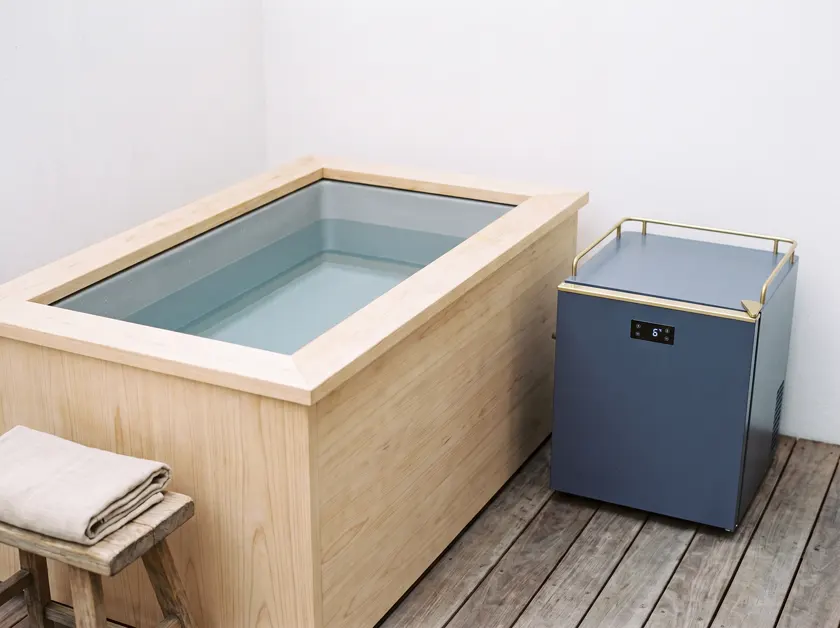
In most of the world a plunge is a tub. In most of Africa it is a machine, and the single commonest fault we a…
Read more →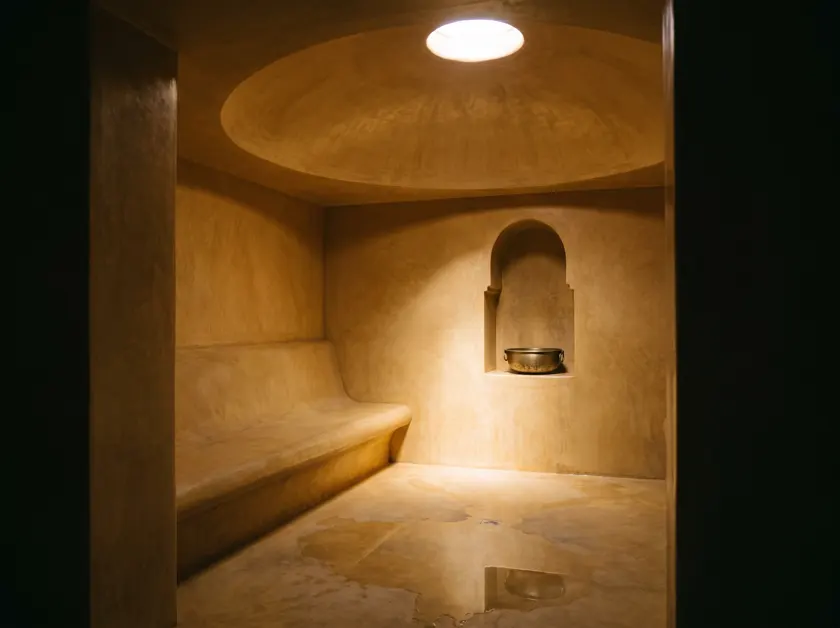
We are called to more failed steam rooms in Africa than failed saunas, and the cause is nearly always the same…
Read more →