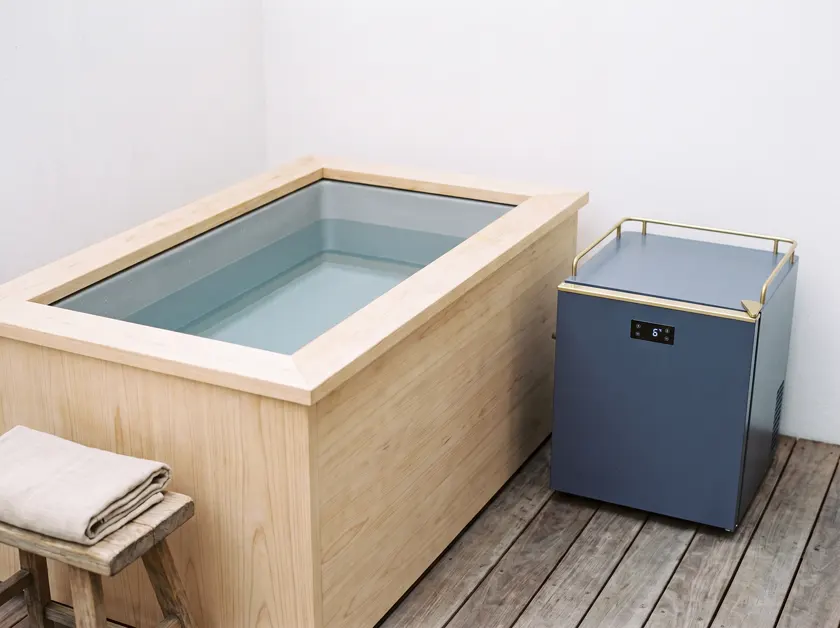
Cold plunges
In most of the world a plunge is a tub. In most of Africa it is a machine, and the single commonest fault we a…
Read more →A sauna is the simplest room we build and the one most often specified wrongly, because almost every sizing chart in existence assumes a country none of our clients live in.
Indicative across Africa: USD 3 300 – 25 000, supplied and installed. Local currency on each country page.
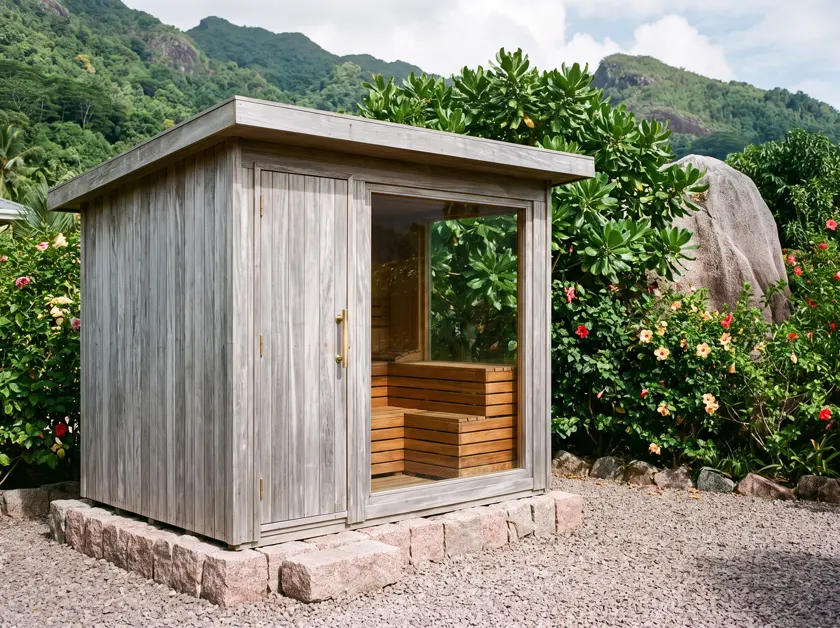
Heater capacity starts at about 0.85 kW per cubic metre of genuinely insulated cabin. A 2.0 × 2.4 m cabin at 2.1 m high is roughly 10 m³, so a 9 kW heater is the starting point — the starting point, not the answer.
The first correction is altitude. Thinner air carries less heat per kilowatt, so a heater chosen from a sea-level chart stalls below temperature. At Nairobi's 1,795 m the correction is real, and on the Ngorongoro crater rim at roughly 2,300 m it is large. At sea level in Lagos, Dar es Salaam or Mahé there is none, and we say so rather than padding the quote.
The second is glass. Every square metre of glazing loses heat far faster than an insulated wall, so we add roughly 0.42 kW per square metre before rounding up to a heater we can actually buy. That is why the glass goes in the drawing before the heater is chosen, never after.
Given a choice between a bigger heater and a better-insulated cabin, we take the insulation every time. A well-insulated room reaches temperature faster, holds it on a third of nameplate and costs less every evening for the next decade — and on a property running off batteries that difference decides whether the sauna gets used at all.
Behind the timber: mineral wool at the right density and thickness, a continuous foil vapour barrier taped at every lap, a battened air gap, then the lining. Each of those has a failure mode we have been called to repair, and none of them are visible at handover, which is exactly why they get skipped elsewhere.
A hot room cycles from ambient to 90 °C and back with humidity swinging each time water hits the stones. Timber that moves under that cycle opens joints, cups benches and works fixings loose. Resinous species bleed. Knots conduct heat differently and can get hot enough to burn skin.
So linings and benches are thermo-treated aspen or pine — heat-treated at around 200 °C, which drives out the resins and stabilises the fibre. End grain is sealed in the workshop as it is cut, before any panel goes together, because sealing after assembly reaches perhaps half of it and never the cut ends inside joints where water actually collects.
Locally available species go into frames, plinths and surrounds, where they belong. Eucalyptus is superb for construction and wrong for a bench, and we will decline to line a hot room in it however available it is.
On any African coast: A4 stainless for every fixing including the ones nobody sees, drained and vented cavities rather than sealed ones, a ventilated void under the cabin rather than a floor flat on a terrace, deep eaves and a plinth that lifts timber clear of splash.
Inland and at altitude: none of that premium, and insulated floors instead, because highland ground is genuinely cold and a cabin standing on it loses more through the floor than through any wall.
In the harmattan and the dry season: cleanable hardware rather than sealed-for-life, because out here everything gets washed down eventually.
The same cabin, specified and priced in each country we build in:
Eight to twelve weeks where a vehicle reaches the site; ten to fourteen for an island or a fly-in camp, and almost all of that difference is shipping.
Yes, and two meeting at a corner with no post between them. It costs a step on the heater and we put that in the calculation rather than discovering it at commissioning.
Wood-fired suits highland lodges with fuel and a maintenance routine, and needs a correct flue, clearances, a spark arrestor and a fire-resistant plate. Electric is simpler wherever supply allows.
In most of the world a plunge is a tub. In most of Africa it is a machine, and the single commonest fault we a…
Read more →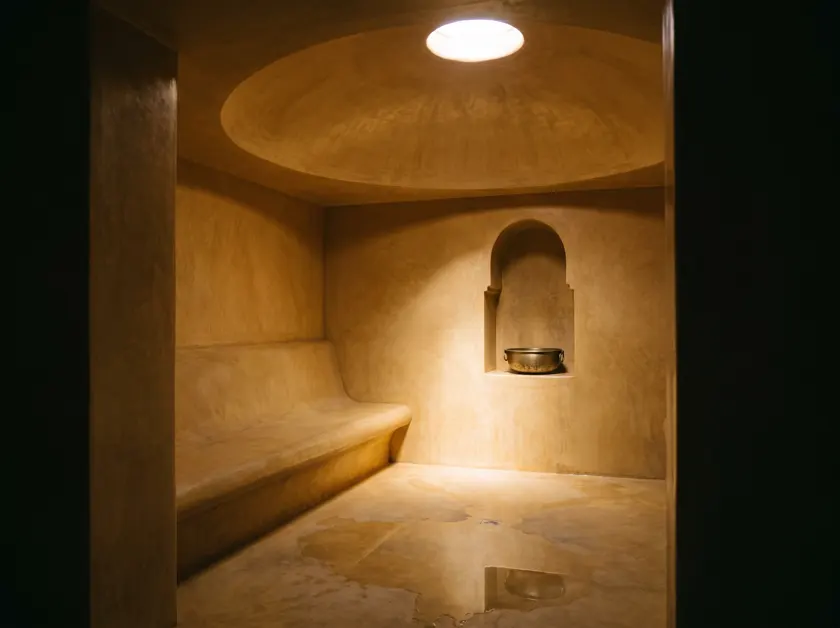
We are called to more failed steam rooms in Africa than failed saunas, and the cause is nearly always the same…
Read more →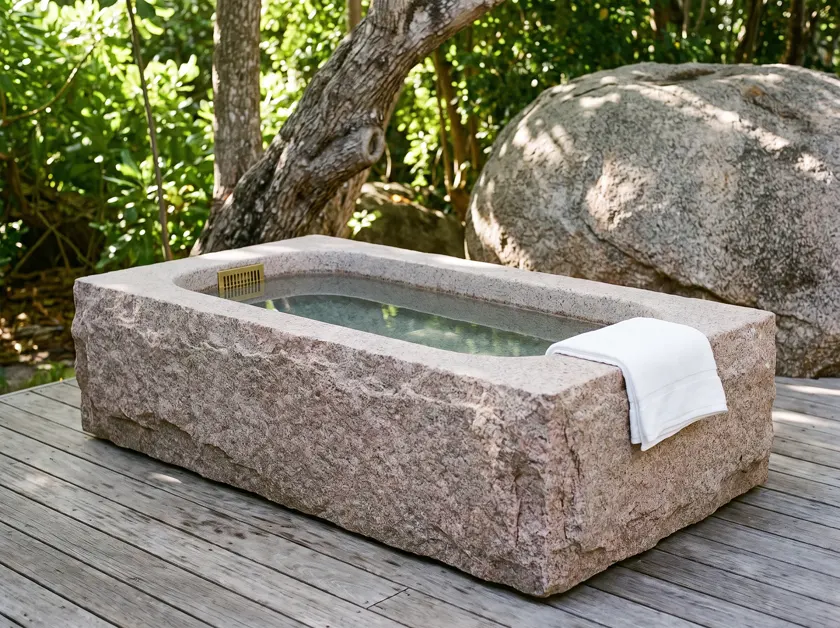
This is the one thing we make that could not be made anywhere else, because the block comes out of the ground …
Read more →