
11 min
What a Sauna and Cold Plunge Cost Across Africa in 2026
An honest continental price breakdown: what a sauna and cold plunge cost in eight African countries, what move…
Read more →It is the one variable on this continent that costs you money on one side of the room and hands it straight back on the other — and almost nobody quotes either side.
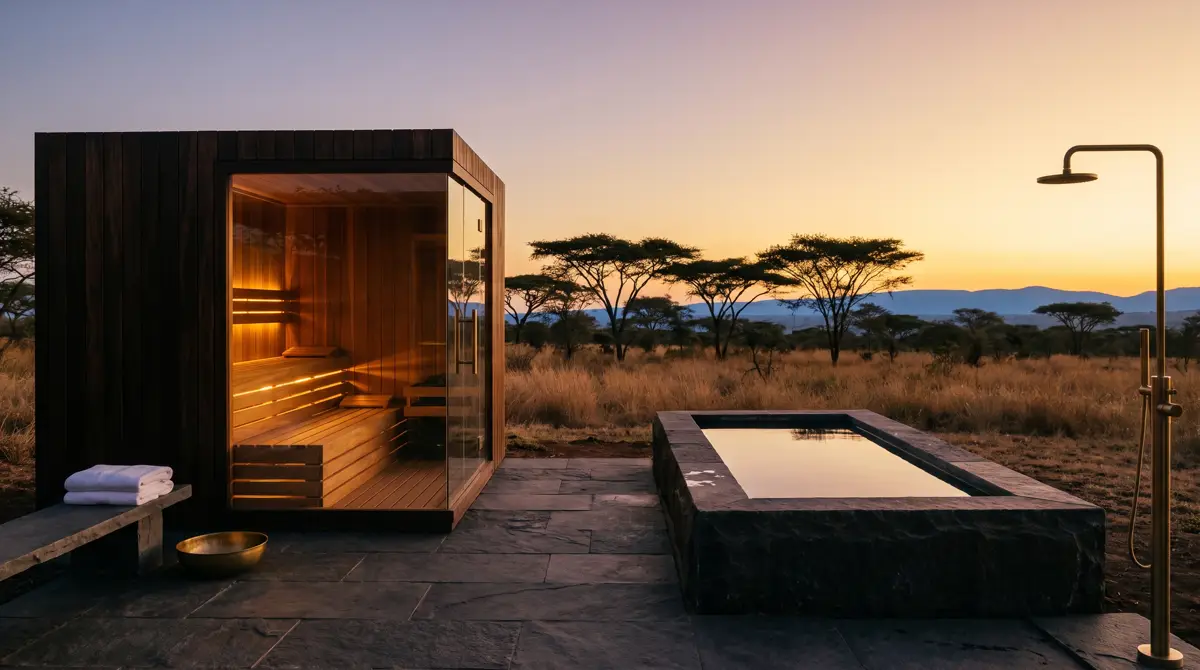
A sauna heater works by heating air and stones, which then heat the room and the people in it. Air density falls with altitude, so a given volume of highland air carries less heat than the same volume at sea level. A heater sized from a sea-level chart therefore under-delivers, and the cabin climbs to 70–75 °C and stalls.
That is not a dramatic failure. It is worse than that: it is a quiet one. The room works, just never quite well enough, and the client concludes that saunas are overrated rather than that the heater was chosen for a different country.
It is also why the commonest fault we are called to fix in Nairobi is a heater, not a cabin. Replacing an under-sized heater in a sound cabin is a fraction of a rebuild, and it is frequently the cheapest useful thing we do in a year.
Nairobi sits at about 1,795 metres. That is high enough to need a real correction — usually one step up the heater range compared with the identical cabin in Mombasa.
The Ngorongoro crater rim is around 2,300 metres, and there the correction is large. Moshi, under Kilimanjaro, sits lower but still meaningfully above sea level. Johannesburg and the Highveld are near 1,750 metres. The Atlas valleys above Marrakech climb fast. Enugu's hills in Nigeria do not — they are well below the elevation where this begins.
And at sea level — Lagos, Dar es Salaam, Mahé, Grand Baie, Hurghada, Cape Town, Victoria — there is no correction at all, and we say so rather than padding the quote with one. A supplier who applies an altitude factor nationally is not being careful; they are being lazy in a way that costs you money.
Volume first: about 0.85 kW per cubic metre of genuinely insulated cabin. Then the altitude factor, taken from your site's real elevation rather than a national average — the gap between Arusha and the crater rim is another step on its own. Then glazed area at roughly 0.42 kW per square metre, because glass loses heat far faster than an insulated wall. Then round up to a heater we can actually buy.
That whole chain is printed in the quote. You can check it, and you can compare it against anybody else's, which is the point.
Highland lodges and houses sit on genuinely cold ground, and a cabin floor is a large surface in direct contact with it. We insulate floors to the same standard as walls in the highlands, which is not standard practice and is immediately noticeable in how fast the room reaches temperature.
Pipework — supply, drain, any circulation run — stays inside the insulated envelope. On the Ngorongoro rim freezing is not a theoretical concern, and an exposed run is a repair waiting for a cold night.
The payoff is a cabin that comes up fast in the one hour it is actually wanted, rather than one left running all afternoon to be ready by evening.
Everything that makes the hot side harder makes the cold side easier, and the effect is larger than most people expect.
A chiller fights the gap between your setpoint and the air around the tub, and it fights hardest at night. In Lagos or on Zanzibar the night never helps: ambient stays high and the compressor works through it. In Nairobi the nights are cool all year. At the crater rim they are genuinely cold.
So a shaded, insulated, lidded tub in the highlands holds low temperatures largely by itself. At the rim we regularly quote no chiller at all — and for a 14–18 °C plunge, which is what most people actually use repeatedly and enjoy, the climate does the whole job. That removes a capital cost, a monthly bill and a machine that could fail.
For a true 4–6 °C ice bath you still need a machine, but a smaller one than the same tub needs at the coast, and it will last longer because compressor wear tracks run hours far more closely than it tracks age.
The same brief — a four-person cabin and a plunge held at 8 °C — produces two different quotes 450 kilometres apart. In Diani on the Kenyan coast: standard heater, chiller a step above temperate figures, marine specification throughout, quarterly service with a corrosion inspection. In Karen in Nairobi: heater one step up for altitude, a smaller chiller, no marine premium, half-yearly service.
Neither is the right answer nationally. Anybody quoting a single national specification for Kenya is wrong in at least one of those two places, and usually in the more expensive direction.
Highland lodges have something coastal properties usually do not: fuel, space for a flue and a maintenance routine that can handle one. A wood-fired stove at Moshi, in the Atlas or on the northern circuit removes the largest electrical load from a stretched supply entirely, and the character suits the setting in a way an electric element never quite does.
It needs a correct flue with proper clearances, a spark arrestor and a fire-resistant floor plate — installed rather than improvised — and it needs a woodshed treated as part of the installation so the fuel is genuinely dry. Wet firewood burns badly, smokes, tars a flue and consumes roughly twice the volume for the same heat.
It also needs a defensible fuel source. Firewood sourced badly is a real problem in several of our highland markets, and a lodge marketing sustainability while burning uncertified timber has a contradiction on its hands. Where a property cannot source responsibly we recommend electric on a solar schedule and say why.
The two corrections compound, and clients are frequently surprised by how much. A four-person cabin with one full glass wall at the crater rim can need a heater two steps above the same cabin built solid at sea level: one step for the glazing and one for the altitude.
That is not an argument against glass at height — the view from a highland deck is usually the entire reason to build there. It is an argument for settling the glazing on the drawing before the heater is chosen, and for reading the calculation rather than accepting a number.
Where a supply genuinely cannot carry the resulting heater, the honest sequence is: improve the insulation first, reduce the glazed area second, and only then reduce the cabin. Reducing the heater is never the answer, because an under-sized heater at altitude is exactly the fault we spend our Nairobi service visits correcting.
If you are building a spa on the northern circuit, in the Atlas, on the Highveld or anywhere above roughly 1,500 metres, three things follow. Budget a step up on the heater and insist the calculation appears in writing. Budget insulated floors, which is unusual and worth it. And budget less — sometimes nothing — on the cold side, because the climate is doing the work a compressor does elsewhere.
That last point is the one worth arguing for with a supplier, because it is the one that reduces their invoice. We would rather tell you than sell you a machine, and it is the reason clients come back to us for the second property.
Want this checked against your own room? Send us the dimensions and a photograph and we will come back with a drawing.
An honest continental price breakdown: what a sauna and cold plunge cost in eight African countries, what move…
Read more →
Why the cold side is the difficult half of contrast therapy in Africa: chiller sizing for real tropical ambien…
Read more →
The five stones we carve plunge basins from across Africa: Seychellois granite, Mauritian and Kenyan basalt, Z…
Read more →