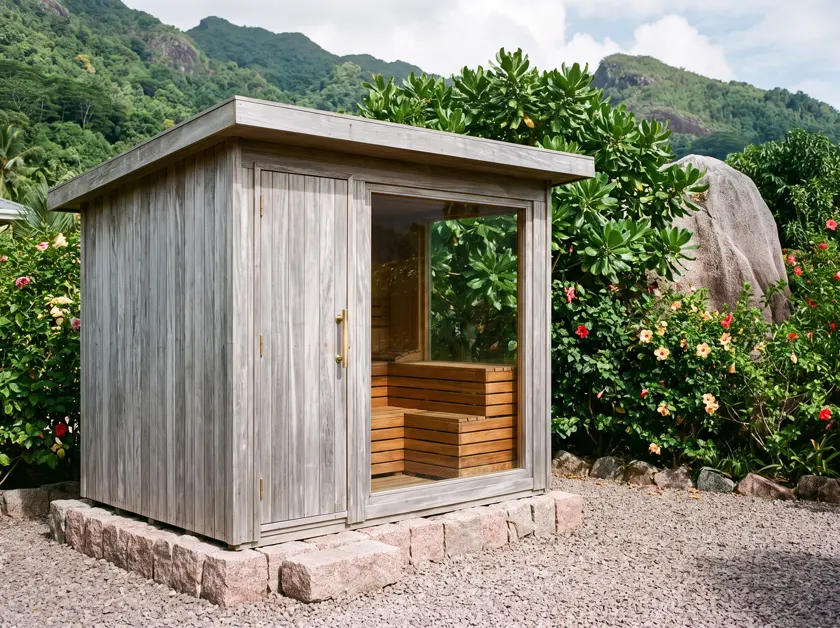
Saunas
A sauna is the simplest room we build and the one most often specified wrongly, because almost every sizing ch…
Read more →A camp spa is an off-grid engineering problem with a hospitality brief attached, and the peak is the ninety minutes after the afternoon game drive.
Indicative across Africa: USD 12 000 – 90 000, supplied and installed. Local currency on each country page.
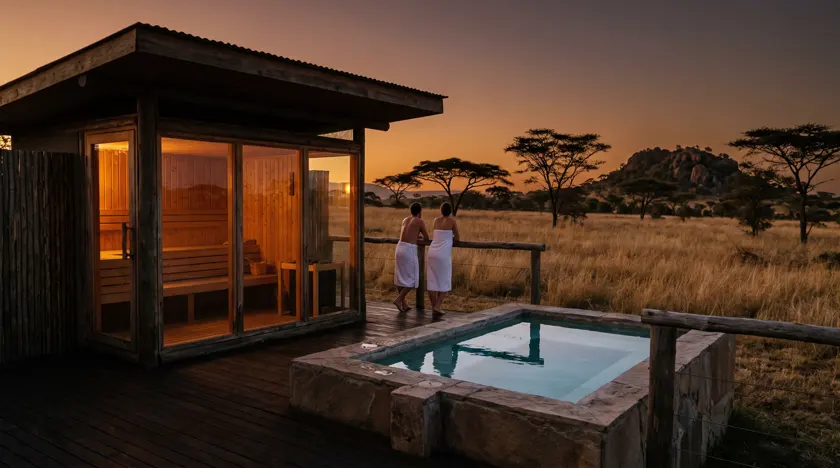
Demand at a camp is not spread across the day. It is concentrated into the window between the drive returning and dinner, and again briefly at dawn. Everything is sized on that.
In practice that means a heater chosen for a fast heat-up rather than an economical hold — a cabin that takes an hour to get hot is useless when guests are back at five and eating at seven — and more plunge positions than the guest count suggests.
Most camps run solar with battery storage and a generator behind it. The heater and the chiller are the two largest loads and must never start together, so we sequence them in the controls, schedule the heater into the solar window where there is one, and work from the camp's actual figures rather than assumptions.
Water is the harder constraint. Camps truck or borehole their supply, so the plunge is sized to the water budget rather than the brief, and filtration with ozone extends water life to a month or more. An insulated lid is an operating saving measured in litres and kilowatt-hours.
Serengeti, the Mara, the southern parks and the bushveld: dry-season dust blankets a condenser in weeks. Washable pre-filters, sealed plant housing, units sited away from the approach track and a three-month interval that is actually kept.
Ngorongoro, Moshi and the Atlas: altitude and genuinely cold nights. Heater corrected upward, floors insulated as heavily as walls, pipework kept inside the insulated envelope, and a plunge that often needs no machine at all. A camp that has both gets both specifications quoted explicitly rather than an average.
Where a camp is reached by light aircraft, the aircraft's door and weight limits set the component sizes — from the first drawing, not at the airstrip.
Inside national parks and conservation areas, works, noise, materials and above all grey water are regulated. We design the grey-water route properly, specify biodegradable chemistry and ozone rather than heavy chlorine, and prepare the submission.
And where a camp closes for part of the year, we build in a written shutdown and start-up routine and walk the team through both. It takes an afternoon and it is the difference between opening the season with a working spa and opening it with a repair bill.
Camp and lodge work, priced by country:
Desert camps, island lodges and mountain refuges in these countries are quoted through their hotel or resort page: Morocco · Egypt · Mauritius · Seychelles · Nigeria
A demountable deck with a compact cabin, yes. A permanent tiled suite, no.
Yes, with the loads sequenced and the plunge sized to the water budget. We work from your actual system figures.
Scheduled blocks shared between camps, a spares kit on site and a trained camp team. Not call-outs.
A sauna is the simplest room we build and the one most often specified wrongly, because almost every sizing ch…
Read more →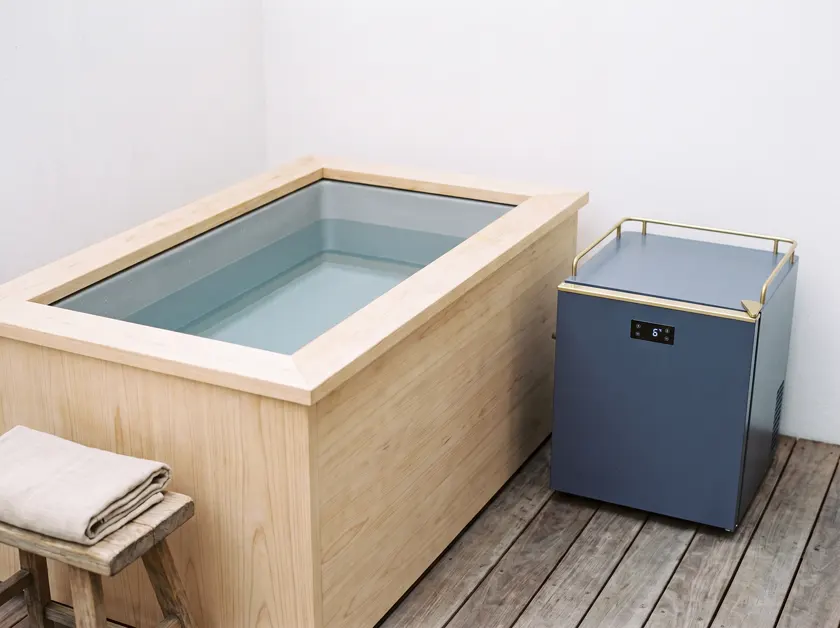
In most of the world a plunge is a tub. In most of Africa it is a machine, and the single commonest fault we a…
Read more →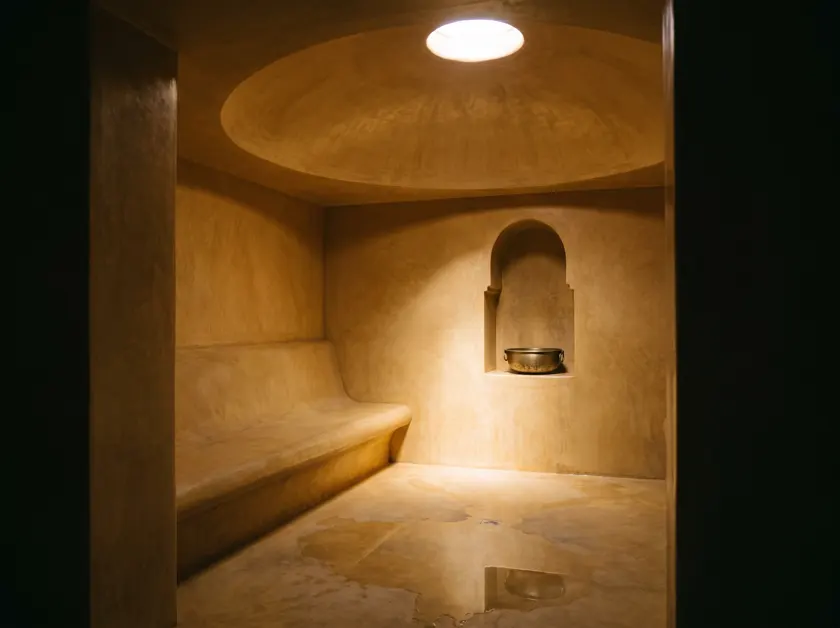
We are called to more failed steam rooms in Africa than failed saunas, and the cause is nearly always the same…
Read more →