
11 min
What a Sauna and Cold Plunge Cost Across Africa in 2026
An honest continental price breakdown: what a sauna and cold plunge cost in eight African countries, what move…
Read more →Across most of our markets, asking whether the grid can carry a 9 kW heater is the wrong question. The right one is where that load sits inside the system the property already runs.
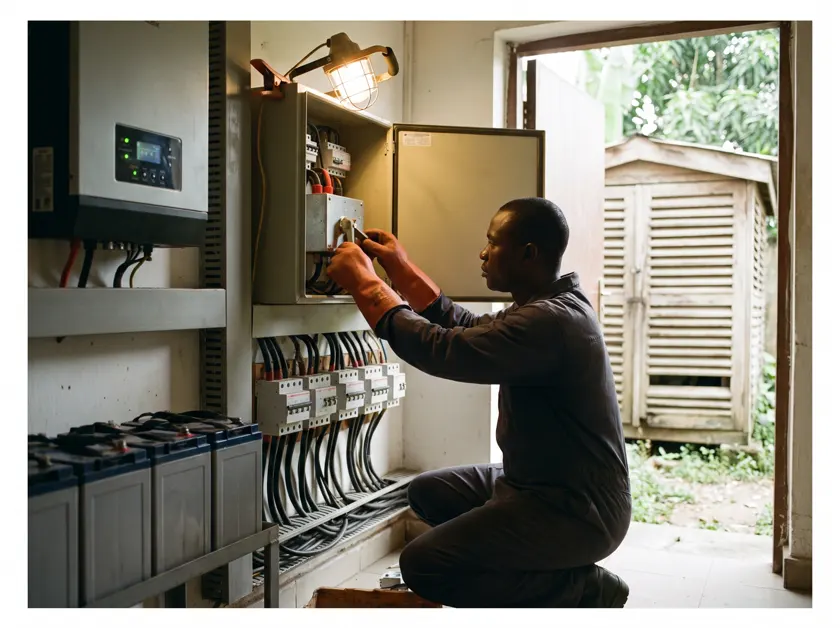
In Nigeria, average available generation on the national grid was about 5,151 MW in December 2025 out of 13,625 MW installed, against national demand estimated near 18,345 MW. Nobody plans a serious household load around that arithmetic, which is why practically every property we quote for already has an inverter, a battery bank and a standby generator.
Nigerian households added around 803 MW of solar in 2025 alone — a 141 per cent jump on the year before, taking installed capacity to roughly 1,019 MW and making it the second-largest solar market in Africa. In South Africa the same thing happened for a different reason: load shedding drove households and businesses to build inverter and battery capacity, and now that load shedding has ended, that base is sitting there capable of running exactly the kind of scheduled load a sauna represents.
At every safari camp, island lodge and remote property we work on, the situation is the same by geography rather than by policy: solar with battery storage and a generator behind it.
None of that is a problem for us. It is the design premise.
A sauna heater is resistive, which makes it beautifully predictable: it draws its rated power steadily until the thermostat cuts, with no inrush to speak of and no power factor argument. A 6 kW heater is 6 kW.
The catch is size and duration. Taking a well-insulated four-person cabin from ambient to 85 °C is roughly forty to fifty minutes at full draw, then cycling at perhaps a third of that to hold. On a battery bank that is a meaningful discharge, and on solar it is a load you want inside the window rather than after sunset.
A chiller is the opposite: a modest continuous load with a compressor inrush at each start. Its daily energy is much lower than the heater's but it is spread across twenty-four hours, and the hours that matter are the ones after dark when an array is producing nothing. The lever there is the lid, which lets an insulated tub coast overnight so the machine starts the morning where it finished rather than fighting a tub that drifted up five degrees.
The heater goes on a scheduled circuit, permitted inside the solar window where there is a meaningful array, or on generator by explicit selection. The chiller sits on the essential circuit, inhibited during the heater's heat-up and free to cycle afterwards. A hard interlock prevents both starting within the same few seconds, and a soft start goes on the compressor where the supply is marginal.
On a generator this matters more than raw capacity. A simultaneous start is what trips a set that would have carried both loads perfectly well one at a time, and it is entirely avoidable in the controls.
None of this is exotic. It is ordinary load management, and the only reason it is unusual in wellness installations is that most installers treat a sauna as an appliance rather than as a system component.
Every property with a changeover has a division between what it feeds and what it does not. It is usually drawn when the building goes up and almost never revisited when appliances are added.
We check that division physically before designing anything. We have found plunge circuits on the non-essential side more than once — meaning the one appliance in the house that genuinely needs continuity was the one that lost it at every outage. The tub drifted warm during every cut and the owner concluded the chiller was faulty.
The fix is a conversation with the property's electrician and a small amount of rework. It is not our trade and we do not do it ourselves: we draw what the wellness loads need and hand a named licensed electrician a load profile they can work to, with peak draw, expected duty cycle, circuit allocation and what must never start alongside what.
Off-grid rarely means only power. Camps truck or borehole their water, island properties collect rainwater, and lodges inside conservation areas have rules about where grey water may go.
So the plunge is sized to the water budget rather than the brief. Filtration with ozone extends water life to a month or more, a rinse shower at the entry point extends it further, and the insulated lid reduces evaporation — which in dry-season heat is a real number measured in litres per week rather than a rounding error.
Inside national parks we design the grey-water route properly: a correctly sited soakaway away from watercourses, or collection into the property's existing treatment, with biodegradable cleaning chemistry specified from the start and ozone or UV rather than heavy chlorine. That happens to be both the compliant answer and the better one for guests.
Many camps and island lodges close for part of the year. An installation left wet, full and unattended through a closed season degrades fast, and the first week of the next season is spent on repairs instead of guests.
We build in a written shutdown routine — drain, flush, cover, protect, isolate — and a matching start-up routine, and we walk the team through both at handover. It takes an afternoon and it is the difference between opening with a working spa and opening with a bill.
Sometimes a system will not carry what a client wants. A 5 kVA inverter with a small bank and no meaningful array will not run a 9 kW heater in any arrangement worth having, and pretending otherwise produces a room that gets used twice.
In that case there are three real options and we present all three. Build a smaller, better-insulated cabin with a 6 kW heater on a scheduled circuit. Fit an infrared cabin instead, which draws 1.5 to 2.5 kW and which any inverter carries comfortably. Or upgrade the system — which is the electrician's quote, not ours, and we give them the figures to work from.
That conversation costs us a few large sales a year. It has never cost us a client, and it is the reason people call us back for the second property.
Want this checked against your own room? Send us the dimensions and a photograph and we will come back with a drawing.
An honest continental price breakdown: what a sauna and cold plunge cost in eight African countries, what move…
Read more →
From Nairobi at 1,795 m to the Ngorongoro rim: why African highland saunas need a bigger heater, and why the s…
Read more →
Why the cold side is the difficult half of contrast therapy in Africa: chiller sizing for real tropical ambien…
Read more →