Saunas
In Lagos the question is never whether the grid can carry a 9 kW heater. It is how the heater sits beside the …
Read more →Nigeria has already built the hard part. Households added about 803 MW of solar in 2025 alone (Businessday), and most serious homes run an inverter and a generator. What is usually missing is someone who fits a sauna and a chiller into that system properly.
Typical project in Nigeria: NGN 2.5M – 11M, supplied and installed · six to ten weeks per room after the drawing is approved, plus shipping.
Across the continent: Power & off-grid integration in all eight countries →
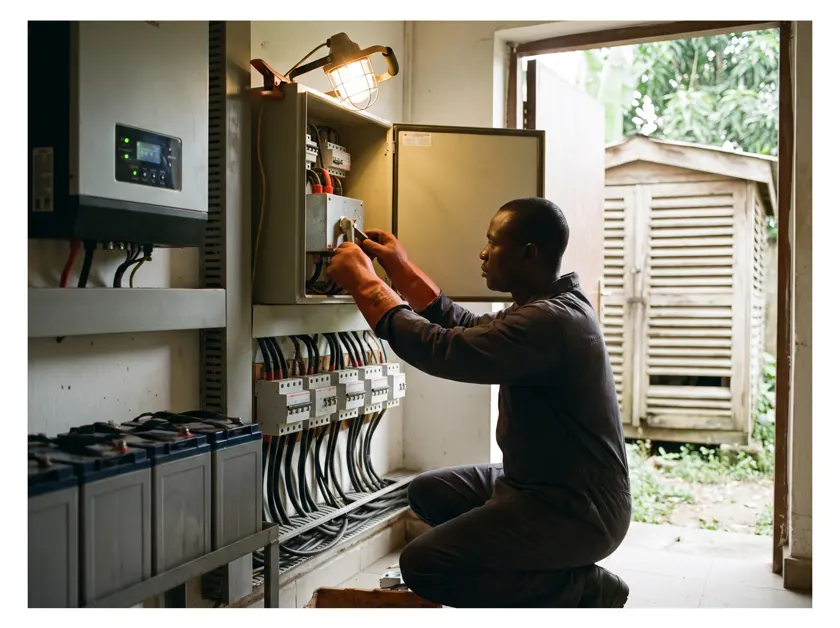
Average available generation on the national grid was about 5,151 MW in December 2025 against an installed 13,625 MW (Nigeria National Grid factsheet), while national demand is estimated near 18,345 MW. No sensible household load plan assumes the grid will be there, which is why nearly every home we quote for has an inverter, batteries and a generator.
For us that is the starting point, not a problem. A heater and a chiller are two more loads to place intelligently in a system that already exists.
We start from your figures — inverter rating, battery capacity and chemistry, array size, generator rating and the house's existing base load — and place each appliance: the heater on a scheduled circuit, ideally within the solar hours; the chiller held off during heat-up and running afterwards; both locked out of starting together.
We confirm physically which circuits the changeover feeds, and we hand your electrician a drawing and a load schedule to install from. The electrical work itself is theirs; the design of the wellness loads is ours.
Two numbers matter: what a sauna session costs and what the chiller costs each month. On a Band A supply the NERC tariff was about ₦209.50 per kWh in late 2025; on a diesel generator, at the NBS average of about ₦1,410 per litre in November 2025 and roughly 0.3 litres per kWh, the fuel alone costs about twice that. Solar hours are the cheapest of all, which is why the heater is scheduled into them.
| Power item | Indicative, million NGN |
|---|---|
| Inverter and changeover integration | 2.5 – 9 |
| Three-phase supply and board work | 3 – 11 |
Where your system cannot carry what you want, we say so and offer an alternative: a smaller cabin, a scheduled heater, an infrared cabin, or an upgrade quoted by your own installer.
The pattern that works in most Lagos and Abuja homes is simple: warm the sauna in the late afternoon while the panels still produce, let the chiller pull the plunge down in the middle of the day, and leave the batteries for lights, fans and the fridge after dark. A lidded tub loses only a degree or two overnight, so the chiller rarely needs to run on battery at all.
Where the generator is the only backup, we set the controls so that a changeover never sees the heater and chiller start together — the moment most generator trips happen.
Often, for a compact cabin with a 6 kW heater on a scheduled circuit. We check against your battery bank before saying yes.
No — that is your electrician's or solar installer's work. We specify what the wellness loads need and coordinate with them.
Less than most people expect on a scheduled circuit: an evening session uses around 5–7 kWh. The chiller is the steady monthly cost, and we quantify it up front.
Send us a photo of the spot and the rough size. Within one business day you get photos of comparable rooms we have finished and an itemised, position-by-position quote.
In Lagos the question is never whether the grid can carry a 9 kW heater. It is how the heater sits beside the …
Read more →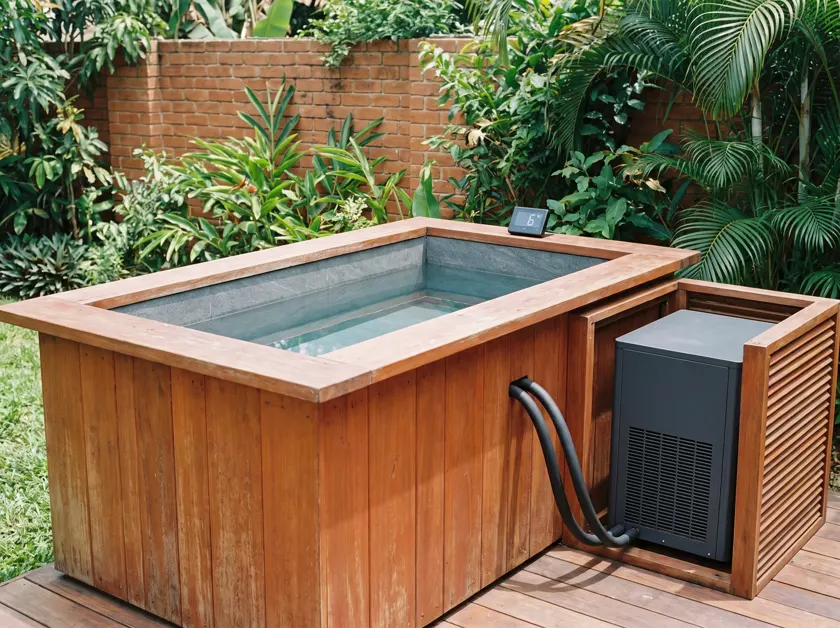
Lagos has no cool season and no cold night. An ice bath here is a chiller with a tub around it, and that chill…
Read more →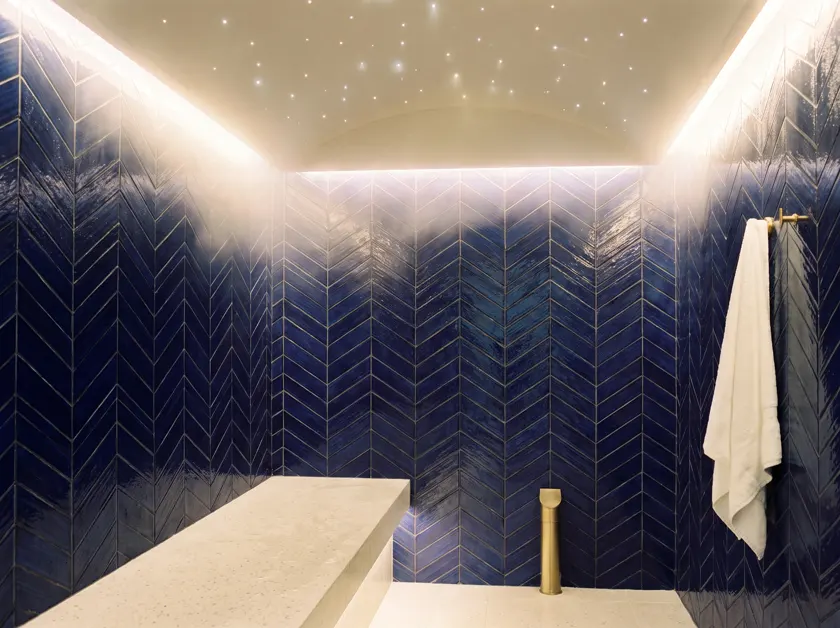
A Lagos steam room has three enemies: humid outside air that stops it drying, borehole water that scales the g…
Read more →