
11 min
What a Sauna and Cold Plunge Cost Across Africa in 2026
An honest continental price breakdown: what a sauna and cold plunge cost in eight African countries, what move…
Read more →Nigeria already built the hard part. What is missing is somebody sizing a wellness load into it properly instead of connecting it wherever is convenient.
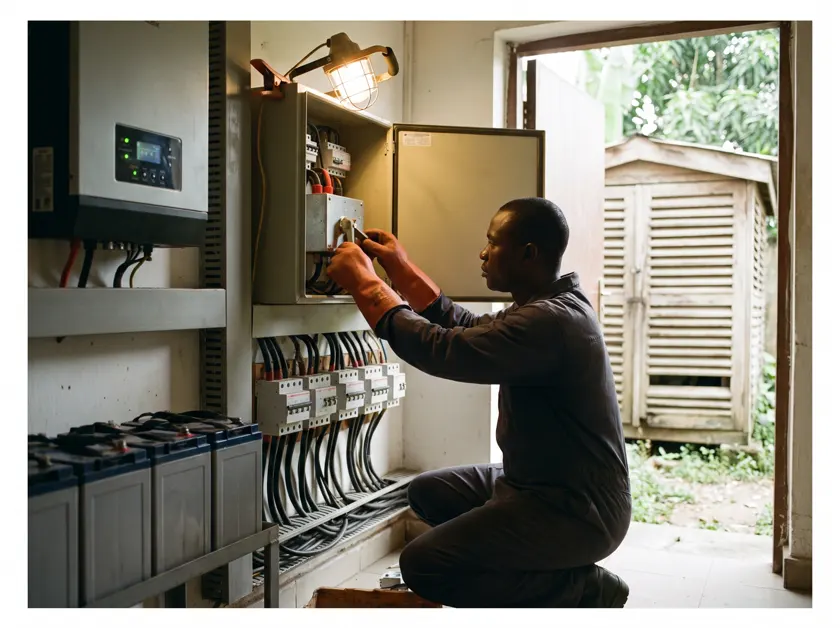
Nigerian households added around 803 MW of solar in 2025 alone — a 141 per cent jump on the year before, taking installed capacity to roughly 1,019 MW and making this the second-largest solar market in Africa. A typical household solar and inverter system costs somewhere between ₦1.9 million and ₦7 million, and in the houses we work in it is simply part of the building.
So the question is never whether you have power. It is what happens when a 9 kW resistive load and a compressor are added to a system that was sized for lights, fans, air conditioning and a fridge.
A sauna heater is resistive, which makes it beautifully predictable: it draws its rated power, constantly, until the thermostat cuts. A 6 kW heater is 6 kW. There is no inrush to speak of and no power factor argument.
The catch is the size of it and the duration. Taking a well-insulated four-person cabin from ambient to 85 °C is roughly forty to fifty minutes at full draw, then cycling at perhaps a third of that to hold. On a battery bank that is a meaningful discharge, and on solar it is a load you want inside the window rather than after sunset.
So we schedule it. Where there is a decent array, the heater runs in the afternoon and the cabin is hot when people want it. Where there is not, it runs on the generator or on grid when grid is present, and the controls simply refuse to start it otherwise. That is a configuration decision, not a limitation.
A chiller is the opposite: a modest continuous load with a compressor inrush at each start. Its energy per day is much lower than the heater's but it is spread across twenty-four hours, and the hours that matter are the ones after dark when the array is doing nothing.
The lever here is the lid. An insulated, lidded, shaded tub coasts overnight with the compressor barely running, so the machine starts the morning where it finished rather than fighting a tub that drifted up five degrees. On a battery system that difference is the whole argument.
We also inhibit the chiller while the heater is in its heat-up. Two large loads starting together is what trips a generator or collapses a bank, and it is entirely avoidable in the controls.
Every Nigerian house has a division between what the changeover feeds and what it does not. It is usually drawn when the house is built and rarely revisited when appliances are added.
We check, physically, which circuits are on the essential side before we design anything. Twice in the last year we have found a plunge circuit on the non-essential side — meaning the one appliance in the house that genuinely needs continuity was the one that lost it every time the grid dropped. The tub drifted warm during every outage and the owner concluded the chiller was faulty.
The fix is a conversation with your electrician and a small amount of rework. It is not our trade and we do not do it ourselves; we draw what the wellness loads need and coordinate with a named electrician who signs for it.
A workable arrangement for a typical Lagos house with solar, batteries and a generator looks like this. Heater: scheduled circuit, permitted between late morning and mid-afternoon, or on generator by explicit selection. Chiller: essential circuit, inhibited during heater heat-up, otherwise free to cycle. Lighting and extract: essential circuit, trivial loads. Steam generator, where there is one: treated exactly like the heater.
Then a hard interlock so the heater and the chiller compressor can never start within the same few seconds, and a soft start on the compressor where the inverter is marginal.
None of this is exotic. It is ordinary load management, and the only reason it is unusual in wellness installations is that most installers treat a sauna as an appliance rather than as a system component.
Sometimes the honest answer is that your system will not carry what you want. A 5 kVA inverter with a small bank and no meaningful array will not run a 9 kW heater in any arrangement worth having, and pretending otherwise produces a room that gets used twice.
In that case there are three real options and we present all three. Build a smaller, better-insulated cabin with a 6 kW heater on a scheduled circuit. Fit an infrared cabin instead, which draws 1.5 to 2.5 kW and which any inverter carries comfortably. Or upgrade the system — which is your electrician's quote, not ours, and we will give them the load figures to work from.
That conversation costs us a few large sales a year. It has never cost us a client, and it is the reason people call us back for the second house.
A generator is far more sensitive to how a load starts than to how large it is. A sauna heater is kind to a generator: it is resistive, it draws its rated power immediately and it holds it steady. A chiller compressor is not: locked-rotor current on a start can be several times running current for a fraction of a second, and on a generator already close to its comfortable load that fraction of a second is what trips it.
So we soft-start compressors where the supply is marginal, and we forbid coincident starts in the controls rather than relying on luck. Where a property runs a fixed-speed generator with no meaningful headroom, we would rather specify a slightly smaller chiller with a better-insulated tub than a large one that the generator resents.
The other generator question is what happens on changeover. A compressor that is mid-cycle when the supply switches should restart after a short delay rather than immediately, and that delay is a setting rather than a component. It gets set at commissioning and written into the handover notes.
Some clients are installing or expanding solar at the same time as the wellness room, which is the easiest version of this conversation because both can be sized against each other.
The useful rule of thumb: a sauna heater is an afternoon load with a large peak and a small daily energy figure, so it wants array capacity rather than battery capacity. A chiller is the reverse — modest peak, substantial daily energy, much of it after dark — so it wants battery capacity rather than array.
A household that intends to have both is therefore buying a little more of each, and knowing which is which stops people over-buying panels for a problem that is actually storage, or the reverse. We give your solar installer the two load profiles and let them do their own arithmetic.
Two figures, both calculated from your system rather than from a brochure. What a session costs, expressed both in kilowatt-hours and in naira at your tariff. And what the chiller costs per month at your setpoint, in your shade, with your lid.
Plus a load profile your electrician can read: peak draw per appliance, expected duty cycle, which circuit each one wants and what must never start alongside what. If you change installers later, that document is the useful thing we leave behind.
Want this checked against your own room? Send us the dimensions and a photograph and we will come back with a drawing.
An honest continental price breakdown: what a sauna and cold plunge cost in eight African countries, what move…
Read more →
An honest breakdown of sauna and cold plunge prices in Nigeria: what fits inside ₦8 million, what pushes a pro…
Read more →
From Nairobi at 1,795 m to the Ngorongoro rim: why African highland saunas need a bigger heater, and why the s…
Read more →