11 min
What a Sauna and Cold Plunge Cost Across Africa in 2026
An honest continental price breakdown: what a sauna and cold plunge cost in eight African countries, what move…
Read more →We are called to more failed steam rooms in Nigeria than failed saunas, and the cause is nearly always the same: the room was built to dry itself by opening a door.
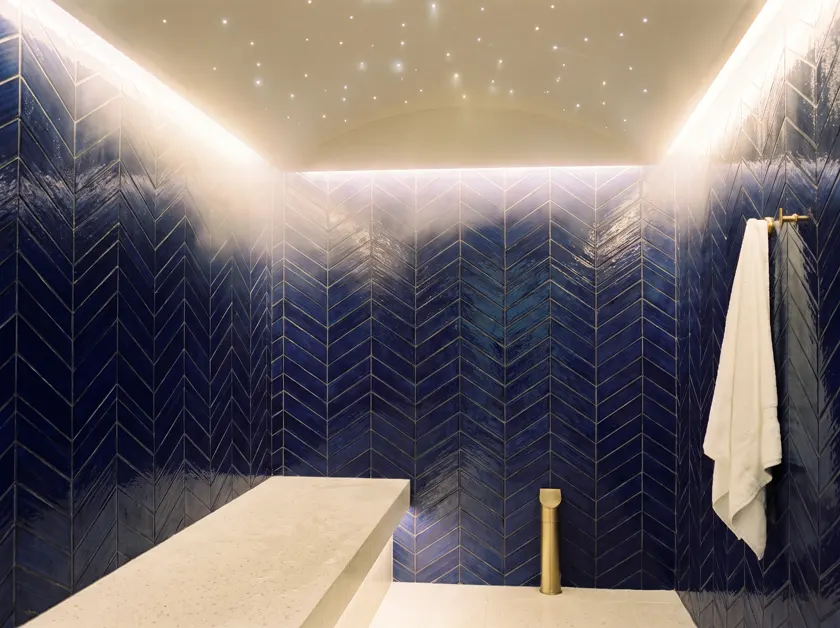
In temperate countries a wet room recovers between uses partly because the surrounding air is drier than the room. In Lagos, Port Harcourt, Uyo and Calabar the surrounding air is frequently close to saturated, so a room left to itself does not dry — it just stops being hot.
Everything that grows on a wet surface grows faster when that surface stays wet and warm. A steam room that never properly dries is a steam room with a smell by month six and a maintenance argument by year two.
So ventilation here is not a comfort feature. It is the mechanism that keeps the room serviceable, and it is the first thing we design rather than the last thing we add.
Mechanical extract, ducted to outside, sized for several air changes after a session. Not a fan in the ceiling that discharges into a void. Not a grille into an adjacent corridor. Outside.
Extract terminating in a ceiling void is the single most common fault we find in existing Nigerian installations, and it is worse than no extract at all, because it takes saturated air and injects it into the structure where nobody can see what it does. We have opened ceilings above two-year-old steam rooms and found exactly what you would expect.
The duct needs a fall or a condensate drain, an insulated run where it passes through cooler space, and a terminal that a bird cannot nest in. All of it is ordinary, and all of it is skipped regularly.
A timer runs the fan for a fixed period after the room switches off. In a climate where outside humidity varies from merely high to saturated, a fixed period is sometimes right and often not, and when it is not the room stops with water still on the surfaces.
A humidistat runs the fan until the room is actually dry and then stops. It costs very little, it uses less energy across a year than a conservative timer, and it removes the guesswork entirely. On every wet room we build in this country it is standard.
The same logic applies to a sauna, incidentally. A sauna is a dry room in use and a wet one afterwards, and a run-on extract gives the timber a chance.
Liquid membrane over the slab and up the walls past the ceiling junction, taped and detailed at every corner, then screed falling at least 1:50 to the drain, then the finish. The ceiling pitched three to five degrees or gently domed so condensate runs to the walls instead of dripping on people.
The failures are always at junctions: where the membrane meets an existing block wall, a door frame, a bench support, a light fitting, a steam outlet. Those are the places that take time and the places that get rushed.
Nigerian blockwork is absorbent and frequently not as flat as a membrane would like. Preparation — filling, fairing, priming — is most of the labour on a good tank and almost none of the labour on a bad one.
A great deal of Lagos and Abuja runs on borehole, and borehole chemistry varies enormously between neighbourhoods — sometimes between houses on the same street. Hard water will scale a steam generator in months, and a scaled generator is a service call, then a bigger service call, then a replacement.
We test at the property before specifying, and the test sets the descaling interval that goes into your service schedule. Where the water is genuinely hard we specify softening on the feed, which is cheaper than the alternative over any reasonable life.
A generator is also a substantial electrical load with a duty cycle, so it goes through the same circuit and sequencing conversation as a sauna heater rather than being connected wherever is nearest.
First we find out where the extract goes, because nine times out of ten that is the answer. Then we look at the junctions, particularly around the door and the steam outlet. Then we test the water and look inside the generator.
Most failed rooms are recoverable. A new ducted extract route with a humidistat, the junctions cut out and re-detailed, the generator descaled or replaced, and a service schedule that somebody actually follows will usually return a room to service for a fraction of a rebuild.
What is not recoverable is a tank where moisture has been travelling into the structure for years. At that point the honest advice is to strip back to the slab and start again, and we say so even though it is the more expensive recommendation.
A sauna in this climate is a dry room for ninety minutes and a damp one for the rest of the day. Without a run-on extract and a vent path, the timber never gets below the moisture content it wants, and after a couple of years the boards cup, the benches loosen and the smell changes.
The remedy is unglamorous: an adjustable low inlet and a high outlet on the opposite side, a run-on extract, and a ventilated void under the cabin so its underside can dry. On outdoor cabins it also means deep eaves and drained cavities, because the same rainfall that tests a Calabar roof tests a sauna wall.
We also seal end grain in the workshop as it is cut rather than after assembly. It is invisible in the finished product, it adds a day, and it is the difference between a cabin that looks right in fifteen years and one that looks tired in four.
Thermally modified softwood and properly dried hardwood both behave well in Nigerian humidity. Ordinary construction softwood does not, whatever is painted on it, and we will not use it in a wet room whatever the saving.
For tiled surfaces, large-format porcelain with narrow joints is easier to keep than small mosaic, though mosaic is what most clients want and what suits a domed ceiling. Where we use mosaic we specify an epoxy grout, because cement grout in a permanently wet room in this climate is a maintenance job forever.
Metal is simple: A4 stainless in Lagos, the delta and Calabar, including fixings nobody sees. Inland at Ibadan, Abeokuta and Enugu a grade down is defensible. Plated steel is never defensible anywhere in this country in a wet room.
Duct the extract outside. Control it with a humidistat. Make the membrane continuous and detail every junction properly. Fall the screed to the drain and pitch the ceiling. Test the water before specifying the generator. Put the generator on a sensible circuit.
Six things. Do them and a wet room in Nigeria lasts. Skip any one of them and it is a countdown.
Want this checked against your own room? Send us the dimensions and a photograph and we will come back with a drawing.
An honest continental price breakdown: what a sauna and cold plunge cost in eight African countries, what move…
Read more →
An honest breakdown of sauna and cold plunge prices in Nigeria: what fits inside ₦8 million, what pushes a pro…
Read more →
From Nairobi at 1,795 m to the Ngorongoro rim: why African highland saunas need a bigger heater, and why the s…
Read more →