11 min
What a Sauna and Cold Plunge Cost Across Africa in 2026
An honest continental price breakdown: what a sauna and cold plunge cost in eight African countries, what move…
Read more →We get asked this by every commercial client and almost never by a domestic one. It deserves a proper answer rather than a brochure.
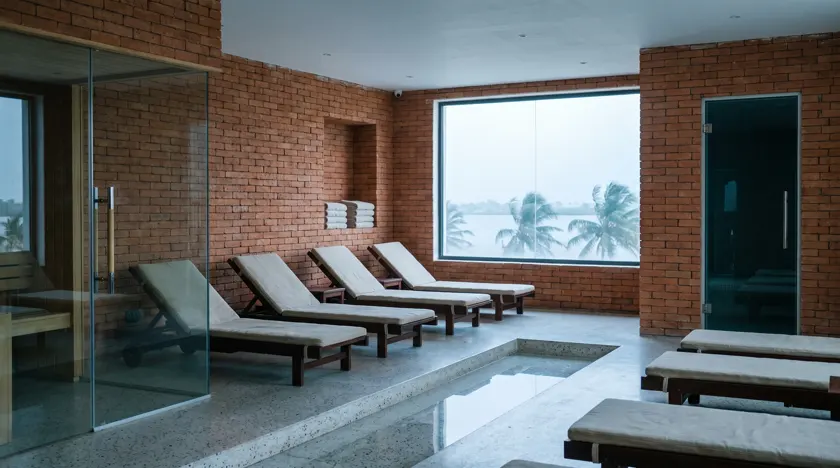
There are three commercial propositions and they behave completely differently. A hotel thermal suite is a facility that supports a room rate and appears in booking decisions. A gym recovery zone is a membership-retention tool with measurable throughput. A club spa is an amenity that justifies a joining fee.
They need different sizing, different staffing and different hygiene regimes, and conflating them is how a hotel ends up with a gym's ice baths in a room guests do not want to be seen in.
A cold plunge zone in a Lagos or Abuja gym has a hard number attached: throughput. Two to four minutes in the water plus changeover gives ten to fifteen people per tub per hour, and your evening peak is usually two to three hours.
Size on that peak rather than on your membership list. Most clubs that come to us with a two-tub plan leave with three, because the queue is what members remember and a queue at the one thing your competitor does not have is a wasted advantage.
The retention argument is straightforward: a member who uses a recovery zone twice a week has a reason to come in on days they would otherwise skip, and the marginal cost of that visit to you is a few kilowatt-hours and some filtration. Whether that translates into renewals is your data, not ours, but the mechanism is real and gyms that have installed properly tell us it is.
A thermal suite does not sell itself by the treatment; it sells itself in the photographs and the facility list. For a Victoria Island or Ikoyi hotel competing for corporate and international guests, a genuine sauna-steam-plunge circuit is a differentiator because most competitors have a tired gym and a pool.
The condition is that it has to work. A suite that is dark on a Friday evening because it was never put on the essential board, or warm because the chiller was undersized, actively damages the thing it was bought to support. Guests do not conclude 'the spa is closed tonight'; they conclude 'this hotel is not what it claims'.
That is why we spend so long on redundancy and circuits for hotel work, and why it is a larger part of the quote than clients initially expect.
Capital: the installation, plus the structural and drainage work, plus the circuit and changeover integration. We separate those so you can see them.
Running: the chiller, year round, which in Lagos is a steady monthly figure and in Abuja slightly less. The heater, which is a function of hours open. Water and treatment. Filter cartridges and ozone cells. We give you these before you commit.
Staffing: someone has to test the water, keep the log and clean to a schedule. On a commercial installation that is perhaps twenty minutes a day, and it is the cost most often left out of a business case and most often the reason a suite degrades.
Service: quarterly in Lagos and the delta, half-yearly inland, with a corrosion or dust inspection depending on where you are. Budget it as a line rather than as a surprise.
Not the capital cost. Three things: undersizing, so there is a queue or the water is never cold enough; supply, so it stops working whenever the grid does; and staffing, so the water quality drifts and guests stop using it.
All three are decided before anything is built. Size on the peak. Put every guest-facing load on the essential board. Train the team properly at handover and come back at six months to check the log is being kept — which we do as standard, because a suite that degrades reflects on us as much as on the property.
A fourth, quieter killer is putting the plunge somewhere guests will not walk to in a towel. The circuit has to be a circuit; if it requires crossing a public corridor, it will be used once per stay and then never.
Do not build a large suite you cannot staff. A well-run compact circuit beats a neglected large one in every measure that matters, including photographs.
Do not buy equipment that cannot be serviced here. Send us a model number before you import something interesting; an orphaned unit with no parts route is a very expensive ornament.
And do not open without a spares kit on site. Import lead times mean a single failed element can close a room for three weeks, and three weeks in season is the whole year's argument for having built it.
Take a Lagos gym with a busy two-hour evening peak. Three tubs at ten to fifteen people per tub per hour gives sixty to ninety uses across that peak, which for most clubs is comfortably more capacity than the peak demands and leaves room for growth without a second build.
Against that sits a capital cost in the gym-recovery band on our price page, a chiller running year round, cartridges and ozone cells, roughly twenty minutes of staff time a day, and quarterly service. Those are all numbers we give you in writing before you commit, calculated for your room rather than generically.
What you then model is the retention effect, and only you have that data: how many members currently lapse, what a retained member is worth over a year, and how many of them would use a recovery zone twice a week. We will not invent that number for you, and any supplier who does is selling rather than advising.
A surprising number of commercial installations fail commercially while working perfectly, because the room they are in is unpleasant. A cold plunge in a windowless corner beside the bin store is a cold plunge nobody photographs and nobody recommends.
Light, a floor that is dry to walk on, somewhere to put a towel, somewhere to sit afterwards, and a route from the changing room that does not cross a public corridor. Those are cheap and they are what turns a facility into a habit.
It is also the part most likely to be cut when a budget tightens, and the part we argue hardest to keep.
For a gym in Lagos or Abuja with a real evening peak, on the evidence of the clubs we have built for, yes — and faster than owners expect, because the capital cost of a well-specified two or three tub zone is modest against what a gym spends on equipment that gets less use.
For a hotel, it pays back through occupancy and rate rather than through the spa's own revenue, which means it is a marketing investment with a maintenance obligation attached. If you will maintain it, build it. If you will not, build something else — and we would genuinely rather tell you that at the first meeting.
Want this checked against your own room? Send us the dimensions and a photograph and we will come back with a drawing.
An honest continental price breakdown: what a sauna and cold plunge cost in eight African countries, what move…
Read more →
An honest breakdown of sauna and cold plunge prices in Nigeria: what fits inside ₦8 million, what pushes a pro…
Read more →
From Nairobi at 1,795 m to the Ngorongoro rim: why African highland saunas need a bigger heater, and why the s…
Read more →