
11 min
What a Sauna and Cold Plunge Cost Across Africa in 2026
An honest continental price breakdown: what a sauna and cold plunge cost in eight African countries, what move…
Read more →South Africa spent a decade buying backup power out of necessity. The necessity has gone — and the hardware turns out to be close to ideal for exactly the equipment we install.
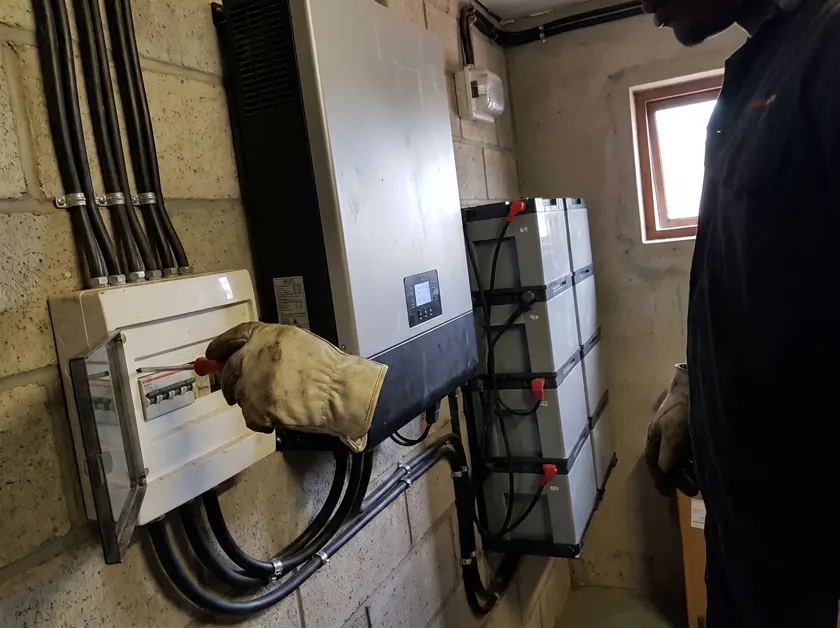
The country has now gone more than 475 days without load shedding, and passed a full unbroken year in May 2026 — the first time since September 2018 (South African Government). Eskom reports unplanned outages at their lowest level in nine years and roughly R26.9 billion saved on diesel across three years (Eskom).
We say this plainly because the opposite is still being sold. Specifying a wellness installation around a crisis that has ended produces an expensive, over-engineered system that solves a problem you no longer have.
Inverters, lithium batteries and rooftop solar, installed at a density unmatched anywhere else on the continent. Most of it is now underused: it was bought to keep the lights on during a four-hour block, and there are no blocks.
For a wellness installation that hardware is genuinely useful, in two specific ways.
A plunge chiller is a small, steady load — nothing like a geyser or an oven. Putting it on a battery-backed circuit costs very little and means the water never drifts during any interruption, planned, unplanned or municipal.
For a household that matters mildly. For a club or a hotel it matters a great deal: a shared tub that drifts to twenty degrees has to be pulled back down, and doing that costs far more in electricity than holding it cold did in the first place.
A sauna heater is the opposite kind of load — large and brief. Its heat-up window is twenty to forty minutes at full draw, and it does not matter at all when that happens as long as the cabin is warm when you want it.
A timer and a relay, wired so the heat-up runs in the middle of a sunny afternoon, shifts the single largest load in the installation onto your own panels for most of the year. On a household with a decent array that is the difference between a sauna that costs something to run and one that costs almost nothing.
It is a few thousand rand at build time and genuinely annoying to retrofit through a finished wall, which is why it belongs in the first drawing.
Do not try to run a 9 kW heater off batteries in the evening. It is technically possible with a large enough bank and it is a poor use of storage — you will discharge a substantial fraction of your battery to heat a room, in the hours when you most want the battery for everything else.
Do not oversize a backup system for wellness equipment. The chiller needs very little; the heater should be scheduled rather than backed. Anyone quoting you a large battery expansion specifically to run a sauna is selling batteries.
And do not skip the electrician's certificate. A heater circuit is a serious load and it needs to be wired, rated, protected and signed off properly, backed circuit or not.
The chiller on the backed circuit, always, because it is cheap and it protects the one thing that suffers from an outage.
The heater on a scheduler with a relay, set to your generation profile, with a manual override for the evenings you did not plan.
A dedicated, correctly rated circuit with RCD protection and a certificate. Heat-rated cable into the cabin. The control and the overheat cut-out tested at commissioning and again at every service.
None of that is exotic. It is simply built for the country as it is now, rather than as it was three years ago.
If the house is being built or renovated, put in the conduit and the cable for both the heater circuit and the chiller circuit while the walls are open, even if the sauna is two years away.
Run the chiller circuit from the backed side of the board. Leave a spare way. It costs very little now and it is the difference between a straightforward installation later and a week of chasing through finished plaster.
It is the same advice we give in every country we work in, and in South Africa it comes with the extra advantage that the backed side of your board probably already exists.
Take a household with a common mid-size array and a battery bank, a four-person sauna with a 9 kW heater, and an insulated plunge with a 1 HP chiller.
The chiller, holding setpoint on a lidded insulated tub, is a modest continuous draw — the sort of load a battery bank carries without noticing, and the sort that a short interruption would otherwise undo.
The heater is the big one, and it is brief. Scheduled into the early afternoon, its entire heat-up window sits inside the generation peak on most days from September to April. In the Cape winter, when the array produces least and the sauna is used most, it falls back to the grid — which is exactly when grid electricity is doing its most useful work of the year.
None of this requires new hardware. It requires a timer, a relay and somebody thinking about it at drawing stage.
There is an awkward seasonal mismatch worth naming. A Cape or Highveld winter is exactly when a sauna gets used most and exactly when a solar array produces least, and the two curves move against each other for three or four months a year.
That is an argument for a scheduled heater rather than an on-demand one. Heat the cabin inside the best part of the day even if the session is at seven, insulate heavily enough that the room holds, and accept that in June some of the energy comes from the grid rather than the roof. A well-insulated cabin loses far less over three hours than most people assume.
It is also an argument against oversizing the heater to compensate for a poorly insulated room. A bigger element does not fix heat loss, it just pays for it faster.
Which side of the board is my spare way on, backed or unbacked? The chiller wants the backed side; the heater does not need it.
What is the continuous rating of my inverter, and what else is already on the backed side? A chiller is small, but so is the headroom on a system that is already carrying a fridge, a router, lights and a pool pump.
Can the heater circuit be switched by a relay from a timer, and is that compliant here? It is, done properly, and it wants to be in the certificate rather than added afterwards.
And: is there a spare conduit to where the cabin is going? If the answer is no and the walls are open, fix that today. It is the cheapest decision in this entire article.
Want this checked against your own room? Send us the dimensions and a photograph and we will come back with a drawing.
An honest continental price breakdown: what a sauna and cold plunge cost in eight African countries, what move…
Read more →
An honest breakdown of sauna and cold plunge prices in South Africa: what sits inside R60,000, what pushes a p…
Read more →
From Nairobi at 1,795 m to the Ngorongoro rim: why African highland saunas need a bigger heater, and why the s…
Read more →