11 min
What a Sauna and Cold Plunge Cost Across Africa in 2026
An honest continental price breakdown: what a sauna and cold plunge cost in eight African countries, what move…
Read more →We will not hand you a return percentage. We will give you the market numbers with sources, the real cost structure across three climates, and the arithmetic to run on your own figures.
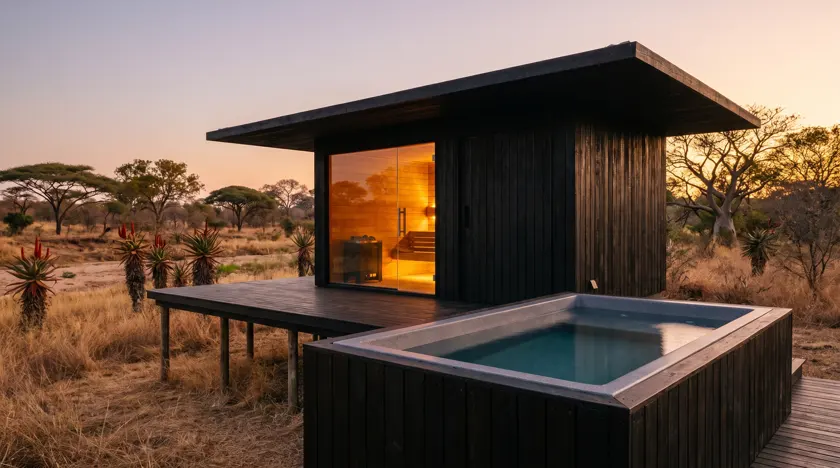
South Africa received 10.5 million tourists in 2025, up 17.7 per cent on 2024 and 2.6 per cent above the pre-pandemic level of 2019 (Statistics South Africa). The first six months of 2026 brought 5.6 million arrivals, with the nine-month figure passing 6.5 million (Travel And Tour World).
That is a genuinely recovered market rather than a recovering one. It is also a competitive one: this country has more good small hospitality per capita than almost anywhere we work, so a spa here is competing against real alternatives rather than against nothing.
Rate and filter position. A property that can credibly list a sauna and cold plunge appears in more searches and competes in a higher bracket. This is the largest effect and the hardest to isolate.
Treatment revenue, entirely dependent on staffing. A beautiful suite with nobody trained to sell treatments earns very little; a modest one with a good therapist earns steadily.
Reviews and length of stay. Wet areas appear in reviews out of all proportion to their floor area, and in a market where guests compare four similar lodges, review score is a pricing input.
Build. A small suite — sauna, steam room, two plunge positions and rest — needs about 30 to 40 square metres plus 6 to 8 of plant, and sits in our 440 to 980 thousand rand band. A full lodge or resort spa runs to 2,400.
The climate premium is real and it differs: coastal properties pay for A4 stainless, sealed enclosures and deeper cavities; bushveld properties pay for dust filtration and off-grid sequencing; Cape properties pay least, because the winter does some of the work.
Running. Energy, water, chemistry, cartridges. In the Cape and the Winelands the chiller barely runs for half the year, which is a genuine operating advantage over a KZN or bushveld property.
People. At minimum one trained person who owns the log. This is the cost most often left out and the one most likely to decide whether the suite earns anything.
Take the annual running cost, add the build cost amortised over five years, and divide by your average achieved rate. That is the number of additional room-nights a year the suite has to produce to break even.
Compare it with your current annual room-nights. A low single-digit percentage means build it. If it needs ten per cent more occupancy, be sceptical — then run the same sum for one excellent sauna and a properly built plunge, which in the guesthouse segment frequently clears the bar when a full circuit does not.
Building four thin rooms instead of one good one. In a twelve-room Franschhoek hotel, one superb sauna with a cold plunge and a view beats a cramped circuit every time, and costs a third as much.
Specifying nationally rather than locally. A KZN coastal property built to a Cape specification will be replacing hardware in year two.
Buying a chiller for a Cape property that did not need one, then paying to run it. And, conversely, not buying one for a KZN property that did.
No ventilation strategy on the coast. It is the single most common reason a small hospitality spa stops being an asset — it never dries out, and then it is mentioned in reviews.
The Cape and the Winelands have a genuine quiet season and a winter that sells the product, which is an unusually good combination: build in the quiet months, earn in the cold ones.
KZN and the bushveld run closer to year-round, so work is phased around occupancy and there is no cheap window to wait for.
Plan the build calendar around that rather than around when the budget was approved. It changes both the cost and the disruption.
One well-built sauna with a view, one properly insulated and shaded plunge, a rest area with water and shade, and the drainage, extract and electrical capacity for everything else you might add later.
In the Cape that package may not need a chiller at all, which makes it cheaper again. It photographs well, it survives its climate, and it moves the property into the same search filter as far more expensive suites.
Everything else can follow in a later phase — provided the services went in at the start, which is the one thing we would insist on regardless of budget.
Decide before opening which four numbers you will track, and review them at six months alongside the first full service visit.
Treatment revenue per available room-night, rather than per treatment — it exposes a staffing problem faster than anything else.
The share of direct enquiries that mention the spa. One question on the booking form and a season of answers is worth more than any projection.
Review mentions split positive and negative, because in this market the direction of those mentions is an early warning system months before the plant actually fails.
Energy against occupancy. If consumption stays flat while occupancy falls, something is running that should not be: a setpoint left low, a lid never used, a heater schedule overridden and forgotten.
Siting the plunge away from the sauna. If the circuit from hot to cold crosses a public corridor or a car park, guests do it once and never again, and a facility used once per stay does not appear in a review.
Sizing on the member list instead of the busiest hour. A queue at the one thing your competitors do not have is a wasted advantage, and clubs consistently underestimate their own evening peak by a position or two.
Budgeting the build and not the twenty minutes a day. Somebody has to test the water, keep the log and clean to a schedule. It is not much time and it is the single strongest predictor of whether a suite still looks good in its third year.
A lot of South African lodges and guesthouses already have a spa room built ten or fifteen years ago that no longer performs. Opening one up usually reveals the same things: an undersized or absent chiller, a membrane that failed at the corners, corroded coastal fixings, and a heater with stones that were never turned.
Refurbishing is almost always cheaper than building new, and the arithmetic is easier because the floor area exists and the guest expectation is already set.
It is also the moment to fix the specification for the actual climate rather than repeating whatever was done originally. We survey before quoting a refit, because a refit priced from a walk-through is a refit whose price changes in week two.
Want this checked against your own room? Send us the dimensions and a photograph and we will come back with a drawing.
An honest continental price breakdown: what a sauna and cold plunge cost in eight African countries, what move…
Read more →
An honest breakdown of sauna and cold plunge prices in South Africa: what sits inside R60,000, what pushes a p…
Read more →
From Nairobi at 1,795 m to the Ngorongoro rim: why African highland saunas need a bigger heater, and why the s…
Read more →