
11 min
What a Sauna and Cold Plunge Cost Across Africa in 2026
An honest continental price breakdown: what a sauna and cold plunge cost in eight African countries, what move…
Read more →Island prices carry three things mainland prices do not: shipping, cyclone anchorage and a marine specification. Here is the arithmetic, with all three visible.
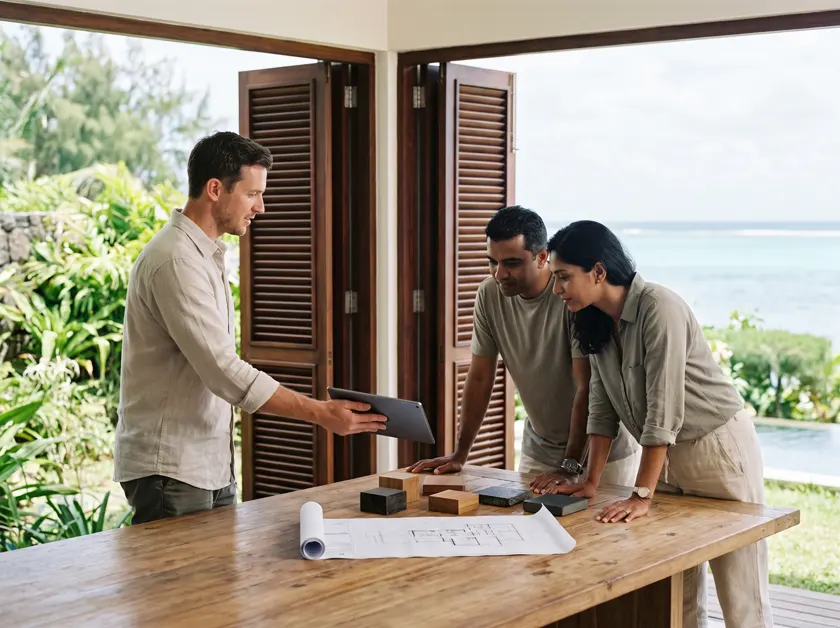
Cabin volume first, because it drives timber, insulation and heater together. A two-person cabin is roughly a third of the material of a six-person one and half the heater.
Glass second: a heavier frame, more careful sealing and a bigger heater. On a lagoon-facing deck the glass is the whole point, so it is rarely the place to economise — but it should be chosen with the heater difference visible.
Anchorage third, and this is the island line. Straps and threaded rod into concrete pads, engineer-signed where exposure warrants, on a continuous load path from roof to ground. It is a modest percentage of the project and it is not optional.
Services fourth: the cable run, the drain, and the structural check for anything holding water on a deck.
Teak, equipment, heaters and chillers are all imported, and everything arrives by sea. That is weeks rather than days, and it means the programme is planned around one arrival rather than around a supplier down the road.
The practical consequence is not mainly cost — it is sequencing. We order long-lead items first, then do the deck, the anchorage, the drainage and the electrical work while the container is on the water. On a well-planned project the equipment lands into a site that is ready for it.
It also means we hold and leave spares. A part that takes three days in Europe takes three weeks here, and a spares box with part numbers on the lid is worth more than its cost several times over.
A four-person teak cabin with one glass wall on a lagoon-facing deck, plus an insulated plunge tub with a chiller. Roughly: timber and insulation the largest block, glass and frame next, chiller and filtration a significant block of their own, then anchorage and marine specification, then heater and controls.
The chiller is a bigger share here than in temperate markets because it runs all year. There is no season in which it idles, so it is sized and specified as a year-round machine rather than a summer one.
A plunge tub carved from a single block of local basalt. A thatched pavilion over the cabin. Corner glazing with no post. Coral stone benches. Any two and you are near the top; all of them and you are building the thing we photograph.
The basalt tub deserves its own note: it is heavy, it is beautiful, and it changes both the structural check and the anchorage design. It is worth it, and it is not a late decision.
The heater is the same everywhere: full load for the twenty to forty minute heat-up, then cycling at a third to a half of nameplate. An evening session is closer to 4-6 kWh than to 9.
The chiller is the line that differs. Running every month of the year, it is the largest ongoing cost in the installation, and the three things that reduce it are insulation, a lid that gets used and shade. A shaded, insulated, lidded tub costs a fraction of an exposed one to hold at the same temperature.
Service is quarterly rather than half-yearly, because humidity and salt do not take a season off. Budget for four visits a year, not two.
How is it anchored, and who signs the detail? If the answer is about weight rather than a load path to concrete, walk away.
What grade are the fixings? A4 stainless throughout, including the ones nobody sees. Nothing less survives continuous humidity and salt.
How does the room dry after use? A ducted mechanical extract with a long run-on timer, or a humidistat. A vent and hope is not an answer on this island.
What spares will be on site, and with what part numbers? A builder who has worked here will have an immediate answer, because they have waited three weeks for a thermostat at least once.
Build the deck, the anchorage, the drainage and the cable run properly now, and the cabin later. Those are the parts that cost multiples to retrofit; a cabin is not.
If you have to choose between a sauna and a plunge, take the sauna on the coast — the ocean is already there for the cold half, and a properly built plunge can follow.
And put the spares kit in the first budget rather than the second. It is the cheapest insurance on this island.
A quote that gives you one number for a wellness zone is a quote you cannot interrogate. Ours separates seven lines, and any serious builder's should separate something similar.
The cabin itself: timber, insulation, glass, door, benches, heater and controls. The plunge: shell, insulation, lid, liner or stone, and the chiller with its filtration. The anchorage package, with a note of who signs it. The marine specification premium, so you can see what the coast costs. The deck or platform, if we are building it. The services: cable run, drain, extract duct. And the access and delivery, including the shipping leg.
Seeing those separately is what lets you make decisions. If the anchorage is what makes an exposed site expensive, you can choose a sheltered corner of the same garden and save more than any discount would give you.
Insurers on this island ask about fixed external structures, and an engineer-signed anchorage detail is the answer that ends the conversation. Without one, a freestanding timber cabin on a coastal deck is a question mark on a policy.
We provide the detail and the calculation as part of the handover pack, and we have sent them directly to brokers more than once. It costs us nothing and it saves clients a surprising amount of correspondence.
It is also worth telling your insurer that the installation exists. A wellness zone is not a small addition to a property and a policy written before it was built may not contemplate it.
Flat-pack sauna kits arrive on this island regularly and we are asked to install them just as regularly. Some are perfectly decent cabins; almost none are specified for here.
The recurring problems are the same: plated rather than A4 fixings, no provision for anchorage, no ventilated void underneath, vapour barriers designed for a dry climate, and controls with proprietary boards that cannot be sourced locally.
We will install a client's own kit and we will tell you in writing what we think it will and will not survive. What we will not do is anchor a structure we have not assessed and put our name against it.
Want this checked against your own room? Send us the dimensions and a photograph and we will come back with a drawing.
An honest continental price breakdown: what a sauna and cold plunge cost in eight African countries, what move…
Read more →
From Nairobi at 1,795 m to the Ngorongoro rim: why African highland saunas need a bigger heater, and why the s…
Read more →
Why the cold side is the difficult half of contrast therapy in Africa: chiller sizing for real tropical ambien…
Read more →