
11 min
What a Sauna and Cold Plunge Cost Across Africa in 2026
An honest continental price breakdown: what a sauna and cold plunge cost in eight African countries, what move…
Read more →Mauritius is a volcano with a beach around it. The rock under your feet is the best material on the island for a cold plunge, and it is sitting there.
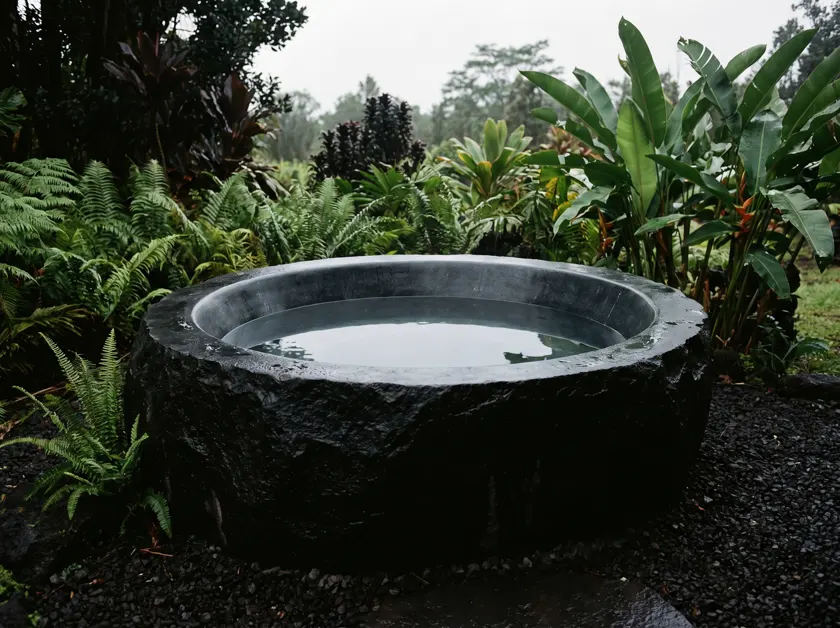
Thermal mass. A tub carved from a single block of dense volcanic rock holds temperature far better than a clad tub of the same volume, because the stone itself is part of the thermal system rather than just a wall around the water.
In practice that shows up as a chiller that cycles less, a tub that recovers faster after somebody gets in, and water that stays stable through a hot afternoon rather than drifting.
It looks like it came out of the ground here, because it did. Dark, dense, slightly irregular, with the surface worked rather than manufactured. Against teak and coral-white plaster it is unmistakably Mauritian in a way an imported product never is.
It also ages well. It does not rot, corrode, fade or need re-oiling. In a climate that attacks almost everything, a block of basalt is simply indifferent.
A carved basalt tub full of water is a serious load concentrated on a small footprint. That is not an obstacle but it is a decision that has to be made early, because it changes three things.
The structure: on a deck or a suspended floor it needs an engineer's opinion before we quote, and often a local thickening or a beam beneath it.
The anchorage: the mass helps against uplift, but the tub still has to be tied into the structure rather than standing free, and the detail is different from a light cabin's.
And the access: it arrives as a finished block and it cannot be carried down a garden path. If a crane cannot reach the position, the answer is a clad tub, and it is better to know that at drawing stage.
We select the block first — the grain, the density and the absence of voids all matter, and no two blocks are alike. Then the bowl is cut and the inner surface honed to a smooth, comfortable finish while the outer face is left rough.
That contrast between honed and rough is the whole aesthetic, and it is also practical: the honed bowl is easy to clean, and the rough outer face does not show every mark.
Fittings are set into the stone rather than surface-mounted, which takes time and is the reason the lead time on a carved tub is longer than on a clad one.
A carved basalt tub sits in our 330 to 620 thousand rupee band, against roughly 100 to 165 for an insulated teak tub without a chiller. It is a significant step and it buys three things: performance, permanence and appearance.
It is worth it on a property that is not moving, where the tub is visible and central, and where the structure can take it without heroics. It is not worth it on a rented apartment terrace, and we will say so.
Clean with mild soap and water. Avoid acidic descalers, which will etch the honed surface over time. Expect the colour to deepen slightly as the stone takes up oils and minerals — that is patina, not damage.
The water system underneath it is the same as any other tub: insulation behind the stone where the design allows, circulation, cartridge filtration, ozone or UV, and a lid. Stone is not a substitute for any of those.
And it will outlast everything else in the installation, including, probably, the house.
Coral stone is the island's pale counterpart: warm to sit on, lighter, and beautiful as a bench or a threshold. It is also soft, porous and limited in supply, so we use it as detail rather than by the square metre.
A basalt tub with a coral stone bench beside it is about as Mauritian as a wellness zone can be, and both materials came from within a few kilometres of where they are installed.
The tub is the obvious use but not the only one. Basalt makes excellent plinths under cabins, thresholds that will take decades of wet feet, bench bases, and cladding to a plunge surround where a full carved tub is out of budget.
Split-face basalt on a wall behind a sauna is one of the cheapest ways to make a wellness zone look like it belongs to this island rather than to a catalogue. It is local, it is inexpensive as a cladding, and it reads as deliberate.
The one place we avoid it is underfoot in a shower, where it is too textured to clean easily. Honed coral stone or microcement is better there.
Block selection takes time. We look at grain, density and voids, and a block that photographs well can turn out to have a fault through it once opened. That means a carved tub has a longer lead time than a clad one and it is not a decision to make late.
Cutting and honing is skilled hand work, and the workshops that do it well are not numerous. We book capacity early and we would rather tell a client to wait six weeks than substitute a lesser block.
For clients who want the material but not the lead time, a clad tub with a basalt surround and a split-face wall gets a great deal of the way there in a fraction of the time.
There is very little maintenance in the stone itself. Basalt is dense, chemically stable, indifferent to ozone and entirely unbothered by salt air, which is close to ideal for this island. It needs no sealing and no annual treatment, and a wipe of the rim plus a scrub of the bowl when the tub is drained is the whole routine.
Two practical notes. Because the mass is large, a basalt tub takes longer to pull down from warm than a clad one does, so the right way to run it is to fill it, let the chiller work overnight and then hold it there under a lid rather than letting it drift up between sessions. Run that way it is cheaper than a clad tub, not dearer.
And avoid acidic descalers on the stone. They are formulated for the steel inside a steam generator, not for a honed volcanic surface, and they will dull it.
Against oiled teak: basalt wins on thermal performance, permanence and appearance; teak wins on weight, cost, lead time and the ability to move it.
Against microcement: microcement is cheaper, lighter, faster and can be any shape, and it will need recoating within a decade. Basalt will not.
Against an imported acrylic tub: no comparison worth making in this climate, and we would rather not install one.
If the property is permanent, the structure can take it and the budget is there, basalt is the right answer on this island. If any of those three is missing, a well-built clad tub is not a compromise — it is simply the correct choice for that situation.
Want this checked against your own room? Send us the dimensions and a photograph and we will come back with a drawing.
An honest continental price breakdown: what a sauna and cold plunge cost in eight African countries, what move…
Read more →
An honest breakdown of sauna and cold plunge prices in Mauritius: what sits inside Rs 200,000, what pushes a p…
Read more →
From Nairobi at 1,795 m to the Ngorongoro rim: why African highland saunas need a bigger heater, and why the s…
Read more →