
11 min
What a Sauna and Cold Plunge Cost Across Africa in 2026
An honest continental price breakdown: what a sauna and cold plunge cost in eight African countries, what move…
Read more →A cyclone does not push a timber cabin over. It lifts it. Almost everything about the engineering follows from that one fact, and almost every failure we are called to comes from misunderstanding it.
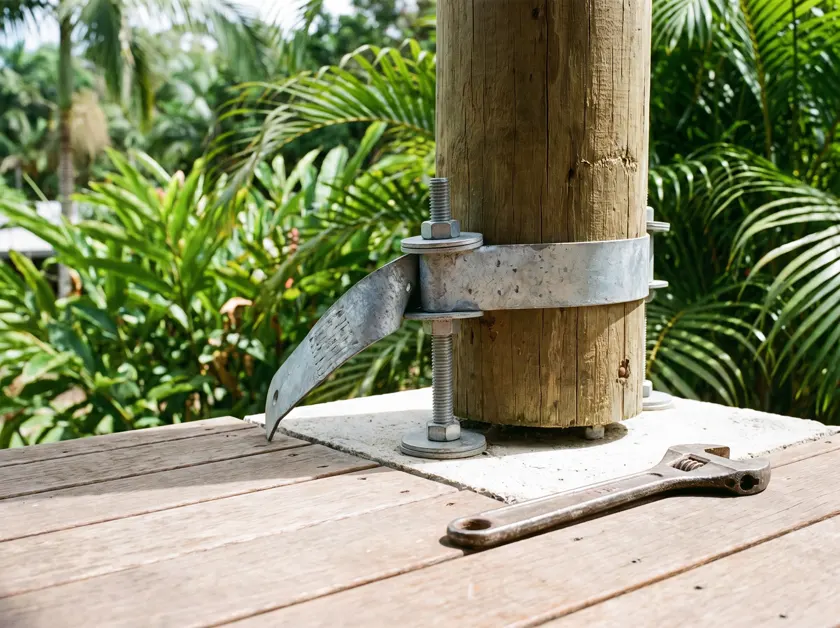
Wind flowing over a roof plane creates suction above it, the same way it does over a wing. A cabin with a large roof and a light structure is a low-performance aircraft waiting for enough wind, and the load is pulling upward rather than pushing sideways.
That is why weight is not a strategy. A heavy cabin resists uplift a little better than a light one, and neither resists it enough. What resists it is a connection to something that is not going anywhere.
Roof to wall. Wall to floor frame. Floor frame to steel feet or bearers. Steel to concrete pad. Every one of those connections has to be capable of carrying tension, and the chain is only as strong as its weakest link.
In practice that means galvanised straps at the roof-to-wall junction, bolted connections rather than nailed ones at the frame, and threaded rod cast or chemically anchored into concrete at the bottom. No friction, no assumptions, no 'it is heavy enough'.
Where exposure warrants it — the east coast, Le Morne, anywhere on a headland — an engineer sizes and signs the detail. Insurers ask, and the answer should exist before they do.
The cheapest engineering is often geometry. A lower cabin with a smaller roof plane sees less uplift than a tall one. A roof pitched to shed rather than to catch behaves better. A cabin tucked behind a wall or a building sees a fraction of the wind of one standing alone on a deck.
We site and shape cabins with that in mind before we start adding steel, because reducing the load is always cheaper than resisting it.
The commonest failure we see is not the cabin. It is something added afterwards: a pergola, a thatch roof, a shade sail, a screen. Those are large surfaces added by somebody who was thinking about sun rather than wind, and they are usually fixed to whatever was convenient.
Anything added over or beside an anchored cabin has to be anchored to the same standard. A pavilion that lifts takes the cabin's roof with it.
Look at the bottom first. Is there a visible connection between the frame and something concrete, or is the structure simply sitting on pads? If you cannot see a strap or a rod, there probably is not one.
Look at the roof-to-wall junction. Straps should be visible or documented. Ask for the detail drawing; if nobody has one, assume it does not exist.
Check the fixings for corrosion. An anchorage is only as good as the metal in it, and a rusted strap is decoration.
We retrofit anchorage to existing installations regularly. It is a straightforward job and it is dramatically cheaper than the alternative.
Before the season, roughly October: inspect every strap, bolt and rod, check for corrosion, secure or remove anything loose, and confirm the drainage around the structure is clear.
During a warning: close and latch everything, remove loose items, and follow the written routine. The fixed structure is already anchored — the work is making sure nothing else becomes a projectile.
After the season: inspect again, particularly the fixings, and deal with anything that moved. Two short visits a year, and they are part of our service calendar rather than an extra.
An anchorage package is a modest percentage of a wellness project, and retrofitting it to an existing cabin is cheaper still.
What it prevents is not only the loss of the cabin. It is the damage a loose structure does to everything downwind of it, the insurance conversation afterwards, and the several months it takes to replace imported equipment on an island.
We have never had a client regret the anchorage line in a quote. We have been called to properties where somebody removed it to save money, and that conversation is a different one entirely.
Cyclone categories are quoted as sustained wind speeds, and the number that matters structurally is the gust, which is substantially higher. Uplift scales with the square of wind speed, so a gust fifty per cent above the sustained figure is more than twice the load.
That is why the engineering here is not proportional to how severe a season sounds. A structure designed for an average year is not marginally under-specified for a severe one — it is dramatically under-specified.
Design is done to the code case for the exposure, not to a recent memory of how bad it got.
Mauritius is small enough to drive across in two hours and varied enough that exposure differs by an order of magnitude within it. A courtyard in Moka, behind buildings and vegetation on the central plateau, is a different structural case from an open deck at Poste Lafayette.
So we assess the specific position, not the island. Two clients the same distance from the sea can have completely different anchorage requirements depending on what is upwind of them.
This is also why a neighbour's installation is not a useful precedent. If theirs has survived five seasons it may be well anchored, or it may simply be sheltered by your house.
It is a common job and a straightforward one. We survey the structure, identify the load path and the missing connections, and add straps, brackets and anchors to bring it to a designed standard.
The most frequent findings are: no bottom fixing at all, a frame resting on pads; a roof-to-wall connection relying on nails; and corrosion in whatever fixings do exist, which means the anchorage that looked present was not.
It usually takes a day or two and costs a small fraction of the original installation. We do several of these every year before the season starts, and we would rather do yours in October than talk to you in February.
One caution about retrofits: an anchorage is only as good as what it is anchored to. If the deck itself is fixed to the ground with nothing more than its own weight, bolting a cabin to that deck achieves nothing except making a larger object that can lift. We check the whole chain, and occasionally the honest answer is that the deck needs work before the cabin does.
Want this checked against your own room? Send us the dimensions and a photograph and we will come back with a drawing.
An honest continental price breakdown: what a sauna and cold plunge cost in eight African countries, what move…
Read more →
An honest breakdown of sauna and cold plunge prices in Mauritius: what sits inside Rs 200,000, what pushes a p…
Read more →
From Nairobi at 1,795 m to the Ngorongoro rim: why African highland saunas need a bigger heater, and why the s…
Read more →