
11 min
What a Sauna and Cold Plunge Cost Across Africa in 2026
An honest continental price breakdown: what a sauna and cold plunge cost in eight African countries, what move…
Read more →We will not hand you a return percentage. We will give you the island's cost structure honestly, including the parts that are more expensive here, and the arithmetic to run yourself.
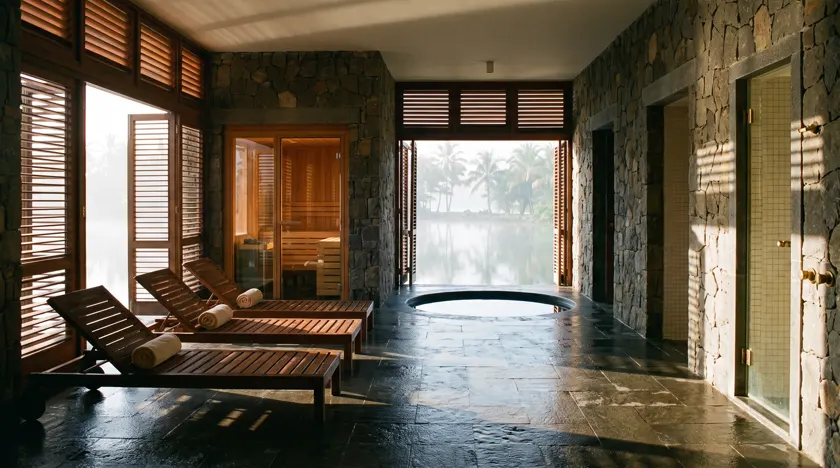
A resort spa and a private villa suite are not the same investment and should not be evaluated the same way. The resort earns treatment revenue and rate; the villa earns rental rate, occupancy and resale value.
Mauritius is unusual in that both markets are strong simultaneously — a top-end resort sector and a large stock of foreign-owned villas that are rented when the owners are away.
A wellness corner — sauna and plunge on one deck with shared plant — sits in our 420 to 880 thousand rupee band. A full suite runs to 1,900.
For a villa that rents, the questions are whether it lifts the nightly rate, whether it lifts occupancy in shoulder months, and whether it survives being used by guests rather than owners. The third is a specification question and it is where most disappointment comes from: controls that guests can break, finishes that cannot take daily cleaning, and no routine for the managing agent.
For a villa that sells, our experience is that a documented installation — manual, service history, spares list — is worth more at resale than the same money spent on finishes. A buyer can see it has been looked after.
A small thermal suite sits in our 1,300 to 2,800 thousand rupee band; a full resort spa runs to 6,500. On top of the build there is duplicated plant, documentation, training and a spares holding.
Against that: at the top of the Indian Ocean market the spa is a booking reason rather than an amenity, and a tired one is noticed immediately. The realistic comparison is not spa against no spa, but a good spa against the one your neighbours refurbished last year.
Three lines cost more here than on a mainland: shipping, cyclone anchorage and marine specification. Together they are a meaningful percentage of a project and none of them is optional.
There is also a fourth, softer one: spares and service. Quarterly visits rather than half-yearly, and a spares kit on site. Budget for it as an operating cost from day one rather than discovering it in year two.
Take the annual running cost of the suite, add the build cost amortised over five years, and divide by your average achieved rate — nightly rate for a villa, room rate for a resort.
That gives the additional nights per year the suite has to produce. Compare it with your current occupancy. A low single-digit percentage means build it; ten per cent means be sceptical and run the sum again for a smaller version.
For a villa, add the resale consideration separately rather than folding it in. It is real but it is not annual income.
Underspecifying for the climate, then paying for it in year three. A cabin built to a mainland specification on this coast is a short-term asset.
No anchorage, or anchorage removed to save money during value engineering. It is a small line and it is the one that decides whether the rest of the project exists after a bad February.
No ventilation strategy, so the room never dries and starts to smell — which on a rented villa arrives directly in the reviews.
And no spares, no manual and no trained caretaker, which turns a small failure into a three-week closure.
A well-built sauna, properly anchored, with a shaded bench and an insulated plunge sized for the household. Ventilation and drainage done properly. Documentation and a spares kit.
That package is a fraction of a full suite, it survives the island, and on a rental villa it is what guests photograph. Everything else can follow, provided the deck, the anchorage, the drainage and the cable run went in at the start.
That last clause is the whole point of this article. On an island, the expensive mistakes are the ones you cannot fix without a shipment.
In our experience reviewing feedback with clients, three things get mentioned and one does not.
Mentioned: whether the water was genuinely cold, whether the room smelled, and whether anything was broken. Not mentioned: the material the tub was made of, which the guest could not identify and did not care about.
That has a direct implication for budgets. Reliability, temperature and cleanliness earn the reviews; finishes earn the photographs. Both matter, but if the budget forces a choice, buy the chiller, the ventilation and the service contract before the stone.
For a rented villa, the suite will be operated by a managing agent and used by people who have never seen one before. That shapes everything.
Controls that are obvious and cannot be misconfigured. A laminated card by the door with three lines on it. A caretaker checklist for between guests. A service contract so the agent is not sourcing a technician under pressure.
Agents who have looked after one of ours tend to recommend the next one, which on an island of this size is most of our marketing.
Two weeks for survey, drawing and the structural opinion if a basalt tub or a deck is involved. Equipment and timber ordered at the end of week two.
Weeks three to six: deck, anchorage pads, drainage, cable run, extract duct. All of this happens while the container is at sea.
Weeks six to nine: equipment arrives, cabin assembled, plant installed and wired, tub set and connected.
Week ten: commissioning, water testing, handover, manual, spares kit, training for the caretaker.
Ten weeks, of which four were shipping that overlapped with work. Compressing that is possible only by holding stock, which is why we do.
The one thing that reliably breaks that timeline is a late change to anything structural — moving the tub, changing to carved basalt, or relocating the cabin to a more exposed position. All three change the anchorage and possibly the engineer's input, and all three are cheap in week one and expensive in week six. We push clients hard to settle those decisions before the container is booked, and the ones who do are the ones whose projects finish on the date we first gave them.
Want this checked against your own room? Send us the dimensions and a photograph and we will come back with a drawing.
An honest continental price breakdown: what a sauna and cold plunge cost in eight African countries, what move…
Read more →
An honest breakdown of sauna and cold plunge prices in Mauritius: what sits inside Rs 200,000, what pushes a p…
Read more →
From Nairobi at 1,795 m to the Ngorongoro rim: why African highland saunas need a bigger heater, and why the s…
Read more →