11 min
What a Sauna and Cold Plunge Cost Across Africa in 2026
An honest continental price breakdown: what a sauna and cold plunge cost in eight African countries, what move…
Read more →We build in places where the climate does half the work for free. This is not one of them, and pretending otherwise is the commonest way a cold plunge here disappoints its owner.
A plunge tub gains heat from three directions: the air around it, the sun on it, and the ground or structure under it. Every one of those sources is working against you in the Seychelles, in every month.
Sea temperature around these islands sits in the high twenties for most of the year and the air rarely drops far at night. There is no cool season and there is no cold night. A well-insulated tub left with no machine will settle somewhere near ambient and stay there.
That water is refreshing for about four seconds and then it is simply warm water. It does not produce the cold-shock response, it does not do anything useful for recovery, and it certainly does not justify what it cost. We would rather have this conversation before the quote than after the installation.
In temperate countries a chiller is sized on the assumption that the nights help. Here they do not, so we start a step above a temperate figure and then adjust for the real variables: tub volume, insulation, whether it is shaded, whether it has a lid, and the setpoint you actually want.
A 10 °C tub and a 4 °C tub are different machines, and the gap between them is larger than most people expect. We quote both when a client is undecided, because the difference in capital cost and the difference in monthly running cost are both worth seeing before choosing.
Undersizing is the commonest fault we are called to on this island chain. A chiller that runs continuously and never reaches setpoint is not a cheap chiller; it is a chiller that will fail early while never having done its job.
Shade is first and largest. A tub under a takamaka canopy rather than on an open terrace runs measurably cheaper every month for the life of the installation. We site for shade before we size the machine, and where a client insists on full sun we show them both numbers rather than arguing.
Insulation is second. The shell, the base and the pipework all matter, and the base is the one most often skipped by other installers. A tub sitting directly on a warm terrace slab is heating the slab, continuously.
The lid is third and is by a wide margin the best value item in the whole project. It stops evaporation, it stops solar gain, and it holds temperature overnight so the machine starts the day where it finished. It has to be light enough that people actually close it — a lid nobody lifts is a lid nobody replaces.
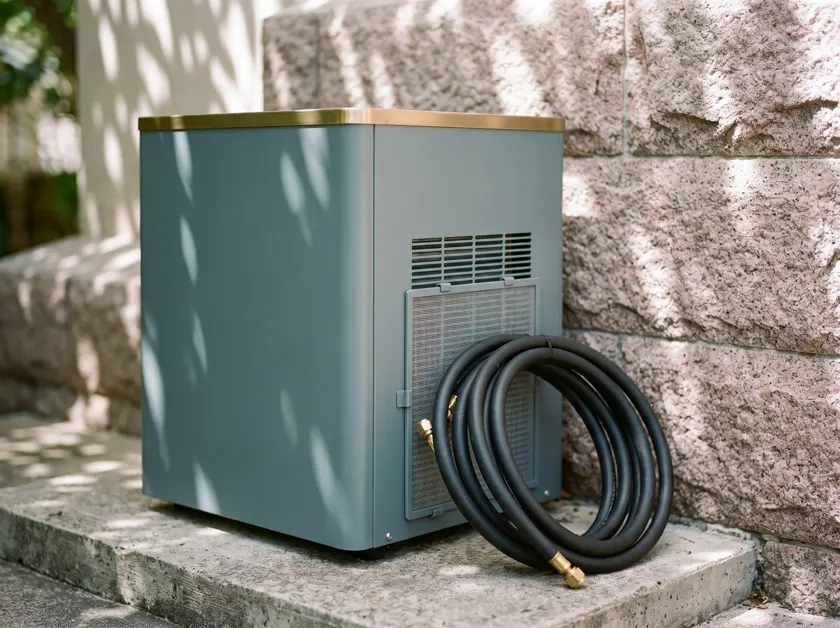
Every site in the Seychelles is coastal, so the machine specification is constant: a titanium heat exchanger in the water circuit because the water is cold, circulating and ozonated; a sealed enclosure with washable pre-filters so the condenser breathes filtered air rather than salt aerosol; everything raised off the ground and away from splash; anti-vibration mounts because plots here are close together and the evenings are quiet.
Then it is serviced quarterly with a corrosion inspection, and that schedule is quoted with the installation rather than sold afterwards. In this climate the service is what determines the machine's lifespan, not the badge on it.
The chiller cycles rather than running flat out, and the duty cycle depends on all of the above. We calculate a monthly figure for your specific tub on the PUC tariff and give it to you with the quote.
It is not a trivial number. A well-shaded, well-insulated, lidded tub at 10 °C is a modest monthly cost; an unshaded uninsulated tub at 4 °C with no lid can be several times that. Those are the same tub with different decisions around it, and the decisions are made at design stage, not afterwards.
For properties on solar we go further and look at the load profile rather than the tariff: scheduling the compressor into the solar window where the battery bank allows, and sequencing it so it never starts at the same moment as a sauna heater.
Everything that grows in water grows faster when the surroundings are warm, and that is the other reason the machine matters: cold water is also more stable water.
Circulation, cartridge filtration and an ozone or UV stage are standard on everything we build here, and a rinse shower at the entry point turns a weekly water change into a monthly one. On shared installations — gyms, clubs, resorts — those are not options.
With that arrangement a domestic tub runs four to eight weeks between changes. Without it, weekly, and the owner quietly stops using it by month three.
Supply here is generally reliable but not perfect, and clients reasonably ask what a cut does to a plunge. The answer is comforting: an insulated, lidded tub holds its temperature for many hours, the chiller restarts by itself when supply returns, and a cut of a few hours is invisible by the next morning.
What matters more is what the cut does to the rest of the installation. We specify controls that fail safe and restart cleanly, and on properties with a generator we make sure the chiller is on a circuit that the changeover actually feeds — we have found plunge circuits left off the essential board more than once, which means the one appliance that genuinely needs continuity is the one that loses it.
On solar-and-battery properties we go further and agree with the electrician which loads are shed first. A compressor that restarts repeatedly into a failing battery bank is worse than one that stays off for an hour.
In the Seychelles, a cold plunge is a machine. Shade it, insulate it, put a lid on it, size the chiller properly for a climate that never gives you a cool night, and it will be the most used thing on your terrace.
Skip the chiller and you have bought an expensive water feature. We will tell you that before you spend the money rather than after, and if that costs us a sale occasionally, it is still the right way round.
Want this checked against your own room? Send us the dimensions and a photograph and we will come back with a drawing.
An honest continental price breakdown: what a sauna and cold plunge cost in eight African countries, what move…
Read more →
An honest breakdown of sauna and cold plunge prices in the Seychelles: what sits inside SCR 100,000, what push…
Read more →
From Nairobi at 1,795 m to the Ngorongoro rim: why African highland saunas need a bigger heater, and why the s…
Read more →