
11 min
What a Sauna and Cold Plunge Cost Across Africa in 2026
An honest continental price breakdown: what a sauna and cold plunge cost in eight African countries, what move…
Read more →Everything imported into this country lands at Victoria. What happens after that decides whether an island project takes ten weeks or fourteen.
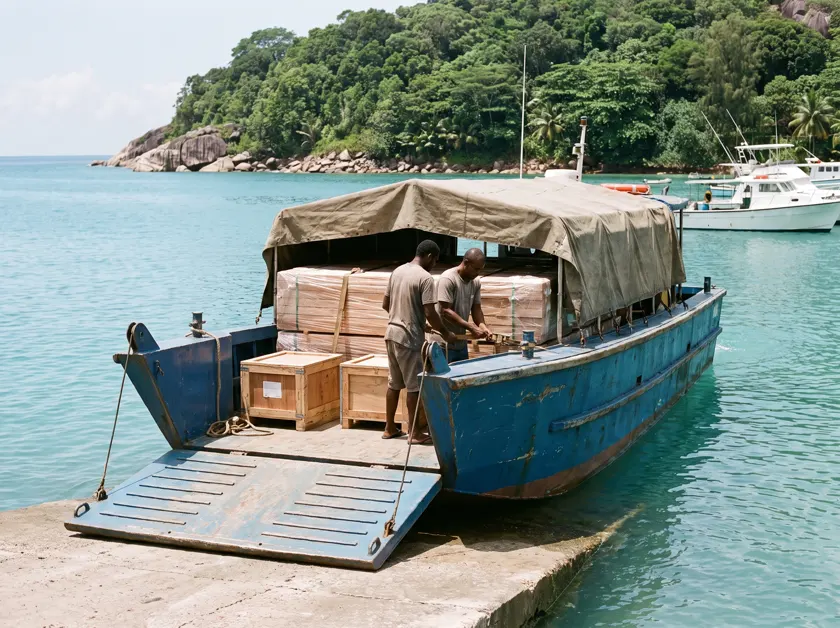
There are one hundred and fifteen islands in the Seychelles and only a handful with meaningful construction activity. Mahé has the port, the workshop, the trades and the suppliers. Praslin and La Digue are a barge or ferry away on a schedule. The private and outer islands are a boat with a timetable measured in days and, in bad weather, a timetable that moves.
None of that is unusual for anyone who lives here. What is unusual is how many contractors quote as though it were not true, and then discover it during a project.
Every cabin we build is assembled in full in the yard at Providence before it goes anywhere. Panels are fitted together, the door is hung, the benches go in, the heater is placed, and the whole thing is photographed and every component numbered. Then it comes apart again for shipping.
This costs us two days and it saves a fortnight. A joint that does not close, a bracket that fouls, a door that binds — every one of those is a ten-minute fix in the workshop and a week-long problem on La Digue. We have never regretted the two days.
The photographs go with the load, so the crew reassembling on the island is following a picture of the finished object rather than a drawing.
The entire project ships once: panels, heater, controls, chiller, hoses, filtration, fixings, sealant, insulation, tiles, drainage, tools. It is packed against a written checklist that somebody signs, and it carries a deliberate margin of the things that get lost, damaged or found short — fixings, seals, cable, sealant, cartridges.
We would much rather over-pack by a box than be right by a bracket. The cost of the margin is trivial; the cost of a second crossing is a week of everybody's time and a client wondering what else was not thought through.
At handover we leave a box on the property containing the parts that fail most, each with its part number written on it: a heater element, a thermostat, a filter cartridge, hose seals, an ozone cell where one is fitted, and a handful of A4 stainless fixings.
On Mahé that box is a convenience. On Praslin it turns a week into an afternoon. On La Digue or an outer island it turns a fortnight into ten minutes, because the alternative is an order to Mahé, a crossing, and then a bicycle.
We also train whoever will actually look after it — an owner, a guesthouse manager, a small maintenance team — rather than handing over a manual and leaving. On a small island the person holding the spanner is the whole maintenance department.
La Digue deserves its own paragraph because it is the most extreme access constraint in the country. Movement is by bicycle, ox cart, foot and a very small number of permitted vehicles.
Everything we build for La Digue is designed around that from the first drawing: panels small and light enough to be handcarted, joints engineered to be assembled by two people, and heavy items — a granite basin, a large heater, a chiller — planned explicitly around the ferry and the permitted route. Where something genuinely cannot be moved to the spot, we design a different answer rather than promising one and failing.
It is a real constraint and it produces better buildings, because everything has to be thought through before it leaves the workshop.
Nobody is taking a boat to Praslin for one filter change. We service the outer islands in scheduled blocks so that several properties share the crossing and the cost, and we publish those dates in advance so owners can plan around them.
Every visit in these islands includes a corrosion inspection, because every site here is coastal. Plus the usual: stones turned, elements checked, cut-outs tested, generators descaled to an interval set by the property's actual water, condensers cleaned, cartridges changed, water tested.
Between visits the spares kit and the trained owner handle everything routine. That arrangement is what makes an island installation sustainable rather than a slow decline punctuated by emergencies.
Between roughly December and March the north-west monsoon can hold a barge for days, and in the south-east trade season the crossings to some of the outer islands get uncomfortable enough to be cancelled. Neither is exceptional; both are entirely predictable as a category, even though no particular week is.
So an island programme carries slack against it deliberately, and we say where the slack is rather than presenting an optimistic date and then apologising. Where a project has a hard deadline — a season opening, an owner's arrival — we ship the critical load early and let it wait on the island rather than ship it on time and hope.
Materials waiting under cover on site cost nothing. A barge that does not sail in the week you needed it costs the whole programme.
For Praslin and La Digue we send our own team across for the assembly, because the work is short, skilled and worth doing once. For outer and private islands we send a smaller team and work alongside the property's own maintenance staff, which has the useful side effect that the people who will look after the installation have seen it built.
First fix — drainage, extract, cable routes — is often done by local trades before we arrive, working from our drawings, so that our crew's time on the island is spent assembling rather than waiting. Coordinating that properly is most of what makes an island build efficient, and it is why we want the drawing agreed early rather than refined during the build.
A Mahé project runs eight to twelve weeks. Praslin or La Digue runs ten to fourteen, and almost all of that difference is shipping and scheduling rather than building. An outer or private island runs longer again and is planned around the property's own boat schedule.
If you are working back from a season opening, tell us the date first. We plan backwards from it including the crossing, which is the only way an island deadline is ever met.
Want this checked against your own room? Send us the dimensions and a photograph and we will come back with a drawing.
An honest continental price breakdown: what a sauna and cold plunge cost in eight African countries, what move…
Read more →
An honest breakdown of sauna and cold plunge prices in the Seychelles: what sits inside SCR 100,000, what push…
Read more →
From Nairobi at 1,795 m to the Ngorongoro rim: why African highland saunas need a bigger heater, and why the s…
Read more →