
11 min
What a Sauna and Cold Plunge Cost Across Africa in 2026
An honest continental price breakdown: what a sauna and cold plunge cost in eight African countries, what move…
Read more →The Inner Seychelles are the only granitic ocean islands in the world. A basin carved from a block off your own hillside is the one thing we build that could not exist anywhere else.
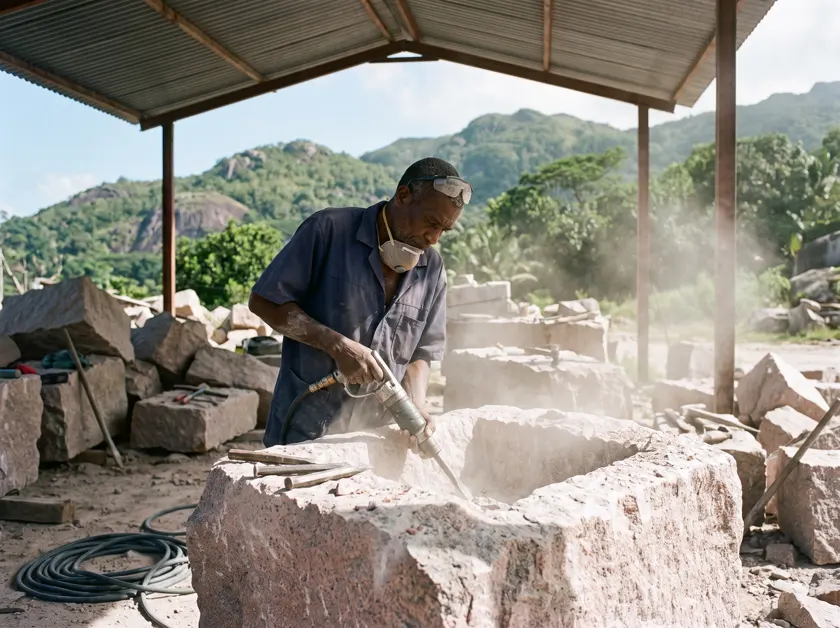
Not every boulder is worth carving. We look for sound stone without through-going fractures, a grain that will hone cleanly, and a shape that already suggests the finished object, because fighting the block wastes weeks.
Where a client has suitable stone on their own plot that is the best possible outcome: the basin belongs to the site in a way nothing imported can. Where they do not, we work from quarried and salvaged blocks held at Providence, and we show you the actual stone before carving rather than a photograph of a different one.
Occasionally we look at a boulder and say no. A cracked block that fails halfway through carving costs weeks and there is no repair worth having.
The block is split along a planned line, then the inner bowl is cut and worked down to a honed finish smooth enough to sit against comfortably for ten minutes. The outer faces are left split and raw.
That contrast is the entire design. From outside it reads as the boulder it came from; inside it is precise. Polishing the outside would make it look like a kitchen worktop and lose the point.
The bowl gets a gentle profile rather than a bucket shape, so that an adult can sit with shoulders under water and shins comfortable. Getting that ergonomics right takes longer than the rough cutting, and it is why we would rather you sat in one at the workshop before ordering.
This is the part nobody sees and the part that decides whether the basin works. Granite has enormous thermal mass but it is not an insulator. A basin with cold water in it and nothing behind it bleeds heat into the ground and the air continuously, and the chiller pays for that every hour.
So behind the stone there is rigid insulation and a waterproof backing doing the thermal and structural work. The granite is the finish and the mass; it is not the tank. Done that way, the same mass that would have cost you money becomes an advantage: the basin holds temperature beautifully overnight under a lid.
The plumbing — circulation, filtration, ozone, chiller feed and return — enters low and hidden so that nothing crosses the rim and nothing is visible from a seated position.
A carved basin is measured in tonnes before any water goes into it. On a ground-level terrace over rock that is a non-issue. On a suspended slab, a balcony or a timber deck it is a structural question with a real answer, and we get an engineer's opinion before quoting rather than after.
This is one of very few things we refuse outright: a stone basin on a structure nobody has assessed. Where the structure will not take it, the honest alternative is an insulated clad tub, which is lighter, cheaper and works extremely well — it simply is not carved from the island.
Carved at Providence, then moved by crane where a crane can reach, and by tracked machine, rollers and a temporary track where it cannot. On a hillside plot the access route for the basin is designed as carefully as the basin itself and priced as its own line.
For Praslin, La Digue and the outer islands the block travels by barge, and the barge sets the maximum size we will quote. That is a hard limit rather than a negotiation, and we establish it before drawing anything.
Occasionally the right answer is to carve on site. Where a suitable boulder is already in the right position and cannot be moved, we bring the tools to the stone instead. It is slower and dustier and the result is unrepeatable.
Granite is chemically stable, unaffected by ozone and utterly indifferent to salt air, which makes it close to the ideal material for this climate. It does not need sealing, it does not stain from clean treated water, and it will outlast everything else in the installation including the building.
What it does need is the same water care as any other plunge: circulation, cartridge filtration, an ozone or UV stage, a lid, and a water change every four to eight weeks. The stone will forgive neglect; the water will not.
One practical note: because the mass is so large, a granite basin takes longer to pull down to temperature from warm than a clad tub does. Fill it, let the chiller work overnight, and then keep it there under the lid rather than letting it warm up between sessions. Run that way it is cheaper than a clad tub, not dearer.
There is very little to do. Granite needs no sealing, no oiling and no annual treatment, and it is indifferent to ozone, to chlorine within sensible limits and to salt air. In practice the only attention the stone gets is a wipe of the rim and an occasional scrub of the honed bowl when the tub is drained.
Two things are worth knowing. First, a honed surface shows mineral deposits from hard fill water more readily than a polished one would, so where a property is on borehole supply we suggest filling through a simple cartridge filter — the same one the circulation uses. Second, do not use acidic descalers on the stone; they are formulated for a generator's steel, not for granite, and they will dull a honed face.
Everything else is water care rather than stone care, and that is the same for any plunge: filtration, ozone, a lid, and a change every four to eight weeks.
Commercially, it is the thing guests photograph. Domestically, it is the thing that makes a wellness area feel like it belongs on a Seychellois hillside rather than in a catalogue. And practically, it is a piece of the island that will still be exactly where you put it long after the cabin beside it has been re-lined twice.
It is not the cheapest answer and we do not pretend otherwise. But of everything we make, it is the thing people come back and tell us about.
Want this checked against your own room? Send us the dimensions and a photograph and we will come back with a drawing.
An honest continental price breakdown: what a sauna and cold plunge cost in eight African countries, what move…
Read more →
An honest breakdown of sauna and cold plunge prices in the Seychelles: what sits inside SCR 100,000, what push…
Read more →
From Nairobi at 1,795 m to the Ngorongoro rim: why African highland saunas need a bigger heater, and why the s…
Read more →