11 min
What a Sauna and Cold Plunge Cost Across Africa in 2026
An honest continental price breakdown: what a sauna and cold plunge cost in eight African countries, what move…
Read more →Equipment that lasts fifteen years in Alexandria will not last five in Hurghada on the same specification. The reason is measurable, and it changes what we build.
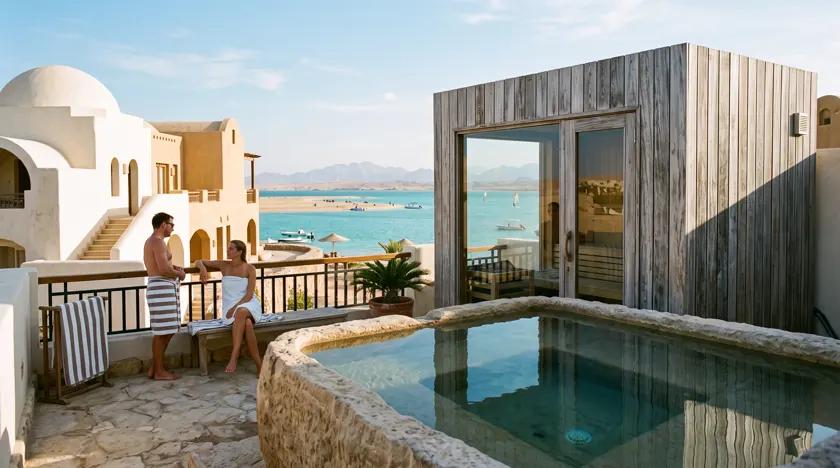
The Red Sea runs at roughly 40 parts per thousand salinity. The Mediterranean sits around 38, and the world ocean average is closer to 35. It is one of the saltiest large bodies of open water on the planet, because it has almost no freshwater inflow and evaporates ferociously.
That higher salt load reaches your building as aerosol carried on the wind. It settles on every surface, it is hygroscopic so it draws moisture out of the air even on a dry day, and it keeps a thin conductive film on metal more or less permanently.
Fixings first, always. Plated screws bleed rust down pale cladding within a season on this coast. Then hinges, latches and glazing hardware, which are small, highly stressed and usually the cheapest thing in the assembly.
Then anything with a fan and an electrical contact: chiller condensers, extract units, control boards. Salt plus moisture on a circuit board is a slow short.
Then timber end grain, which absorbs salt-laden moisture and starts to break down from the cut face inward. And finally the structure, which is the slowest and the most expensive to put right.
A4 stainless throughout, including every fixing nobody will ever see. A2 is not enough on this coast and plated steel is a waste of everyone's time.
Sealed plant enclosures with filtered ventilation, so the chiller and the control gear breathe filtered air rather than salt aerosol. Deeper ventilated cavities behind cladding, drained at the bottom. Every end grain sealed before assembly, not after.
Brass and copper where metal is visible, because both patinate rather than pitting. Chrome on the Red Sea looks tired within two seasons and there is no cure for it.
On the coast we visit every three months and the visit includes a corrosion inspection: every fixing, hinge, latch and enclosure, plus the end grain of exposed timber and the condition of the plant housing.
Catching a bleeding fixing at three months is a screwdriver. Catching it at two years is a cladding panel. That is the entire economics of the interval.
We schedule Red Sea properties in blocks so several share the travel from Cairo, which is how the interval stays affordable rather than theoretical.
Hurghada gives you salt off the water and desert dust off the land at the same time, which is the hardest environment for plant that we work in anywhere.
Dust chokes the condenser so the chiller works harder; salt attacks the metal that is now running hotter. The two accelerate each other, and a unit that would survive either one alone fails when it gets both.
This is why coastal Egyptian installations get sealed, filtered enclosures rather than open-air siting. It is more expensive on day one and it is not optional.
Stone. Limestone, alabaster and microcement do not care about salt in the way metal does, which is why our Red Sea designs lean on stone surfaces and keep metal to fixings, fittings and plant.
Thermo-treated and charred timber, both of which handle salt-laden humidity far better than untreated softwood. Glass, which is inert, provided the hardware holding it is A4.
Design with that in mind and a Red Sea room can look richer than an inland one, because the materials that survive here happen to be the beautiful ones.
What grade are the fixings? If the answer is not A4 stainless, stop.
Is the plant enclosure sealed and filtered, or open? An open chiller on the Red Sea is a three-year item.
How is the end grain sealed, and when? Before assembly is the right answer.
What is the service interval and does it include a corrosion inspection? Six months without an inspection is a European answer given in the wrong country.
And finally: show me a job you did here five years ago. On this coast, five years is the only reference that means anything.
Two cabins, same design, built within a few months of each other. One in a garden in Alexandria, one on a terrace fifteen minutes from the water in Hurghada. The Alexandria cabin was built to a Mediterranean specification: stainless fixings, ventilated cavity, standard plant siting.
The Hurghada one was built to the full marine specification: A4 throughout, sealed and filtered plant enclosure, deeper cavity, every end grain sealed before assembly, quarterly service with a corrosion inspection.
At five years both are in good condition. Had the Hurghada cabin been built to the Alexandria specification, we would have been replacing hardware by year two and cladding panels by year four. The extra cost on day one was a single-digit percentage of the project. The avoided cost was a multiple of it.
There are three habits that extend the life of anything on this coast, and none of them cost money.
Rinse. Fresh water over exposed hardware and any external metal after a windy week removes the salt film before it does anything. On a hotel it takes a member of the grounds team ten minutes.
Close it up. A cabin left open to the sea breeze all night is a cabin breathing salt aerosol into its cavity. Doors shut, vents on their normal setting, extract on its run-on timer.
Look at the small parts. Hinges, latches, screw heads, the hose fittings on the chiller. They are the first things to go and they are visible from two metres away. Anyone can spot a bleeding fixing; it just takes someone being asked to look.
We put all three in the handover notes, and on commercial properties we walk the maintenance team through them at training rather than leaving a leaflet.
The fourth habit, which does cost a little, is keeping a small spares box on site: a handful of A4 fixings in the sizes used, a spare hinge, a spare latch, a cartridge and a set of hose seals. On a coastal property two hundred kilometres from the nearest workshop, a box worth very little turns a two-week wait into a ten-minute job, and we leave one with the part numbers written on the lid.
Want this checked against your own room? Send us the dimensions and a photograph and we will come back with a drawing.
An honest continental price breakdown: what a sauna and cold plunge cost in eight African countries, what move…
Read more →
From Nairobi at 1,795 m to the Ngorongoro rim: why African highland saunas need a bigger heater, and why the s…
Read more →
An honest breakdown of sauna and cold plunge prices in Egypt: what sits inside 150,000 pounds, what pushes a p…
Read more →