11 min
What a Sauna and Cold Plunge Cost Across Africa in 2026
An honest continental price breakdown: what a sauna and cold plunge cost in eight African countries, what move…
Read more →We will not hand you a return percentage. We will give you the market numbers with sources, the real cost structure on this coast, and the arithmetic to run on your own figures.
Egypt received around 19 million visitors in 2025, with growth of roughly 20 per cent — the strongest in the Middle East (State Information Service; The National). Tourism revenue reached about USD 14.4 billion, up 15 per cent (CairoScene).
The country has roughly 235,000 hotel rooms with a record 46,000 more in the branded pipeline, national occupancy above 80 per cent and Red Sea occupancy above 90 per cent in summer (Travel And Tour World). The government target is 30 million visitors a year (Egypt Business).
Read that carefully and the strategic picture is clear: demand is strong and supply is arriving fast. Differentiation is about to matter more than it did, and wet areas are one of the few amenities a guest filters on before booking.
Rate and filter position. A property that can credibly list a thermal suite competes in a higher bracket and appears in more searches. This is the largest effect and the hardest to isolate, because it shows up as occupancy at a better rate rather than as a line item.
Treatment revenue. The direct line, entirely dependent on staffing. A beautiful suite with nobody trained to sell treatments earns very little; a modest one with a good therapist and a simple menu earns steadily all year.
Reviews. Wet areas appear in guest reviews out of all proportion to their floor area, generously when they work and viciously when they smell. On the Red Sea, where properties compete on very similar beaches, review score is a pricing input.
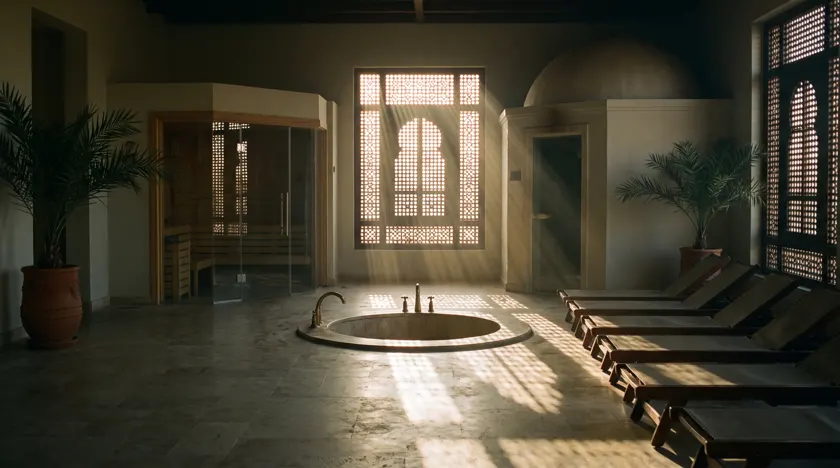
Build. A small hotel suite — sauna, steam room, two plunge positions, rest — needs about 40 to 60 square metres plus 10 to 14 of plant for a duplicated installation, and sits in our 1,250 to 2,700 thousand pound band. A full resort spa runs to 6,000.
The coastal premium is real: A4 stainless throughout, sealed and filtered plant enclosures, deeper cavities. Budget for it rather than discovering it.
Running. Energy, water, chemistry, cartridges, and on Egyptian mains a softener for the steam generator. The chiller is the seasonal line and on the Red Sea it is a big one from May to September.
Service. Three months here, not six, because salt and dust together are the hardest environment we work in. Plus a corrosion inspection at every visit.
People. At minimum one trained person who owns the log. This is the cost most often left out of the business case and the one most likely to decide whether the suite earns anything at all.
Take the annual running cost of the suite, add the build cost amortised over five years, and divide by your average achieved room rate. That is the number of additional room-nights a year the suite has to produce to break even.
Compare it with your current annual room-nights. If the answer is a low single-digit percentage, build it. If the suite has to lift occupancy by ten per cent to wash its face, be sceptical — and then run the same sum for a smaller version, because a well-executed sauna and plunge often clears the bar when a full circuit does not.
Building a large suite with single plant. One failure then closes a listed amenity in a full house, which on this coast in July is a serious problem. Duplicated plant and isolation on each room is the fix and it must be in the first drawing.
Specifying to an inland standard. Plated fixings and an open chiller on the Red Sea are a three-year installation sold as a fifteen-year one.
No water treatment. The generator will scale, and it will scale at the worst possible moment because that is when it is working hardest.
And staffing it as an afterthought. A spa without a trained operator is a maintenance liability that generates no revenue, which is the worst of both outcomes.
A lot of Red Sea properties already have a spa built fifteen years ago that no longer performs. Opening one up typically reveals a scaled generator, a membrane that failed at the corners, corroded fixings and an undersized chiller.
Refurbishing is usually far cheaper than building new and the arithmetic is easier, because the floor area already exists and the guest expectation is already set. It is also the moment to fix the specification properly rather than repeating the original mistakes.
We survey before quoting a refit, because a refit priced from a walk-through is a refit whose price changes in week two.
One well-built sauna, one properly insulated and shaded plunge with a correctly sized chiller, a rest area with shade and water, and the drainage, extract and electrical capacity for everything else you might add later.
That package is a fraction of a full circuit, it photographs well, it survives the climate, and it moves the property into the same search filter. Everything else can follow in a later phase — provided the services went in at the start, which is the one thing we would insist on regardless of budget.
A suite nobody measures cannot be defended at the next budget round. Decide before opening which four numbers you will track, and review them at six months alongside the first full service visit.
Treatment revenue per available room-night, rather than per treatment. It exposes a staffing problem faster than any other figure.
The share of direct enquiries that mention the spa. One question on the booking form, a season of answers, and you know more than any projection we could give you.
Review mentions, split positive and negative. 'Lovely spa' turning into 'the steam room smelled' is a ventilation or cleaning problem surfacing months before the plant actually fails.
Energy against occupancy. Chiller and generator consumption should track guests. If consumption stays flat while occupancy drops, something is running that should not be — a setpoint left low, a lid never used, a timer overridden.
Very few Egyptian resorts can take a spa offline for three months, and none can do it between May and September. So we phase by room.
The sequence that works: build the new plant room first, in a space that is not currently in use, and get it commissioned and isolated. Then take one wet room at a time, screened behind a dust barrier, with noisy work in agreed morning windows.
A sauna can be stripped and rebuilt in about a week while the steam room stays open; then the reverse. Guests lose one room at a time rather than the whole amenity, and the property never has to remove the spa from its listing.
It costs more than doing everything at once in a closed building. On this coast, where there is no closed season, that premium is simply what building a spa costs — and it is far less than the revenue lost by going dark in July.
Want this checked against your own room? Send us the dimensions and a photograph and we will come back with a drawing.
An honest continental price breakdown: what a sauna and cold plunge cost in eight African countries, what move…
Read more →
From Nairobi at 1,795 m to the Ngorongoro rim: why African highland saunas need a bigger heater, and why the s…
Read more →
An honest breakdown of sauna and cold plunge prices in Egypt: what sits inside 150,000 pounds, what pushes a p…
Read more →