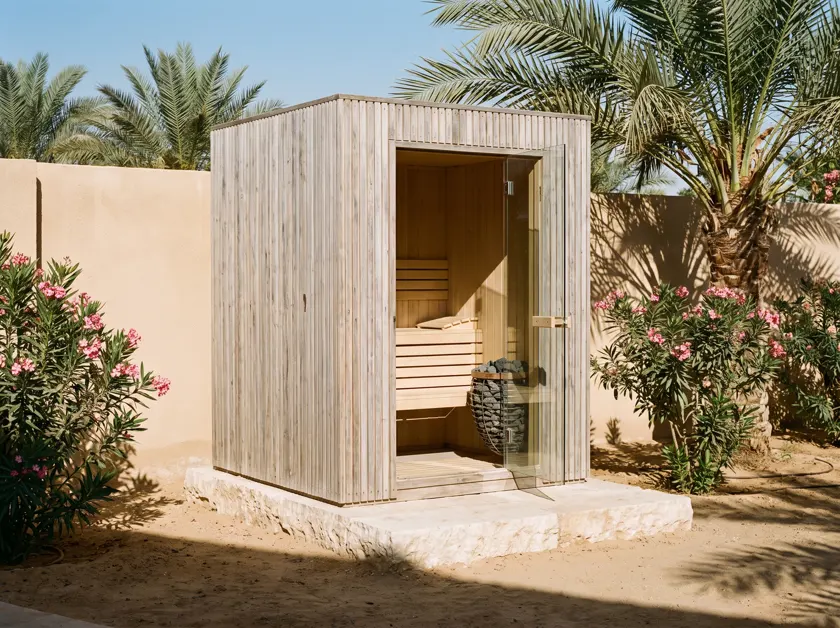
Saunas
Building a hot room in a country that is already hot sounds absurd until you use one. The trick is not the hea…
Read more →In Egypt the cold plunge is the room people use most, and the one most often bought wrong: a tub from a listing, a chiller rated at 25 °C, no lid. Here the order is insulation, shade and a lid first, then a machine sized for a 40 °C afternoon, then treatment for hard mains water.
Typical project in Egypt: EGP 95k – 1,400k, supplied and installed · six to ten weeks per room after the drawing is approved, plus shipping.
Across the continent: Cold plunges in all eight countries →
The water in a plunge warms from four directions: the air, the sun on its sides and lid, evaporation, and the bodies that climb in. In Egypt the first two dominate for five months of the year.
So the shell gets closed-cell insulation in its walls and under its floor, the lid is light enough to be put back every time, and the tub goes into shade — a pergola, a courtyard wall, a basement — before we choose a compressor. Done in that order, a modest chiller cycles on and off; done the other way round, a large one runs flat out and dies early.
| Format | Indicative, thousand EGP | What is inside |
|---|---|---|
| Timber tub, no chiller | 95 – 160 | Insulated shell and lid; properly cold only in winter |
| Tub with chiller | 175 – 380 | Chiller sized for 40 °C, filtration and ozone |
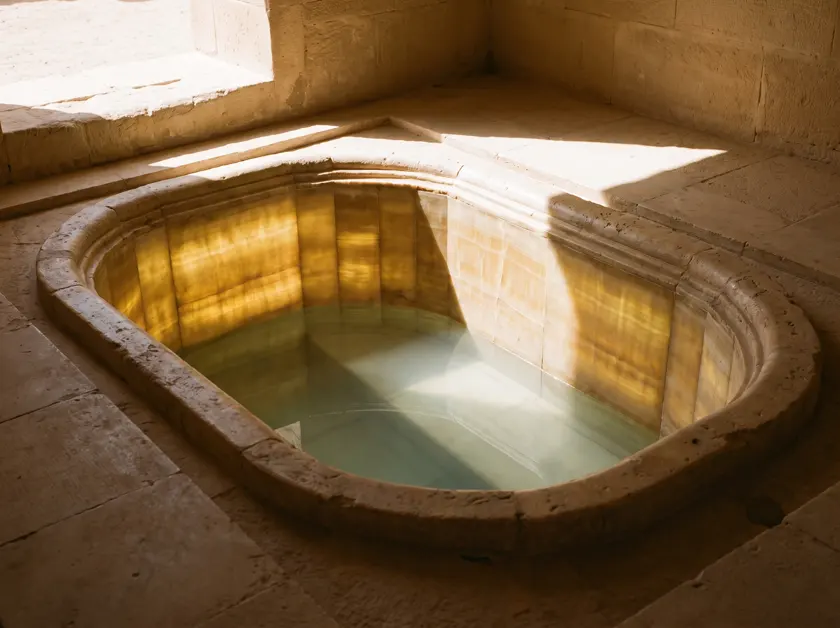
| Alabaster or stone basin, built in | 320 – 600 | Permanent, structure checked before quoting |
| Plunge pool, 6–8 person | 720 – 1 400 | Bench, ladder and its own plant room |
All figures include supply and installation; a survey confirms them. If you are weighing an ice bath for sale online against these, check three things before you buy: the chiller's capacity at 40 °C rather than at a laboratory 25, the heat exchanger metal (titanium for ozonated water), and who in Egypt will service it. Every tub and chiller we supply is tested at our factory in Istanbul before crating, and is covered for 24 months.
In Cairo the enemies are heat and dust. A New Cairo or Sheikh Zayed villa usually sets the tub beside the garden sauna under a pergola, or indoors in the basement suite where the air is already cooler; the chiller lives in a shaded, ventilated corner with washable pre-filters, because khamsin dust blankets a condenser in weeks. On a Zamalek or Heliopolis roof, the slab is checked before any water goes up.
On the Red Sea — El Gouna, Hurghada, Soma Bay, Sahl Hasheesh — salt joins the heat. Resort tubs get A4 stainless fixings, the chiller sits in a sealed, filtered enclosure, and every service visit includes a corrosion check. Summer occupancy on this coast runs above 90 per cent (Travel And Tour World), so a hotel ice bath is planned for the evening queue, usually with a second tub rather than a bigger one.
Warm air and hard mains water are tough on water quality. Every tub gets circulation, cartridge filtration and ozone or UV, and a rinse shower before the tub keeps sunscreen and sweat out of it. Hard water also scales the chiller's heat exchanger, so the descaling date goes into the handover notes alongside the filter changes.
A chiller in Egypt fails for one of two reasons: it was too small for the summer, or its condenser filled with dust. Both are preventable and both are extremely common.
On Egyptian projects the unit is an outdoor-rated chiller with a titanium heat exchanger, since ozonated cold water pits stainless, fed by insulated hoses that enter the tub low down; on the Red Sea the whole unit sits inside a sealed, filtered enclosure.
It runs to a setpoint in cycles and lets the insulated lid do the overnight work, which is the difference between a compressor with a life expectancy and one with a warranty period.
Washable pre-filters on the intake, the grille turned away from the prevailing wind, a shaded position with real clearance, and a three-month service interval instead of six. In khamsin season, check it after the storm rather than on the calendar.
Boxing a chiller into an unventilated cupboard is the fastest way to kill one in this country.
Clean the condenser, check pressures, replace the cartridge, test the ozone cell, inspect the hoses. An hour of work quarterly. On the Red Sea we add a corrosion inspection of fixings and the plant enclosure, because the salt there is more aggressive than the Mediterranean.
Chiller supply and installation on its own: indicative EGP 105k – 360k. How we size chillers across Africa →
Yes — shaded, insulated, lidded and with the chiller sized for it. In full sun with no lid, no, and we will say so before selling a unit that cannot win.
A 1–2 HP chiller draws roughly 1–2 kW. On an insulated, lidded tub in shade it might run six to ten hours a day in July and August — about 200 to 400 kWh a month. With EgyptERA's household tariff reaching about 2.1–2.6 EGP per kWh in the upper tiers (April 2026), that is several hundred pounds a month in peak summer and far less in winter. In full sun without a lid, expect roughly double.
With filtration and ozone, every four to eight weeks for a household tub, with top-ups in between. Hard Cairo water leaves scale on the heat exchanger and the ozone cell, so both are descaled on a fixed interval.
In a Cairo winter, often not for a 15–18 °C plunge. From May to October, yes — mains water alone is too warm.
Yes if parts are obtainable. Send the model number before you buy — the usual fault with a chiller bought online is that it was never big enough for an Egyptian summer.
About a domestic air-conditioning outdoor unit. On a roof terrace it disappears behind a screen.
Send us a photo of the spot and the rough size. Within one business day you get photos of comparable rooms we have finished and an itemised, position-by-position quote.
Building a hot room in a country that is already hot sounds absurd until you use one. The trick is not the hea…
Read more →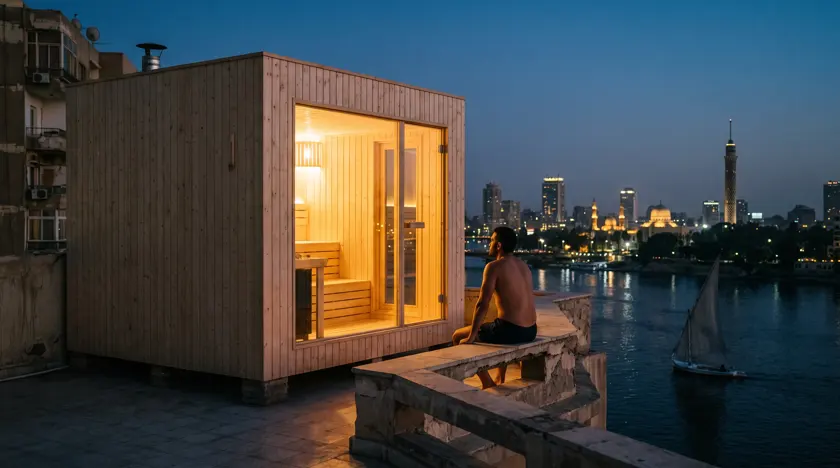
The flat roof is the most under-used room in an Egyptian building, and after sunset it is also the coolest pla…
Read more →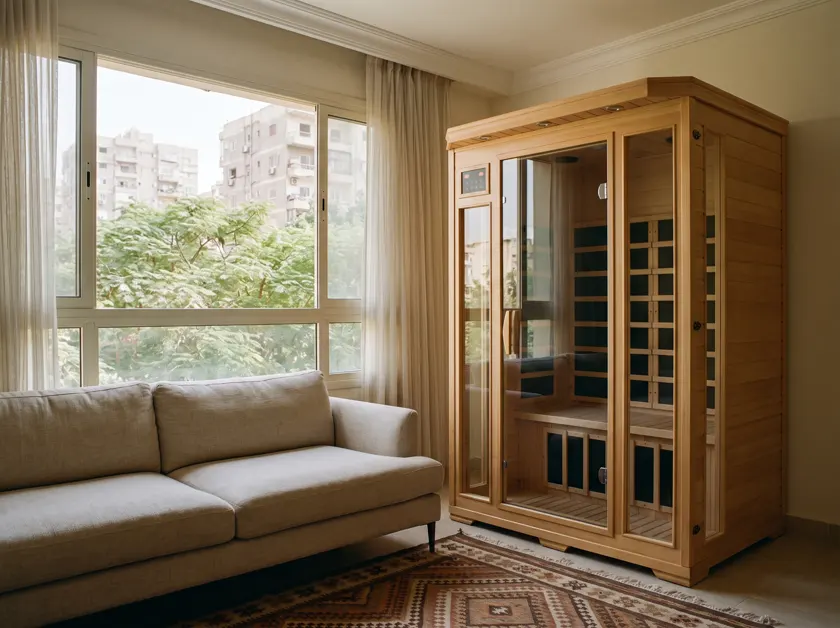
In Maadi, Zamalek or a Fifth Settlement compound flat, a Finnish sauna usually meets three problems at once: n…
Read more →