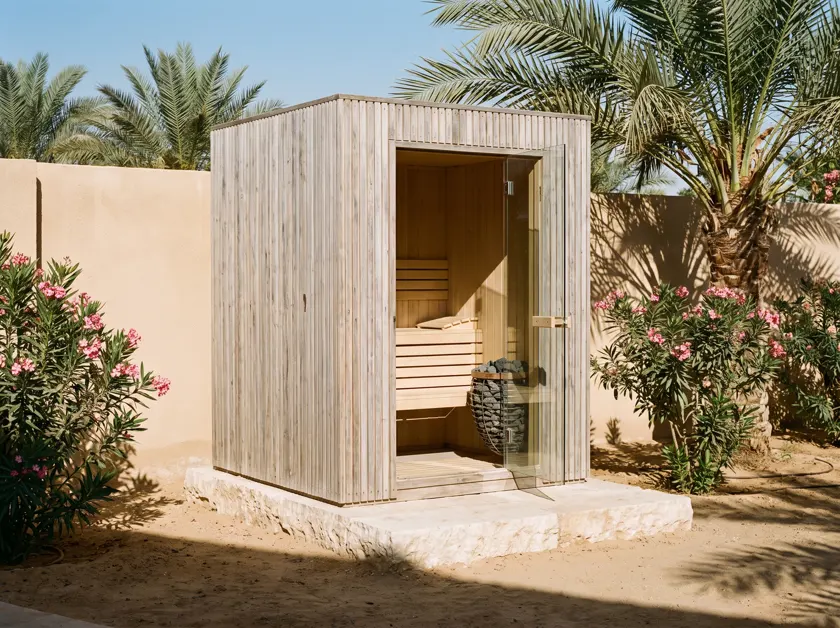
Saunas
Building a hot room in a country that is already hot sounds absurd until you use one. The trick is not the hea…
Read more →The FIP World Padel Report 2025 counts about 1,500 padel courts and 380,000 players in Egypt, and many of them sit inside gyms and compound clubs in New Cairo and Sheikh Zayed. When the courts, the weights floor and the squash boxes empty at the same moment, the recovery room has to take the whole wave.
Typical project in Egypt: EGP 320k – 720k, supplied and installed · six to ten weeks per room after the drawing is approved, plus shipping.
Across the continent: Gym & club recovery zones in all eight countries →
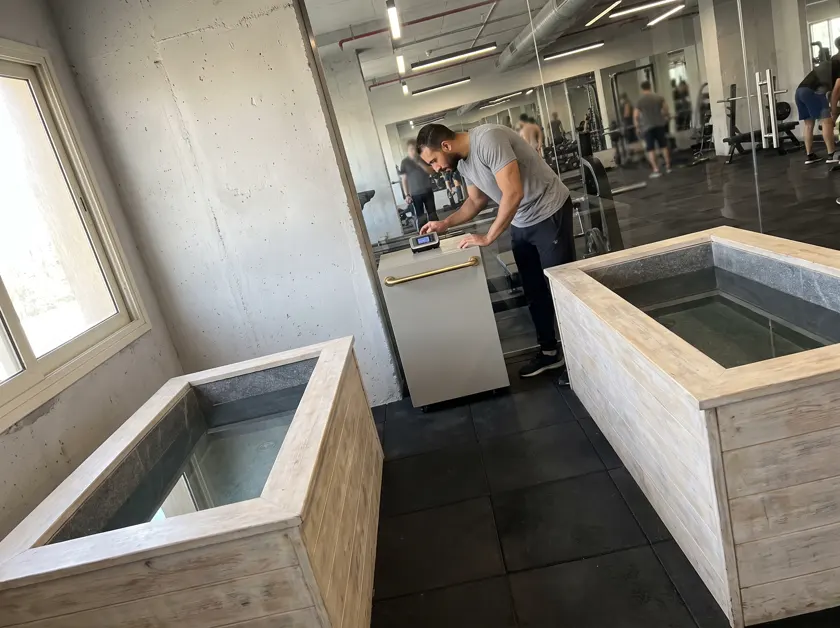
Cairo clubs rarely do one sport. A compound club may run padel, squash, a gym and a pool on one membership, and its peak comes after work and again late at night in Ramadan, when training moves after iftar.
We size the cold tubs on that busiest hour. A member spends two to four minutes in the cold, and with changeover a single tub serves ten to fifteen people an hour, so a club that empties six courts and a class together needs three tubs, not one.
In summer Cairo mains water is often well above 25 °C, so an unchilled tub is not a cold plunge from May to October. Every tub gets a chiller chosen for 40 °C ambient, an insulated shell and a lid that goes back on between waves, and an air-conditioned room roughly halves the chiller's work.
For football and squash squads who want 8–10 °C back to back, we move from packaged chillers to a small central plant with a buffer tank, so the water recovers between groups instead of drifting up through the evening.
Each filled tub with a bather in it weighs about a tonne, so on the upper floor of a mall gym or a compound clubhouse we ask for the structural drawing before we quote. Floors slope to a linear drain, tiles are a textured porcelain that shrugs off chlorine, and a rinse shower stands at the entrance.
Warm air multiplies bacteria. Circulation, cartridge filtration and ozone or UV are standard on every shared tub, with a test log on the wall that members can see.
Khamsin dust and ordinary Cairo grit choke condensers, so chillers sit in a ventilated plant room or a shaded yard with washable pre-filters, and the service interval is three months. Hard mains water leaves scale on the heat exchangers, which is why each tub gets a descaling date in the handover notes.
Indicative budget: 320 to 720 thousand EGP for two chilled tubs plus a sauna, installed; every further tub-and-chiller pair costs roughly 175 to 380 thousand more. Everything is made and pre-assembled in Istanbul before it ships to Alexandria or Port Said, and our crew fits it in a few days, so members barely notice the works.
Message us your court count, class timetable and a floor plan on WhatsApp; a layout and an itemised price come back within one business day.
Three for a club that empties six courts at once, two as an absolute minimum. One tub turns into a queue, and members stop waiting for it.
No. Most members are comfortable at 8–12 °C; colder water is for athletes under supervision. Every degree lower costs chiller capacity, so we agree the target first.
The chillers are the main line. As an illustration, two 2 HP units drawing about 3.5 kW together and running ten hours a day use roughly 1,000 kWh a month; at around 2.6–2.8 EGP per kWh on the commercial tariff (EgyptERA, April 2026) that is close to 3,000 EGP. Shade, lids and an air-conditioned room bring it down sharply.
Send us a photo of the spot and the rough size. Within one business day you get photos of comparable rooms we have finished and an itemised, position-by-position quote.
Building a hot room in a country that is already hot sounds absurd until you use one. The trick is not the hea…
Read more →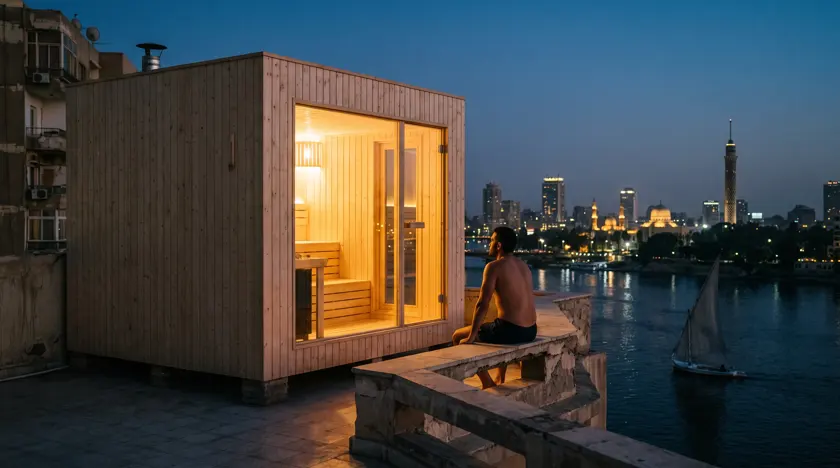
The flat roof is the most under-used room in an Egyptian building, and after sunset it is also the coolest pla…
Read more →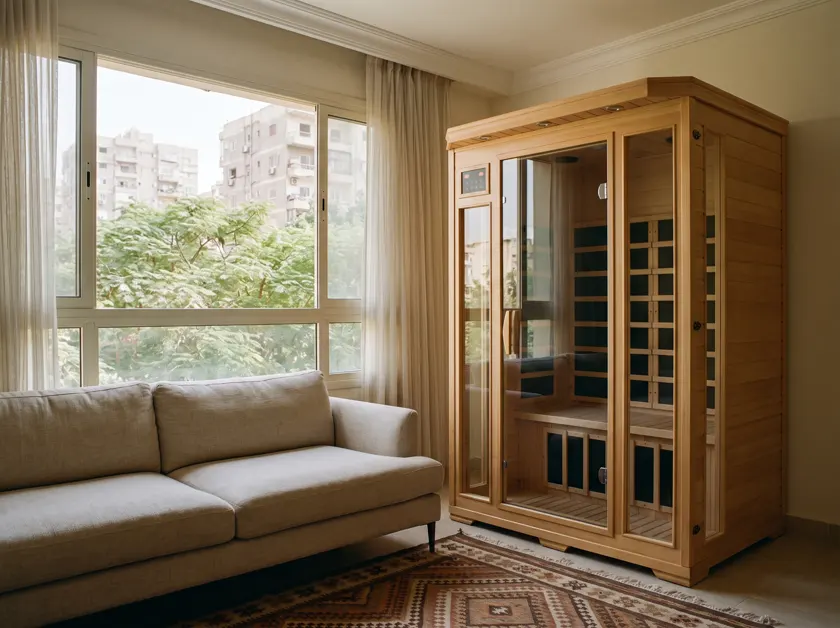
In Maadi, Zamalek or a Fifth Settlement compound flat, a Finnish sauna usually meets three problems at once: n…
Read more →