11 min
What a Sauna and Cold Plunge Cost Across Africa in 2026
An honest continental price breakdown: what a sauna and cold plunge cost in eight African countries, what move…
Read more →Most chiller sizing tables were written for temperate climates. Used unchanged in Egypt they produce a unit that runs continuously, never reaches setpoint in August and fails within three years.
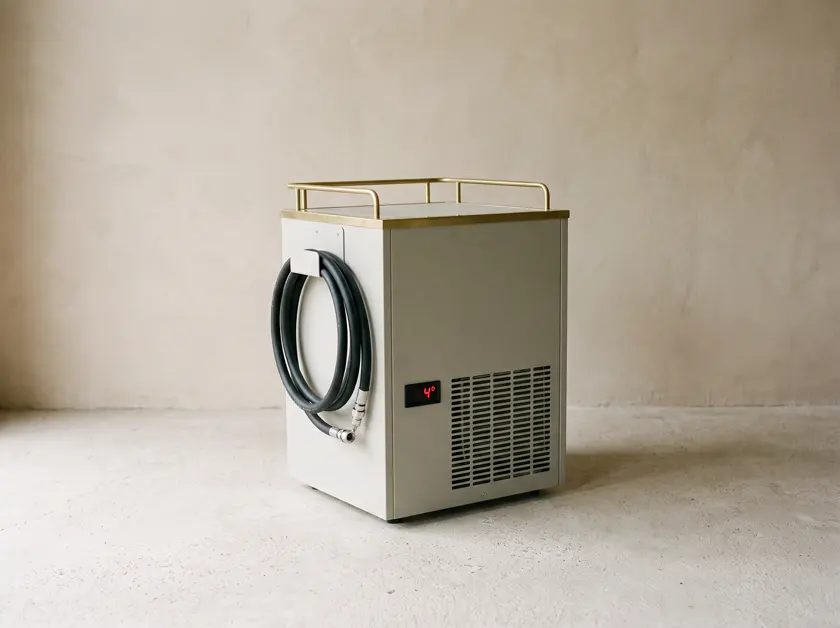
A chiller does not cool water in the abstract. It removes the heat that keeps arriving, and in a cold plunge that heat arrives from four places: the air around the basin, the sun on its surfaces, evaporation from the open water, and the people getting into it.
In a temperate country the first two are small. In Egypt they dominate. A basin held at 8 °C in a 40 °C Cairo afternoon is fighting a thirty-two degree gradient through every surface, plus direct radiation on anything the sun touches.
That is why the honest order of operations is insulation, then shade, then lid, then machine. Reversing that order is the most expensive mistake in this trade.
The figures everyone uses are roughly: 1 HP for tubs up to about 260 litres, 2 HP to about 570 litres, 4 HP to about 1,200 litres.
In Egypt we treat those as a floor and step up when any of the following apply: the basin sits in direct sun for part of the day, the target is 4-6 °C rather than 8-10, the basin is used back to back by a team or by hotel guests, or the installation is in Upper Egypt or on the Red Sea rather than on the Mediterranean.
Two or more of those and we go up a full size. It costs more on day one and it costs dramatically less over the life of the unit, because a compressor that cycles lives far longer than one that runs flat out.
Insulating the shell and the base is the single highest-return decision in the whole installation. A basin with closed-cell insulation in the walls and under the base, in shade, with a fitted lid, presents the chiller with a fraction of the heat load of an uninsulated one in the sun.
In practice that shows up three ways: the compressor cycles instead of running, the unit can often be a size smaller, and the electricity bill in August stops being alarming.
The lid deserves a paragraph of its own. It is the cheapest component in the system and it saves the most, and almost everyone stops using it within a month because the one they were given is too heavy. We make ours light enough to lift with one hand for exactly that reason.
A pergola, a screen, a wall, a mature tree — anything that keeps direct sun off the basin and the plant for the hottest six hours of the day is worth more than the next size of machine, and it costs less.
It also matters where the chiller itself sits. A unit in full sun is trying to reject heat into air that is already hot, which is the definition of working hard for nothing. Shaded, ventilated and with clearance on the grille side is how a chiller is meant to live.
None of this survives contact with a blocked condenser. Fine dust on the desert edge and in khamsin season blankets a condenser in weeks, and a blanketed condenser cannot reject heat no matter how big the compressor is.
So: washable pre-filters on every intake, the grille turned away from the prevailing wind, real clearance rather than a decorative cupboard, and a three-month service interval. In khamsin season, check after the storm rather than on the calendar.
We have opened units in Sheikh Zayed that were three months old and already losing a third of their capacity to dust. The compressor was fine. It simply could not get rid of the heat.
Warm ambient plus hard water plus heavy use is the worst combination for water quality. Cold water does not hide anything, and a shared basin without treatment becomes unpleasant quickly.
Circulation, cartridge filtration and an ozone or UV stage on anything used by more than one household. A rinse shower at the entry point turns a weekly water change into a monthly one, and it costs almost nothing to install at build time.
A 700-litre basin on a New Cairo roof terrace, target 8 °C, used by a family in the evening, shaded by a pergola, insulated shell and base, fitted lid.
The table says 4 HP for 700 litres. Shade, insulation and a lid pull the real load down substantially, but the Cairo ambient pushes it back up, and the roof position means more sun exposure than a ground-level courtyard. We would install 4 HP and expect it to cycle comfortably — not 2 HP because the basin is small, and not 6 HP because somebody was nervous.
The same basin unshaded, uninsulated and without a lid would need more machine than we would be willing to sell, and would still disappoint in August. That is the whole argument of this article in one comparison.
A domestic basin is loaded by ambient, sun and two or three people a day. A gym or hotel basin adds a body-heat load that is continuous through the peak, and every person who gets in brings warm water and warm skin with them.
For commercial work we size on the peak hour rather than the daily average, which usually means a step up from the domestic answer for the same volume, and often a larger circulation pump so the cold water actually moves rather than stratifying around whoever is sitting in it.
We also specify recovery time as a number in the handover: how long the basin takes to return to setpoint after a squad has been through it. If that number is longer than the gap between sessions, the installation is undersized regardless of what the label says.
Ask for the rated capacity at an ambient that matches your site, not at the manufacturer's test condition. A unit rated at 25 °C ambient delivers meaningfully less at 40, and reputable manufacturers publish a derating curve.
Ask what the heat exchanger is made of. Titanium for cold, circulating, ozonated water; stainless will pit under those conditions and it is not a theoretical risk.
Ask what the condenser needs for airflow and clearance, and then look honestly at where you intend to put it. Most chiller failures in Egypt are siting failures wearing a compressor's clothes.
And ask about the controls: a unit that can hold a setpoint and cycle is a different machine from one that runs until switched off, and only one of those has a long life in this climate.
Want this checked against your own room? Send us the dimensions and a photograph and we will come back with a drawing.
An honest continental price breakdown: what a sauna and cold plunge cost in eight African countries, what move…
Read more →
From Nairobi at 1,795 m to the Ngorongoro rim: why African highland saunas need a bigger heater, and why the s…
Read more →
An honest breakdown of sauna and cold plunge prices in Egypt: what sits inside 150,000 pounds, what pushes a p…
Read more →