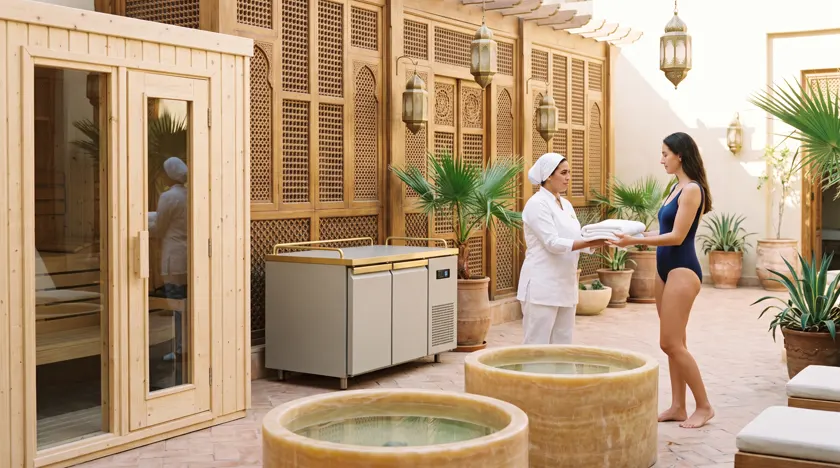
Mediterranean
North Coast, New Alamein & Alexandria
Saunas, steam rooms and cold plunges for Sahel villas, New Alamein towers and Alexandria homes: Mediterranean …
Read more →Greater Cairo holds most of Egypt's private wellness projects: villas and compounds in New Cairo, Katameya and Sheikh Zayed, apartments in Maadi, Zamalek and Heliopolis. The heat is the same across the city; what changes from district to district is the lift, the slab, the dust and what the compound management will approve.
In this guide: New Cairo · Katameya & Palm Hills · Sheikh Zayed & 6th October · Zamalek · Maadi · Heliopolis
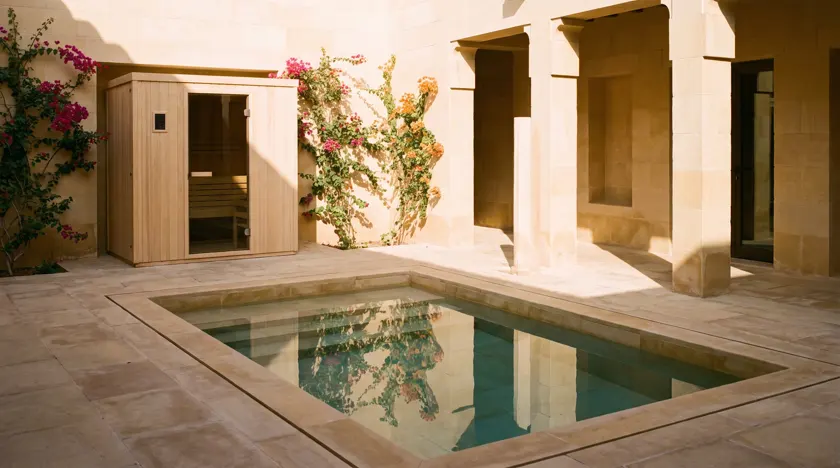
East of the city — New Cairo, the Fifth Settlement, Katameya — the typical project is a basement wellness suite or a garden cabin with a cold plunge inside a gated compound, which means an approval pack and restricted working hours. West, in Sheikh Zayed and 6th of October, the plots are larger and the desert edge brings more dust, so plant siting and filters matter more. In the older centre — Zamalek, Garden City, Heliopolis, Maadi — the work is apartments and roofs: infrared cabins, compact saunas, and plunge tubs only where the structure allows.
Villas generally have 380 V three phase; apartments run 220 V single phase from a board that is often near its limit. Many compounds have standby generators, and a 6–9 kW heater plus a 1–2 HP chiller is a load the facility manager should know about before the first power cut.
| Room | Indicative, thousand EGP | Typical Cairo setting |
|---|---|---|
| Infrared cabin, 2 person | 70 – 120 | Maadi or Zamalek apartment |
| Sauna, 4 person, one glass wall | 225 – 340 | New Cairo garden or basement |
| Plunge tub with chiller | 175 – 380 | Beside the sauna, in shade |
| Home wellness suite, one wall | 540 – 1 100 | Katameya or Sheikh Zayed basement |
| Villa wellness suite, full | 1 150 – 2 400 | Sauna, steam, plunge, plant behind one panel |
Indicative, supplied and installed with VAT inside; confirmed after a survey in person or by video.
Crates for Cairo land at Alexandria or Port Said, clear customs and come in by road. Each room takes 6–10 weeks from drawing approval to commissioning, including the factory build in Istanbul and the sea leg; a complete villa spa takes 12–16 weeks. Compound approvals and working-hour limits go into the programme from the start. Send us a photo of the space and the board, and a project manager replies within one business day with a first itemised figure.
New Cairo is the easiest ground in Egypt to build a wellness room on: level plots, modern concrete, vehicle access and, usually, three-phase already at the board.
A great deal of this work happens while the house is still being finished, which is the cheapest possible time. Drainage with a fall, a three-phase run and a level plinth cost almost nothing in an open trench and a great deal afterwards.
We would rather talk to your contractor in month three than be handed a finished basement with no drain in it.
Most of New Cairo is gated compounds with their own standards for external works, plant noise and contractor access. We prepare the submission — dimensioned drawing, elevation, plant position and a noise figure — because a cabin refused after delivery is an expensive lesson.
Working hours are usually restricted, which adds a few days. That goes in the programme rather than being discovered on day one.
Villas here almost all have a lower ground floor, and it is the right place for a wellness suite: stable temperature, no direct sun, services still accessible. The two questions are whether there is a fall to a sewer or we need a pump, and where the extract duct comes out.
The golf compounds east and west of Cairo are large modern villas with basements, and almost everything we build here goes indoors and stays invisible.
A lower ground floor is the right room: stable temperature, no direct sun, and in these houses the services are usually still accessible. Our layout is a short corridor with sauna, steam and plunge off one wall and a bench opposite — one drainage line, one plant panel.
The decisions that matter are made in the build drawing: a drain with a fall, a ducted extract with a run-on timer, and a cable run back to the board.
Where the villa looks onto a fairway, a glass wall is the obvious move and it is also the expensive one — more frame, more sealing and a bigger heater. We show the heater difference in the quote so the decision is made with the number visible.
Plant noise is the thing neighbours notice. We site units internally or behind planting on the house side, with the grille facing away from boundaries, and we submit a noise figure with the drawing.
West of the Nile the plots are generous and the dust is worse. Sheikh Zayed and 6th October sit on the desert edge, and everything with a fan in it feels that.
The desert edge means fine dust most of the year and heavy dust in khamsin season. A chiller condenser here blankets in weeks rather than months.
We fit washable pre-filters, put grilles away from the prevailing wind, keep units shaded and clear, and service quarterly instead of half-yearly. In khamsin season we check after the storm rather than on the calendar.
A cabin in full sun on this side of the city is unusable before nine in the evening and expensive to cool anything next to it. We design a pergola or a screen at the same time as the cabin, because shade added later never looks deliberate.
Planting helps as much as structure. A row of mature trees on the west side is worth more than another size of compressor.
Gardens here take the full arrangement — cabin, plunge, rinse shower and a shaded bench — without losing the lawn. That completeness is what turns a room used twice a week into one used most evenings.
Zamalek is old Cairo on an island: beautiful buildings, small lifts, narrow stairwells and structures that were never designed for what we are carrying up them.
Before we quote anything here we measure the lift car, the landing turn and the first three metres of stair. A 2.4 m panel that will not turn on a landing is an expensive lesson, so cabins in Zamalek are usually built in smaller sections with more site assembly.
Where there is no lift at all, everything goes up by hand and that is a labour line in the quote rather than a surprise.
Many buildings here predate modern concrete practice. A cabin is light and almost always fine; a plunge tub full of water is nearly a tonne on a small footprint and needs a structural opinion before we will install it.
On roof terraces we spread the load over walls rather than mid-span and use steel feet that also lift the timber clear of standing water.
A roof terrace in Zamalek looks over the Nile. Orient the glass to it, keep the cabin low enough not to annoy neighbours, and the room sells itself every evening.
Maadi is leafy, low-rise and full of households on three-year postings. That shapes the brief more than the buildings do.
When the occupant is on a posting, the question is what happens at the end of it. We build a demountable specification — bolted frame, single service connection point, nothing chased into the structure — so the room can come out without making good.
For a rented flat, an infrared cabin is usually the honest answer: it plugs in, it needs no drain and it goes in the container when you leave.
Most Maadi apartments have a single-phase supply that will not carry a 9 kW heater. A 6-8 kW cabin on a dedicated circuit is possible where the supply and cable allow; above that it is an application, which is worth doing only if you own.
The garden villas here have mature shade, which is a gift. A cabin under trees on this side of the city stays usable through the afternoon and the plunge beside it holds temperature on far less compressor time.
Heliopolis is early-twentieth-century Cairo — arcaded facades, generous ceilings, and service runs that were designed for a different century.
High ceilings are a gift for a wet room: there is room to pitch a ceiling properly and to run a duct above it. What is not a gift is the electrical capacity, which in many of these buildings is at its limit before a 9 kW heater is added.
We survey the board and the incoming supply before promising anything, and in a building like this the honest answer is often a smaller cabin rather than an upgrade application.
Many of these buildings have internal courtyards that solve ventilation and daylight at once. Putting the extract and the plant there rather than on a street facade keeps the building's face intact, which matters in this neighbourhood.
Heliopolis sits on busy roads and everything collects fine grit. Smooth cleanable surfaces, washable filters and a quarterly service are the same discipline as the desert edge, for a different reason.
Usually, with a dimensioned drawing, an elevation, the plant position and a noise figure. We prepare that pack for the management before anything ships.
Yes, if the load is declared. We give your facility manager the heater and chiller ratings so the generator and the changeover can take them.
Often the best: cooler, no direct sun, services close by. The questions are whether there is a fall to the sewer or a pump is needed, and where the extract duct can leave the building.
Yes for the services, at minimum. Drain and cable in an open trench is the cheapest decision in the whole project.
Usually the best place. We check the fall to the sewer and the route for the extract duct first.
Bad enough to change the service interval. Quarterly here, and after every khamsin.
We measure the car, the landing turn and the stair before quoting. Where it will not fit, the cabin comes in smaller sections.
Yes, on the demountable specification, or choose infrared which simply unplugs.
Often not without work. We survey the board before promising anything and sometimes recommend a smaller cabin instead.
Tell us the neighbourhood, send a photo of the space and the rough size. We reply within one business day with photos of comparable finished rooms and an itemised quote.
Saunas, steam rooms and cold plunges for Sahel villas, New Alamein towers and Alexandria homes: Mediterranean …
Read more →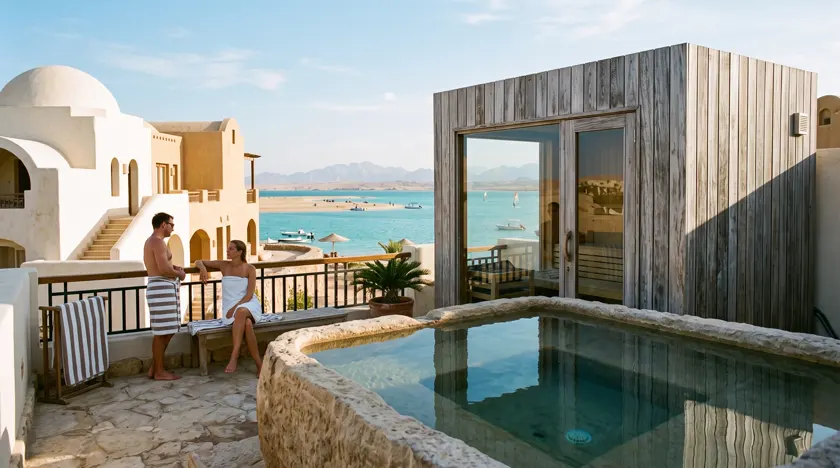
Saunas, steam rooms and cold plunges for El Gouna, Hurghada, Soma Bay, Sharm and Sokhna resorts and Nile lodge…
Read more →