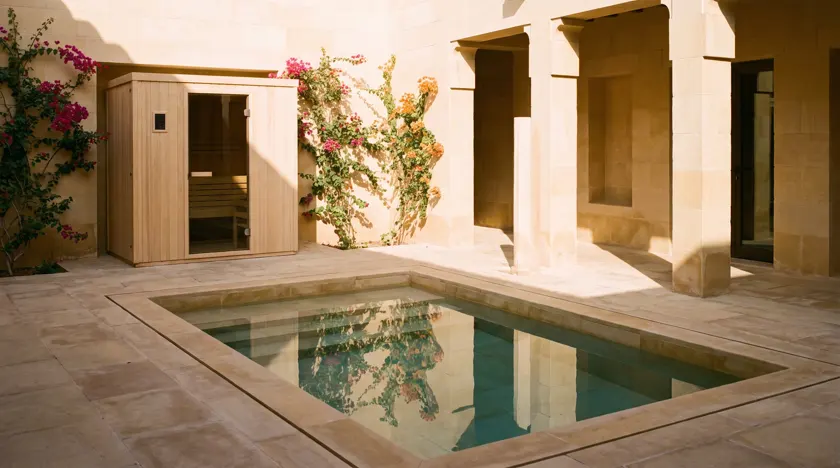
Greater Cairo
New Cairo & Greater Cairo
Saunas, steam rooms and cold plunge tubs for New Cairo, Sheikh Zayed, Katameya, Maadi and Zamalek homes. Facto…
Read more →The Red Sea coast and Upper Egypt are resort country: El Gouna's lagoons, Hurghada's hotel strip, Soma Bay and Sahl Hasheesh at the top of the market, Sharm across the gulf, Sokhna two hours from Cairo, and the Nile hotels of Luxor and Aswan. Salt, dust and heat work together here, and the specification has to answer all three.
In this guide: El Gouna · Hurghada · Soma Bay & Sahl Hasheesh · Sharm El-Sheikh · Ain Sokhna · Luxor & Aswan
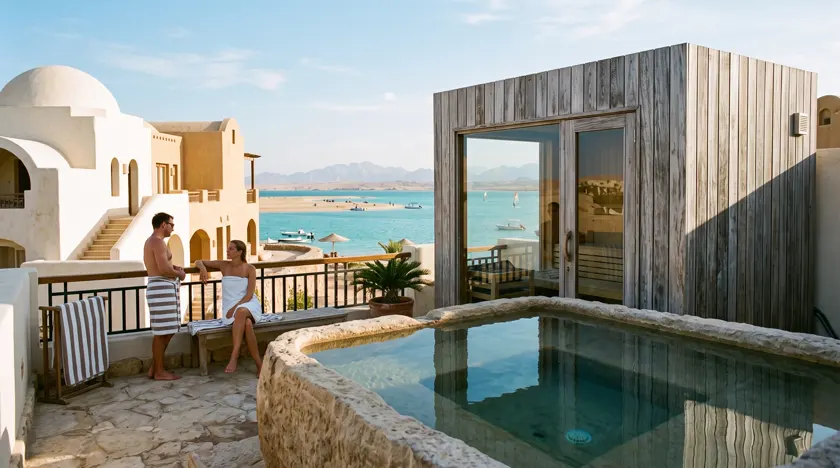
Hurghada, El Gouna and Soma Bay are hotel work first. Summer occupancy on the Red Sea runs above 90 per cent (Travel And Tour World), so suites get duplicated plant, isolation on every room and documentation for the operator. Sharm has many spa floors built fifteen or more years ago that now need refitting. Ain Sokhna is weekend villas used two days a week, which calls for schedulers and holding setpoints. Luxor and Aswan are the hottest sites we build for, where the cold plunge comes first and the sauna is a winter room.
Hotels have three-phase supply and standby generators, and we list every heater and chiller load for the standby changeover. Fixings are A4 stainless, plant sits in sealed, filtered enclosures, and each service visit includes a corrosion check.
| Room | Indicative, thousand EGP | Typical use |
|---|---|---|
| Plunge tub with chiller | 175 – 380 | Villa terrace or lodge courtyard |
| Steam room in limestone, 4–6 | 395 – 760 | Resort spa |
| Commercial sauna, 10–14 person | 540 – 1 150 | Hotel pool deck or gym |
| Hotel thermal suite, small | 1 250 – 2 700 | Boutique hotel or Nile lodge |
| Resort spa, full | 2 800 – 6 000 | Duplicated plant and service contract |
| Red Sea corrosion inspection | 14 – 26 | Per service visit |
Indicative, supplied and installed with the marine specification inside the figure.
Crates for the Red Sea come through Sokhna and travel down the coast road; loads for Luxor and Aswan leave the port as one planned delivery with a spares allowance, because nobody drives back for a bracket. A single room takes 6–10 weeks from drawing approval; hotel suites follow the construction programme and are phased around occupancy. Send us the floor plan and guest numbers, and a project manager replies with an itemised proposal within one business day.
El Gouna runs all year and sits on water that is saltier than the Mediterranean. Both of those facts change what we specify and how often we come back.
The Red Sea runs around 40 parts per thousand, above the Mediterranean and well above the world ocean average. Equipment that lasts in Alexandria will not last here on the same specification.
A4 stainless throughout, including fixings nobody sees. Sealed plant enclosures with filtered ventilation. Deeper ventilated cavities behind cladding. Every end grain sealed. And a corrosion inspection built into every service visit rather than offered as an extra.
El Gouna does not empty out, so there is no quiet window to build in. Work is phased, screened and scheduled around occupancy, and noisy operations go into agreed morning windows.
For hotels that means duplicated plant and isolation on each room, because a suite that closes in a full house is a listed amenity going missing.
Houses on the lagoons sit close to the water table, which matters for any sunken basin. We check the ground conditions before designing anything below finished floor level, and often the honest answer is a raised basin rather than a sunken one.
Hurghada is volume. Resort occupancy on this coast runs above 90 per cent in summer, and a spa here is a piece of operating plant, not a decorative room.
Everything is specified for throughput: commercial generators, duplicated plant so nothing closes, finishes that survive daily deep cleaning, drains that lift and rod, and a documented water regime with somebody's name against it.
Isolation on each room is not optional. In a full resort, one failure closing an entire listed amenity is a revenue problem within a day.
Hurghada gives you both: Red Sea salt in the air and desert dust off the land. Salt attacks metal, dust chokes condensers, and the two together are the hardest environment for plant that we work in anywhere.
Sealed enclosures with filtered ventilation, A4 stainless throughout, washable pre-filters, and a three-month service interval. In practice we visit the Red Sea properties in scheduled blocks so the travel is shared.
Resort maintenance teams change. We train two days at handover, leave a written operating manual and a log book, and return at six months — because a suite run by somebody who was never shown how is a suite that will be broken by year two.
Soma Bay and Sahl Hasheesh compete at the top of the Red Sea market, where guests arrive having chosen the property for the spa rather than discovering it afterwards.
At this level the suite is a reason to book, which changes the brief from adequate to memorable: stone rather than tile, backlit alabaster rather than a light fitting, a circuit that flows rather than a corridor of doors.
It also changes the documentation. Brand standards mean water testing regimes, recorded temperatures, and a plant room that an auditor can walk into.
Stone behaves well here; metal does not. So the design leans on limestone, alabaster and microcement, with metal kept to A4 stainless and brass that is expected to patinate. Chrome on this coast looks tired within two seasons.
Every enclosure is sealed and filtered, and every service visit includes the corrosion inspection.
These properties rarely empty. We phase by room, screen everything, and keep the guest circulation route clean — which on a luxury property is half the job.
Sharm has a lot of existing spa rooms, many of them fifteen years old or more, and much of the demand here is refurbishment rather than new build.
Opening up an old Sharm spa usually reveals the same four things: a steam generator scaled solid, a membrane that was never properly formed at the corners, fixings that have corroded through, and a chiller two sizes too small that has been running flat out for years.
We survey before quoting and we tell you which of those you have, because a refit priced from a walk-through is a refit that changes price in week two.
Where a property cannot close its spa, we phase by room and work behind screens. A sauna can be rebuilt in a week while the steam room stays open, then the other way round.
A refit is the moment to fix the specification: A4 stainless throughout, a sealed and filtered plant enclosure, water treatment for the generator, insulation and a lid for the plunge, and a service interval that matches the coast rather than a European manual.
Ain Sokhna is Cairo's weekend coast: two hours from the city, used hard on Friday and Saturday and empty the rest of the week. Intermittent use is its own engineering problem.
A suite used two days a week and left for five needs a different control strategy from one used daily. Heaters get schedulers so the cabin is warm on arrival; plunges get a holding setpoint rather than being switched off and on, because pulling a basin from thirty degrees back to eight takes longer and costs more than holding it.
We also specify a dry-down routine: the extract runs on after the last session, and the room is closed properly rather than shut wet on a Saturday night.
Where owners want it, we fit simple remote monitoring so a temperature or a leak alarm reaches a phone in Cairo rather than being discovered the following Friday. It is not expensive, and it turns a failed chiller into a Wednesday phone call instead of a ruined weekend.
The coast here is the Gulf of Suez and the salt load is a Red Sea one, so the specification is marine. The advantage over Hurghada is distance: Sokhna is where Red Sea crates come ashore, so delivery is a short road leg.
Upper Egypt is the hottest place we build. Summer temperatures here make a cold plunge the headline product and a sauna the room people use in January.
Our recommendation for most Luxor and Aswan properties is to build the cold plunge and the shaded rest area first, and add a sauna afterwards if guests ask for it. Coming off a day in the Valley of the Kings, cold water is the product.
That inverts the usual order and it is the honest advice for this latitude.
Everything is prefabricated and dry-assembled in our Istanbul factory and sent south in one planned load with spares — an element, a thermostat, a cartridge, a pump seal — because nobody drives back for a bracket.
We also leave a written spares list with part numbers so a local maintenance team can handle common failures between our visits.
This is where Egyptian alabaster comes from. A backlit alabaster niche in a Nile lodge is a material argument the guest can see, made from stone quarried within sight of the property.
Sokhna for the Red Sea coast and, by road, for Luxor and Aswan. The Incoterm, freight and clearance are itemised in the quote.
Yes. We phase room by room behind dust screens, with noisy work in agreed morning windows, so guests lose one room at a time rather than the whole suite.
A4 fixings, sealed and filtered plant enclosures, deeper cavities and sealed end grain. It is itemised, and it costs far less than replacing hardware and cladding in year three.
On inland specification, dramatically. On marine specification, no shorter than anywhere else — that is the point of the specification.
Every three months, in scheduled blocks so several properties share the travel.
Yes — documented plant, water testing regime, recorded parameters and a log an auditor can read.
Usually, and it is far cheaper. A sound carcass is worth re-lining; scaled plant is worth replacing.
Yes, with a scheduler. Set it from your phone on the drive down.
In winter, absolutely. In July the cold plunge is what gets used, which is why we build that first.
Tell us the neighbourhood, send a photo of the space and the rough size. We reply within one business day with photos of comparable finished rooms and an itemised quote.
Saunas, steam rooms and cold plunge tubs for New Cairo, Sheikh Zayed, Katameya, Maadi and Zamalek homes. Facto…
Read more →
Saunas, steam rooms and cold plunges for Sahel villas, New Alamein towers and Alexandria homes: Mediterranean …
Read more →