
11 min
What a Sauna and Cold Plunge Cost Across Africa in 2026
An honest continental price breakdown: what a sauna and cold plunge cost in eight African countries, what move…
Read more →More steam generators die in Egypt from water than from anything else. It is entirely predictable, entirely preventable, and almost never designed around.
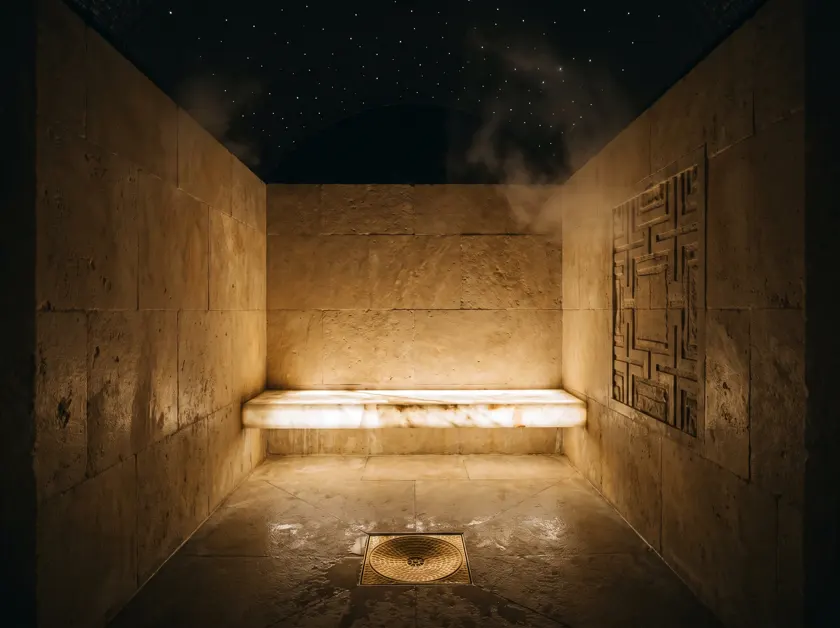
A steam generator boils mains water and sends the vapour into the room. Everything that was dissolved in that water stays behind in the tank — calcium, magnesium, and whatever else the supply carries.
Over cycles the concentration climbs until minerals come out of solution and deposit on the hottest surface, which is the element. Scale on an element is an insulator: the element runs hotter to push the same heat through it, which makes it fail, and the scale keeps building because a hotter surface precipitates faster.
That is the whole failure mechanism, and it is a race between the rate of scaling and the interval at which somebody removes it.
Much of Egypt's mains water is hard and carries a high level of dissolved solids. The exact figures vary by governorate and by season, and a property on a well or a desalination supply on the coast is a different case again.
So the first thing we do on a steam project is test the actual water at the actual property rather than assuming. It takes ten minutes and it changes the specification.
Softening. An ion-exchange softener on the feed to the generator removes the hardness before it ever reaches the tank. It needs salt topping up and occasional servicing, and it is the most reliable answer for a commercial installation.
Automatic drain and flush. Most decent generators can be set to dump part of their tank on a schedule, carrying concentrated water away before it precipitates. It is not a substitute for softening on hard supply, but it dramatically extends the interval.
Manual descaling. The traditional answer: periodically dissolve the scale with an appropriate acid, flush, refill. It works, it is cheap, and it depends entirely on somebody actually doing it.
For a household: automatic drain and flush, plus a manual descale at an interval set by the actual water test — typically every three to six months untreated. The interval goes in the handover notes with the date of the first one.
For a hotel or resort: a softener, because the volume of use means manual descaling would have to happen monthly, and because a commercial suite that closes for a generator failure costs real money. We also specify a spare generator on any installation where the suite is not allowed to close.
In both cases we size the generator knowing what it will be fed, because a unit chosen on volume alone and then fed hard water will not deliver its rated output for long.
Longer time to first steam. Reduced steam volume at the same setting. A rattling or knocking sound from the tank as water boils around deposits. The safety valve lifting when it never used to. And, eventually, an element failure.
Any of those means open it up now rather than at the next scheduled visit. Scale that has gone hard is far more work to remove than scale caught early, and the element is usually already damaged by the time the symptoms are obvious.
Isolate and drain the tank. Fill with an appropriate descaling solution at the right concentration and dwell time — too weak does nothing, too strong attacks the tank and the seals. Flush thoroughly, several times, because residue left in a steam generator ends up in the room.
Inspect the element and the probe, replace seals that have hardened, refill and test through a full cycle. It is an hour or two of work and it is not a job to improvise with kitchen products, which is the single worst thing we find when we open somebody else's installation.
A softener plus its servicing over five years costs a fraction of a replacement commercial generator, and considerably less than the revenue lost when a resort suite closes in peak season.
A domestic descaling regime costs a service visit two to four times a year. The alternative is a new generator every two to three years plus the wet-trade disruption of replacing it.
There is no version of this arithmetic where ignoring the water is the cheaper option. That is why we put it in the specification rather than the maintenance leaflet.
We test at the property before specifying, because supply varies by governorate, by season and by whether the building is on mains, a well or a desalination plant.
The two figures that matter are total hardness and total dissolved solids. Hardness tells you how fast scale will form on the element. TDS tells you how quickly the tank concentrates and therefore how often it needs to dump or be flushed.
A coastal property on desalinated supply is a different case again: low hardness, but often aggressive water chemistry that attacks the tank instead of scaling it. The answer there is not a softener but the right tank material and a corrosion inhibitor, and getting that backwards is a mistake we have been called in to correct.
Scale does not stay politely inside the generator. A scaling unit produces less steam, so the room takes longer to reach temperature and never quite gets humid enough, and guests describe it as weak rather than broken.
Carry-over is the other symptom: water droplets rather than vapour arriving through the steam head, which is unpleasant and, on a hot head, noisy. It is almost always a tank that is over-concentrated and needs dumping.
So the specification is not only about protecting the machine. It is about the room continuing to feel the way it felt on the day it was commissioned, which is what the client actually bought.
We commission with a measured steam-up time and write it in the handover notes. When somebody calls two years later to say the room feels weak, that number is how we tell scale from a control fault in one question.
It is worth saying plainly what the alternative looks like, because we see it often. A generator installed with no treatment on hard mains, descaled once in year one by somebody enthusiastic, then forgotten. By year two the steam-up time has doubled and nobody notices because it happened gradually. By year three the element fails mid-season, the replacement takes a fortnight to arrive, and the room that was the reason guests chose the property is closed while they are in it.
None of that is bad luck. It is a specification decision made at drawing stage, for a few thousand pounds, several years earlier.
Want this checked against your own room? Send us the dimensions and a photograph and we will come back with a drawing.
An honest continental price breakdown: what a sauna and cold plunge cost in eight African countries, what move…
Read more →
From Nairobi at 1,795 m to the Ngorongoro rim: why African highland saunas need a bigger heater, and why the s…
Read more →
An honest breakdown of sauna and cold plunge prices in Egypt: what sits inside 150,000 pounds, what pushes a p…
Read more →