11 min
What a Sauna and Cold Plunge Cost Across Africa in 2026
An honest continental price breakdown: what a sauna and cold plunge cost in eight African countries, what move…
Read more →Nobody publishes hammam prices in Morocco, so every conversation starts from nothing. Here is the arithmetic we use, including the lines people are most surprised by.
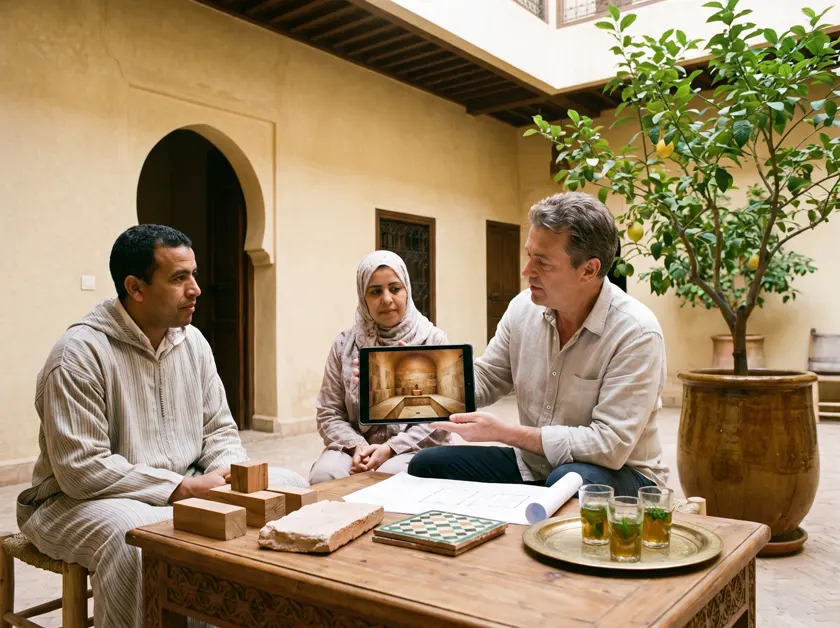
The first number is not marble or zellige. It is whether the room you have can become a wet room at all. A hammam is a tanked box with a heated slab in it, and three things decide whether that is a finishing job or a building job: is there a drain with a fall to it, is there a route for a mechanical extract, and can the floor carry the weight.
If all three exist, you are buying finishes and plant. If none do, you are buying demolition first. That is the single biggest spread in our quotes and it has nothing to do with taste.
In a riad the answer is usually good. Courtyards drain centrally, walls are thick and floors are solid over made ground. In a modern apartment the answer is often no, and we will say so rather than sell you a room that will leak into the flat below.
The göbek taşı is the room. A slab of marble, raised, with a heating loop or an electric mat set into the screed beneath it, running at 40 to 45 degrees on the surface.
Getting that even is the craft. The perimeter of a slab loses heat to the room far faster than the middle, so the loop spacing tightens at the edges — if it does not, you get a slab that is pleasant in the centre and cold where your shoulders are. The commonest fault we are called to correct in other people's hammams is exactly this.
Cost drivers here are the stone itself, the thickness, and whether the loop is water or electric. Water is cheaper to run and more expensive to install; electric is the reverse. In a household that uses the room several times a week, water pays back. In a guest room used at weekends, electric is the sensible answer.
Tadelakt is lime plaster burnished with a stone and sealed with olive-oil soap. Per square metre it sits between good tile and zellige. It has no grout lines to go black, it is continuous, and in a small room it reads as considerably more expensive than it is.
Zellige is glazed terracotta chipped to shape by hand and assembled face-down into a geometric pattern. It is slow, it is beautiful and it is the most expensive surface in the building. It is also the one thing in a Moroccan hammam that a guest will photograph.
Where a budget will not carry full zellige, spend it on a band, a niche or the slab surround against tadelakt everywhere else. A small area of the real thing beats a whole room of the printed substitute, which fools nobody here.
A steam generator sized on room volume with a correction for the finish — marble and thick stone absorb the first ten minutes of every session, mosaic and porcelain do not. A water softener or a descaling regime, because Moroccan mains water is hard and a scaled generator is a dead generator. A mechanical extract with a long run-on timer, ducted out, so the room dries overnight.
None of this is visible and all of it decides whether you still like the room in three years. It is also where cheap quotes save money, which is why a cheap quote and an expensive quote for the same hammam can differ by a factor of two.
At the bottom of our range — around 60 to 110 thousand dirhams — you get a properly tanked room, tadelakt walls, a heated bench, brass fittings and a correctly sized generator. It is a real hammam and it will last. It has no zellige and no dome.
In the middle, roughly 95 to 170, hand-cut zellige appears, along with carved plaster and a marble slab rather than a tiled bench.
Above that, to 260 and beyond, you are buying a shallow dome with fibre-optic starlight, a larger slab, more elaborate zellige, and the kind of joinery and metalwork that takes a specialist several weeks. Nothing in that upper band is waste — it is simply where the money goes when the room is also the reason people come to the house.
Access. In the Marrakech or Fès medina nothing arrives by vehicle. Every sack of lime, every panel and every slab comes in by handcart and shoulder, and on a typical medina job that is the difference between a two-week and a three-week programme. We quote it as its own line rather than hiding it in materials.
Import duty and VAT. This is where Morocco is unusually kind: under the free trade agreement with the European Union, European heaters, generators and thermo-treated timber enter duty-free with a certificate of origin, against most-favoured-nation rates that would otherwise start at 2.5 per cent for industrial goods (trade.gov). VAT at 20 per cent still applies (PwC Tax Summaries). We quote landed, so it is already in our figure — but if you are buying equipment yourself online, check that it is in theirs.
Time. Tanger Med clears in six to twenty-four hours on the expedited scheme (AJ Logistics), which makes Morocco one of the faster markets we work in. The long pole is not shipping, it is the zellige, which is cut by hand and cannot be hurried.
Not on a bigger slab, and not on more zellige. On ventilation and on the drain. A room that dries overnight and can be rodded out when something blocks is a room you will still be using in ten years. A room with a beautiful dome and a trap you cannot reach is one you will be apologising for.
After that, lighting. Warm, low and dimmable, at bench level rather than overhead. It costs very little and it changes the room completely.
When you have three numbers in front of you for the same room, they are almost never for the same room. The way to compare them is to ask each builder four questions in writing and watch what comes back.
What is under the finish? You want to hear about a liquid membrane over slab and walls, taped at every corner, and a screed falling at least 1:50 to the drain. If the answer is about tiles, the quote is for a decorated room, not a waterproof one.
How is the slab heated and what is the loop spacing at the perimeter? A builder who has made an even slab knows this answer immediately. One who has not will talk about the marble instead.
Where does the generator live, how is it descaled and how often? Moroccan mains water is hard, and a generator with no descaling plan is a two-year item sold as a ten-year one.
How does the room dry overnight? The answer should be a ducted mechanical extract on a run-on timer. If it is a window or a passive vent, deduct the cost of the rebuild you will be paying for in three years.
A quote that is thirty per cent cheaper than the others is usually cheaper in exactly these four places, because they are the four things you cannot see on handover day.
Want this checked against your own room? Send us the dimensions and a photograph and we will come back with a drawing.
An honest continental price breakdown: what a sauna and cold plunge cost in eight African countries, what move…
Read more →
From Nairobi at 1,795 m to the Ngorongoro rim: why African highland saunas need a bigger heater, and why the s…
Read more →
Why the cold side is the difficult half of contrast therapy in Africa: chiller sizing for real tropical ambien…
Read more →