Marrakech
Marrakech
Private hammams, saunas and cold plunges in Marrakech: medina riads, Guéliz flats, Hivernage hotels. Factory-b…
Read more →From Essaouira down to Dakhla the Atlantic sets the rules: salt in the air, wind most afternoons, and sea water cool enough that a chiller is optional for part of the year. The clients are surf and kite camps, Agadir's resort hotels and riad owners in Essaouira, and each needs a different balance of heat and cold.
In this guide: Taghazout & Tamraght · Agadir · Essaouira · Dakhla
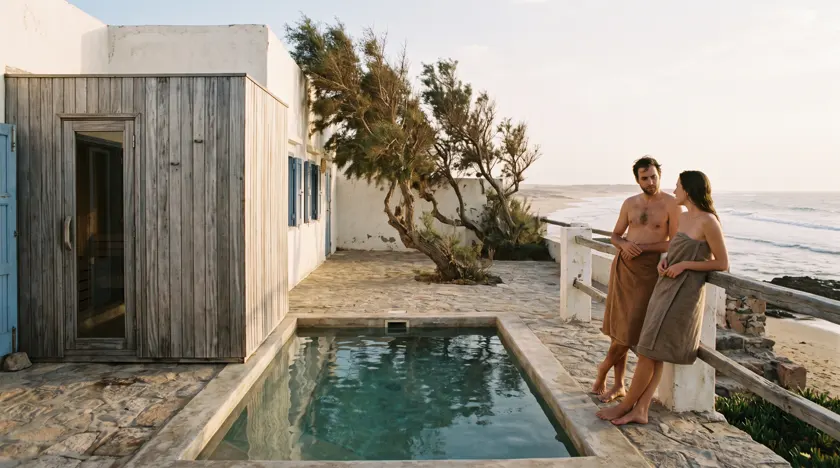
Agadir takes around a quarter of Morocco's tourist overnights (Dabafinance), so the work there is hotel scale: commercial saunas, hammams and plunge pools on a plant room. In Taghazout and Tamraght surf camps want the sauna first, for bodies that come out of the water already cold, then a short controlled plunge. Essaouira is riads and villas in a town where the wind never quite stops, and Dakhla is kite lodges on the lagoon, a long way from any supplier.
Camps often run on single phase or a generator, so we size heaters to the supply and stagger loads rather than assume three phase. Every fixing is A4 stainless, end grain is sealed, and plunges and benches sit behind a windbreak with the glass turned out of the prevailing wind.
| Room | Indicative, thousand MAD | Coastal use |
|---|---|---|
| Plunge tub, timber, no chiller | 20 – 33 | Surf camp, cool-season sea temperatures |
| Plunge tub with chiller | 36 – 78 | Year-round 8–10 °C |
| Sauna, 4 person, one glass wall | 48 – 72 | Camp or villa deck |
| Commercial sauna, 10–14 person | 115 – 240 | Hotel or large camp |
| Hotel thermal suite, small | 260 – 560 | Agadir hotel |
Indicative, supplied and installed; confirmed after a survey in person or by video.
Crates land at Casablanca and continue south by road. For Dakhla, more than a thousand kilometres beyond Agadir, everything travels as one planned load with its spares allowance, because nobody drives back for a forgotten bracket. A room takes 6–10 weeks from drawing approval, and we schedule installation into the camps' quiet months. Send us a photo of the deck or courtyard and the supply you have.
Taghazout is the one place in Morocco where cold water sells itself. Surfers come out of the Atlantic already cold and stiff, and what they want is heat first and then a controlled cold, not the other way round.
The Atlantic here runs cold enough for much of the year that a plunge needs very little chilling — in winter, often none at all. A shaded, insulated basin topped from mains water will sit in the mid-teens without a compressor, and that turns a recovery corner into something a small camp can actually afford.
Where a camp wants a reliable 8 °C through summer we fit a chiller, but the honest first conversation here is whether they need one.
Everything is stainless. Sand gets into every mechanism, so we use simple robust fittings, washable filters and an outdoor rinse point before the basin. A cartridge filter here does more work than anywhere else we install.
Camps fill when the swell is good. We build in the quiet months and phase anything urgent around bookings, and we keep sites tight because the site is usually ten metres from where guests eat.
Agadir takes around a quarter of Morocco's overnight stays, second only to Marrakech (Dabafinance). It is a resort city, and the work here is resort-scale.
A hotel hammam in Agadir serves hundreds of guests a week, and everything is specified for that: commercial-grade generators, duplicate plant where the suite cannot be allowed to close, finishes chosen for daily deep cleaning, and drains that can be lifted and rodded.
It also needs a water strategy. High throughput plus hard water plus evaporation in an Atlantic summer adds up, and we design the filtration and top-up regime rather than leaving it to housekeeping.
Sea-facing terraces here take salt and wind year round. Stainless everywhere, deeper cavities, and plant set behind the building line. Where a spa is on an upper terrace, we check the structure for the water load before anything else.
Unlike Marrakech, Agadir has a genuine quieter season. We schedule major work into it and phase anything that has to happen in peak months around occupancy.
Essaouira has wind. Not a breeze — a reliable, strong Atlantic wind that is why the kitesurfers come and why buildings here are permanently damp.
Essaouira's air does not dry things out; it keeps them wet. Any enclosed room needs mechanical extract with a long run-on timer, and any timber needs to be thermo-treated or charred. Untreated softwood in this town has a short unhappy life.
Vapour barriers must be continuous and on the warm side, with every penetration sealed. A barrier with gaps here traps moisture inside the wall, which is worse than none at all.
A cold plunge in the Essaouira wind is a very short experience. We shelter the plunge and the bench behind a wall or a screen, put the glass at right angles to the prevailing wind, and accept that outdoor sessions here need a windbreak to be pleasant.
Essaouira's medina is UNESCO-listed and the facades are protected. Internally there is freedom; externally almost none, so plant goes inside or set back on the roof, out of sight.
Dakhla is a long way from everywhere. That does not make it difficult — it makes it a logistics exercise, where one planned delivery replaces five casual ones.
More than a thousand kilometres of road south of Agadir means nobody comes back for a forgotten bracket. Everything is prefabricated, packed to a checklist and shipped in one load, with spares for the parts that fail: an element, a thermostat, a cartridge, a pump seal.
We also leave a written spares list with part numbers, because the next problem will happen when we are not there.
The wind that brings the kitesurfers takes heat out of any glazed cabin and makes an unsheltered plunge unusable. Windbreaks are part of the design here, not an afterthought, and every fixing is stainless because the lagoon air is salt.
Most clients here are kite camps: high turnover of fit young guests, heavy simultaneous use after the afternoon session, and a maintenance team of one. We specify simple, robust, serviceable equipment and train whoever is there.
Not always. For part of the year the Atlantic keeps a shaded, insulated tub cool enough for many guests; a chiller buys a reliable 8–10 °C through summer. We price both and let you choose.
As long as anywhere else, if it is built for it: stainless fixings, sealed end grain, a ventilated cavity and plant set back from the sea face. Inland-spec cabins age twice as fast on this coast.
Service visits are scheduled in blocks, and every room ships with a spares allowance and a part-numbered list so the lodge team can handle the common items between visits.
Often not in winter, and sometimes not at all if you are happy in the mid-teens. We will tell you before selling you one.
Yes, phased and screened, but the shoulder season is cheaper and faster and we will push you towards it.
Yes, built for it: thermo-treated or charred timber, stainless fixings, continuous vapour barrier, mechanical extract on a long run-on timer.
Blocks — we schedule Dakhla visits together and leave a spares kit with part numbers so your own team can handle the common failures.
Tell us the neighbourhood, send a photo of the space and the rough size. We reply within one business day with photos of comparable finished rooms and an itemised quote.
Private hammams, saunas and cold plunges in Marrakech: medina riads, Guéliz flats, Hivernage hotels. Factory-b…
Read more →
Saunas, hammams and plunge pools for Palmeraie villas, Ourika-road estates and High Atlas lodges. Built in our…
Read more →
Saunas, steam rooms, hammams and ice baths for Casablanca, Rabat, Tangier and Fès: flats, clubs, villas and ri…
Read more →