
11 min
What a Sauna and Cold Plunge Cost Across Africa in 2026
An honest continental price breakdown: what a sauna and cold plunge cost in eight African countries, what move…
Read more →Tadelakt is the cheapest beautiful way to build a wet room in Morocco and the easiest to do badly. Everything about whether it lasts is decided in the week it is applied.
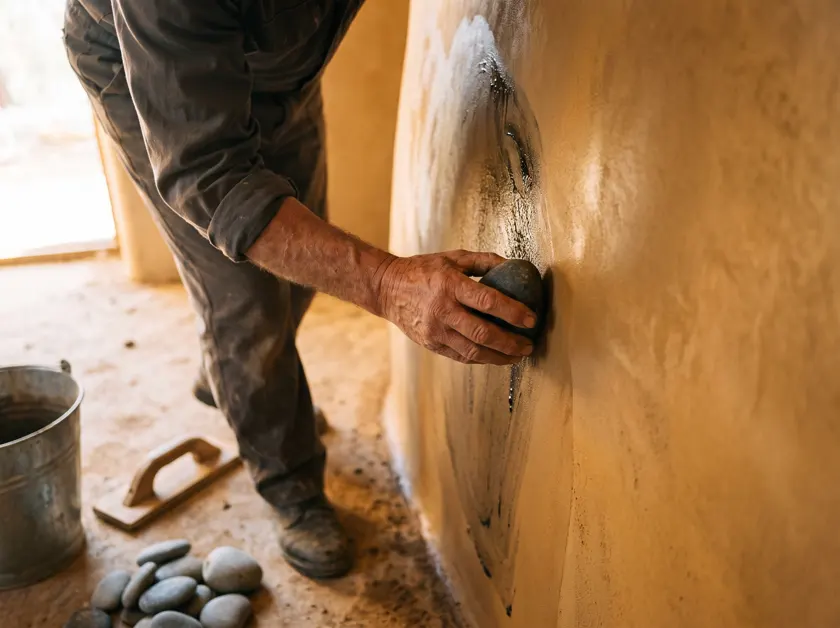
This is the part that surprises people. Nothing is mixed into tadelakt to make it waterproof. It is lime plaster, and it becomes water-repellent through two physical processes.
The first is compression. The plaster is worked and then burnished with a smooth river stone until the surface pores close and the finish takes on a low sheen. The second is saponification: black olive-oil soap is applied and reacts with the free lime to form calcium stearate, a water-repellent layer that is part of the surface rather than a coating on top of it.
Both processes depend entirely on the person holding the stone. That is why tadelakt cannot be priced purely by the square metre, and why we do not give it to whoever is cheapest that month.
A tadelakt wall starts with a sound, stable substrate — usually a lime or cement render, never plasterboard. Then comes the tadelakt itself, applied in a thin coat and left until it has taken up but is still workable.
Then the burnishing begins, and it happens in passes over several days. Each pass compresses the surface further and closes it more. In between, the wall is left alone: lime needs time and air to carbonate, and hurrying it produces a surface that looks correct for a season and then crazes.
Finally the soap goes on, worked in and polished off, usually two or three applications. Only after that is the wall genuinely finished, and it should not see heavy water for several more days.
A soft, slightly irregular sheen rather than a uniform gloss. Subtle variation in tone across the wall, because the material is mineral and applied by hand. Crisp, closed arrises at corners and around niches. No craze pattern anywhere, particularly at the splash line and inside niches where water sits longest.
Run a hand over it: it should feel dense and cool and slightly waxy, not chalky or dusty. Flick water at it and it should bead and run rather than darkening into the surface.
A fine crazing pattern, most visible at a shallow angle in raking light. Dark patches that stay dark hours after the room has been used, which means the surface is absorbing. Chalkiness on the fingers. Sharp uniform gloss, which usually means a varnish or sealer was applied over the top to hide a surface that was never closed properly.
That last one is the one to watch for. A sealed-over tadelakt looks perfect on handover day and fails within two years, because water that does get in cannot get out again.
Pigment is mixed into the lime, so the colour is the material rather than a coat on it. Ochres, rose, off-white and deep grey-green are the range that behaves well. Strong blues and blacks are possible but show every mark and every repair.
It will change over time, and this is a feature rather than a defect. Tadelakt develops a patina, darkens slightly where water runs regularly, and settles into a soft irregularity that is the whole point of the material. If you want a surface that looks identical in five years, we will tell you to use tile.
Walls in a hammam, a steam room or a shower: ideal. Basins and niches: excellent, and a tadelakt basin carved as one piece with the wall is one of the most beautiful things we build.
Floors: possible, and traditional in a hammam, but they take abrasion that walls do not. In a heavily used family shower we usually put honed stone or bejmat underfoot and keep tadelakt on the walls.
Outdoors in full Moroccan sun and winter rain: not our first choice. It can be done with the right lime and the right exposure, but a west-facing exterior wall in Marrakech is a hard life for a lime finish.
Re-soaping once or twice a year keeps the surface sealed. It is a half-day job with soft black soap and a cloth, and we show your household or your housekeeping team exactly how at handover.
Skip it for a year and nothing happens. Skip it for three and the surface starts absorbing, which shows as patches that stay dark. That is repairable by re-soaping and, if it has gone further, by a light re-skim.
Do not use bleach, do not use acidic descalers, and do not use anything abrasive. Lime does not like acid, and a strong cleaner will do more damage in ten minutes than three years of neglect.
A small hammam in tadelakt sits in our 62 to 140 thousand dirham band, and the spread within it is almost entirely labour. A room with simple flat walls is quick. A room with a domed ceiling, curved benches, carved niches and a one-piece basin is weeks of skilled hand work by someone who has done it many times.
When a quote for tadelakt is dramatically cheaper than the others, the saving is nearly always in passes: fewer coats, less burnishing, one soaping instead of three. You cannot see that on handover day. You see it in the second winter.
How many passes, and over how many days? A serious answer is three or more passes across several days, with waiting time between them. An answer measured in a single day is describing a different, lesser material.
Can I see a wall you finished three years ago? This is the question that separates the trades. New tadelakt always looks good. Three-year-old tadelakt in a room that is used daily tells you everything.
What soap, and how many applications? Black olive-oil soap, worked in and polished off, two or three times. If the answer involves a varnish, a resin or a proprietary sealer, walk away — that is a coating applied to hide a surface that was never closed.
What is the substrate? Lime or cement render on a stable background. Not plasterboard, not a skim over old tile, not a wall that still moves.
Who exactly will do the work? Tadelakt is a named-person trade. If the answer is a company rather than a person, ask for the person's name and how long they have been doing it.
And finally: what do I do to look after it? A craftsman who cares about the wall will answer this without being prompted, because a wall that is never re-soaped will make his work look bad in three years' time.
Want this checked against your own room? Send us the dimensions and a photograph and we will come back with a drawing.
An honest continental price breakdown: what a sauna and cold plunge cost in eight African countries, what move…
Read more →
From Nairobi at 1,795 m to the Ngorongoro rim: why African highland saunas need a bigger heater, and why the s…
Read more →
An honest breakdown of private hammam prices in Morocco: what sits inside 60,000 dirhams, what takes a room pa…
Read more →