11 min
What a Sauna and Cold Plunge Cost Across Africa in 2026
An honest continental price breakdown: what a sauna and cold plunge cost in eight African countries, what move…
Read more →We will not hand you a return-on-investment percentage. We will give you the market numbers with their sources, the cost structure, and the arithmetic — and you can put your own occupancy in it.
Morocco recorded 19.8 million arrivals in 2025, up 14 per cent on the previous year, with tourism receipts of 124 billion dirhams, up 19 per cent (Ministry of Tourism; ThinkBusiness Africa). The sector contributes about 7.4 per cent of GDP and supports roughly 880,000 jobs (Dabafinance).
Marrakech alone accounts for close to 40 per cent of overnight stays, with Agadir at around 25 per cent, Casablanca 9 per cent and Tangier 7 per cent (Dabafinance). The national target is 26 million visitors by 2030 (TravelMole).
Those are strong numbers, and they cut both ways. Demand is growing, and so is the number of properties competing for it. A spa is increasingly a filter guests apply rather than a surprise they discover.
Rate. This is the largest effect and the hardest to isolate. A property that can credibly list a hammam and a thermal circuit competes in a higher bracket, and the benefit shows up as occupancy at a better rate rather than as a line on the P&L. In Marrakech specifically, a private hammam is close to an expectation at the upper end of the riad market.
Treatment revenue. The direct line, and it depends entirely on staffing. A beautiful suite with nobody trained to sell and deliver treatments earns very little. A modest suite with a good therapist and a simple menu earns steadily.
Reviews and length of stay. Harder to measure, and real. Wet areas appear in guest reviews out of all proportion to their floor area — generously when they work and viciously when they smell. That asymmetry is itself an argument for spending on ventilation rather than on decoration.
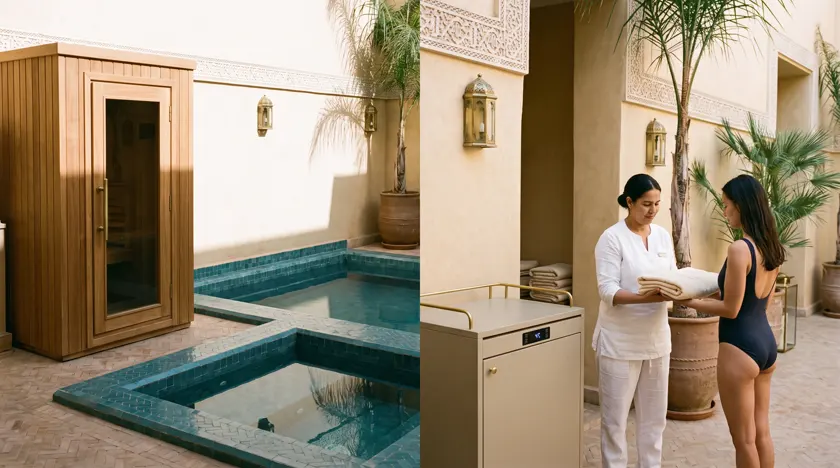
Build. A small hotel suite — hammam, sauna, two plunge positions, a rest bench — needs about 30 to 40 square metres plus 6 to 8 of plant, and sits in our 260 to 560 thousand dirham band. A riad wellness corner, which is one excellent hammam plus a cold basin in a courtyard bay, sits at 110 to 230.
Running. Energy, water, chemistry, filter cartridges, and in Morocco a descaling regime because the mains water is hard. Chiller electricity is seasonal and material in July and August.
People. At minimum one trained person who owns the log. This is the cost most often left out of the business case and the one most likely to decide whether the suite earns anything.
Maintenance. Six-monthly service for commercial rooms, three-monthly on chiller condensers in dusty or coastal locations, and tadelakt re-soaped twice a year.
Take the annual running cost of the suite, add the build cost amortised over five years, and divide by your average achieved room rate. That gives you the number of additional room-nights a year the suite has to produce to break even.
Now compare that with your current annual room-nights. If the answer is a small single-digit percentage, build it. If the suite has to lift your occupancy by ten per cent to wash its face, be sceptical — and talk to us anyway, because a smaller room often clears the bar when a large one does not.
Do the same sum for the version that is one excellent hammam rather than a full circuit. In the riad segment, that smaller version frequently has the better arithmetic, because it moves you into the same search filter for a third of the capital.
Building a thin imitation of a resort suite. Four small rooms done cheaply read as cheap. One room done properly reads as considered, and in a nine-room riad that is the correct answer almost every time.
Under-plumbing. A suite that cannot be isolated room by room has to close entirely when one thing fails, and in a small property that is several days of a listed amenity being unavailable.
No ventilation strategy. The single most common reason a small hotel spa stops being an asset is that it never dries out, and that is a decision made at drawing stage for very little money.
Marrakech has no closed season, so the suite earns year-round and there is no quiet window to build in. Agadir and the Atlantic coast do have a shoulder season, which is cheaper and faster to build in and worth waiting for.
Cooling costs are seasonal everywhere. A cold plunge in a Marrakech summer is the most expensive thing in the suite to run, and shade, insulation and a lid are worth more than the next size of compressor.
One hammam, correctly tanked, with tadelakt walls, a properly even heated slab, mechanical extract on a run-on timer, and a cold basin next to it. Nothing else.
That room will be photographed, reviewed and remembered, and it costs a fraction of a full circuit. Everything else can follow in a later phase, provided the drainage, the extract route and the electrical capacity were put in at the start — which is the one thing we would insist on regardless of budget.
A suite that nobody measures cannot be defended at the next budget round, so decide before opening what four numbers you will track.
Treatment revenue per available room-night, rather than per treatment. This is the number that tells you whether the suite is being sold, and it exposes the staffing problem faster than anything else.
The share of direct bookings mentioning the spa. Most booking engines and enquiry forms can carry a single question, and a season of answers is worth more than any projection we could give you.
Review mentions, split positive and negative. Wet areas are mentioned disproportionately, and the direction of those mentions is an early warning system: 'lovely hammam' turning into 'the steam room smelled' is a ventilation or a cleaning problem showing up months before the plant fails.
Energy against occupancy. Chiller and generator consumption should track guests. If consumption stays flat while occupancy falls, something is running when it should not be — a setpoint left low, a lid never used, a timer overridden. That is money leaving quietly.
Review those four at six months, at the same time as the first service visit, and you will know whether to expand the suite, staff it better, or leave it exactly as it is.
Want this checked against your own room? Send us the dimensions and a photograph and we will come back with a drawing.
An honest continental price breakdown: what a sauna and cold plunge cost in eight African countries, what move…
Read more →
From Nairobi at 1,795 m to the Ngorongoro rim: why African highland saunas need a bigger heater, and why the s…
Read more →
An honest breakdown of private hammam prices in Morocco: what sits inside 60,000 dirhams, what takes a room pa…
Read more →