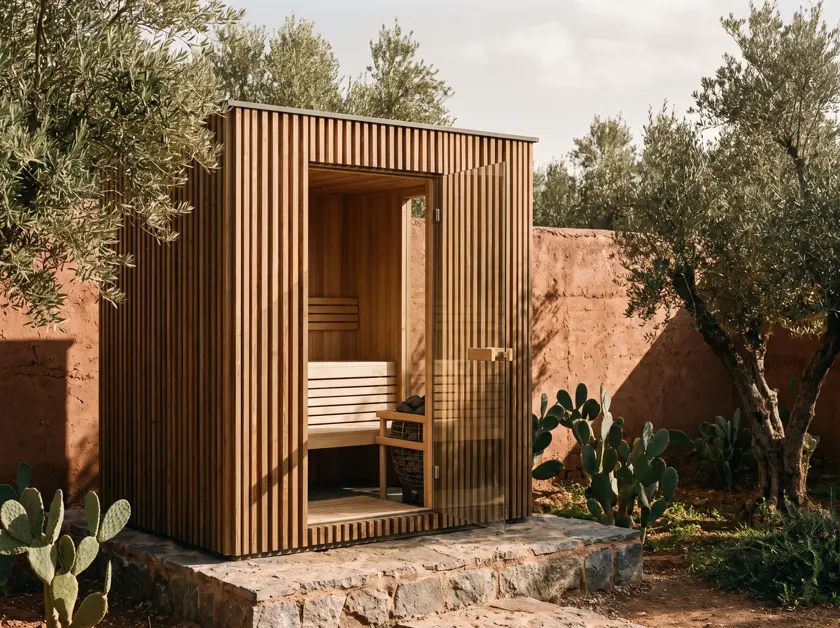
Marrakech
Palmeraie, Ourika & High Atlas
Saunas, hammams and plunge pools for Palmeraie villas, Ourika-road estates and High Atlas lodges. Built in our…
Read more →Marrakech is three cities for a builder: the medina, where nothing arrives by vehicle; Guéliz, where an apartment lift decides what fits; and Hivernage, where hotels need a circuit that runs every evening of the year. We draw the room for each, make it in our Istanbul factory and bring it in through the right door.
In this guide: Marrakech medina · Guéliz · Hivernage
Most medina enquiries are private hammams and courtyard plunge basins for riads under restoration, many of them becoming guesthouses. Guéliz is dry saunas and infrared cabins for flats, where a wet room would need a drain the building does not have. Hivernage and the hotel strip want commercial circuits — hammam, sauna, steam and cold water on one plant room — sized for the evening peak. Marrakech takes close to 40 per cent of Morocco's tourist overnights (Dabafinance), which is why hotel suites here are sized for full houses, not averages.
Power is 220 V single phase in most flats and riads, and 380/400 V three phase on villas and hotels; a riad often needs a new cable run from the meter, priced as its own line. Summer afternoons pass 40 °C, so chillers are sized for peak ambient and kept in shade, and hard water means every steam generator leaves with a descaling plan.
| Room | Indicative, thousand MAD | Typical building |
|---|---|---|
| Tadelakt hammam, 2–3 person | 62 – 110 | Medina riad |
| Hammam with zellige | 95 – 170 | Riad or villa |
| Infrared cabin, 2 person | 14 – 24 | Guéliz apartment |
| Riad wellness corner | 110 – 230 | Courtyard bay: hammam or sauna plus plunge |
| Hotel thermal suite, small | 260 – 560 | Hivernage hotel |
Bands are supplied and installed, and confirmed after a survey in person or by video.
Crates leave Istanbul by sea for Tanger Med, clear in six to twenty-four hours on the fast-track scheme (AJ Logistics) and travel south by road. For the medina they are packed no wider than the tightest turn on your alley, which we photograph during the survey. Allow 6–10 weeks per room from drawing approval to commissioning; a complete villa spa runs 12–16 weeks, and a hotel follows its construction programme.
Send a photo of the room and of the route in; a project manager replies with a first itemised figure within one business day.
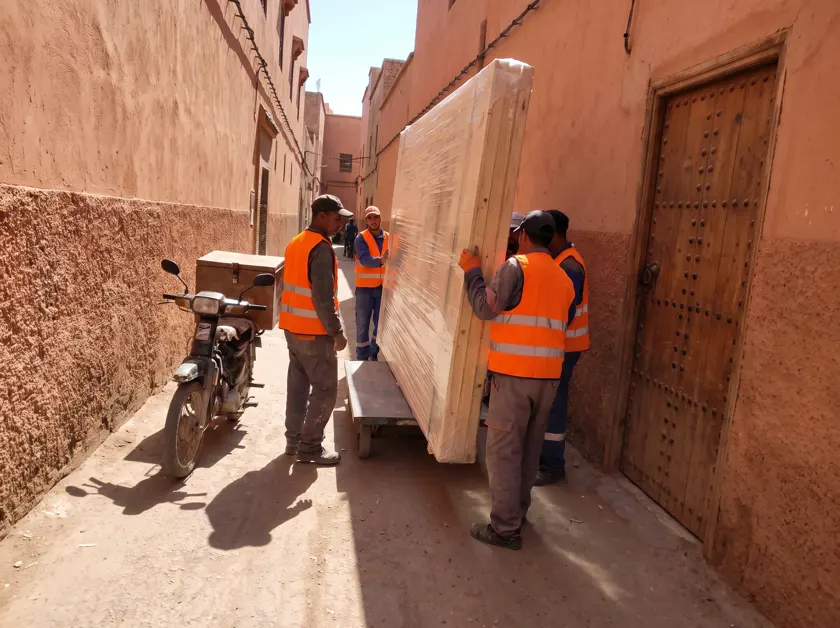
Inside the walls nothing arrives by vehicle. Every panel, every sack of lime and every slab of marble comes in by handcart and shoulder, and that single fact shapes the whole method.
Thick pisé and brick walls that hold temperature, a courtyard that ventilates and lights a wet room without a single window onto the street, and drainage that already runs to a central point. A riad is the best building we work in for a hammam, and it has been ready for one for two centuries.
What it does not give you is spare electrical capacity, a straight duct run, or any certainty about what is inside a wall. We open up and look before we draw.
We measure the narrowest point on the route — usually a turn in an alley or the first landing of a staircase — and size every panel to it. Materials come in early, before the alleys fill, and the site is swept every evening because that alley is somebody's street.
This is a labour line in the quote, not a hidden loading on the material price. On a typical medina job it is the difference between a two-week and a three-week programme.
Internally there is a great deal of freedom. Externally there is almost none: a new flue, a unit on a wall or a change to the roofline is a conversation with the authorities. We design plant to sit internally or set back on the roof where it cannot be seen from the alley.
Guéliz is apartments, and apartments mean single-phase power, no spare drain and a lift with a door that decides what fits.
An infrared cabin plugs into an ordinary socket and needs nothing else. A small Finnish cabin at 6-8 kW is possible where the supply and the cable allow, on a dedicated circuit. Above that you are applying to ONEE for three phase, which is worth doing if you own and pointless if you rent.
We measure the lift and the stairwell before quoting, because a 2.4 m panel that will not turn on a landing is an expensive lesson.
Infrared and dry saunas need no drainage at all. Anything wet does, and adding a drain to a finished apartment floor is rarely worth it. The honest answer in most Guéliz flats is a dry cabin and a cold shower.
Nothing we install in an apartment should be heard downstairs. Cabins sit on isolating feet, and we do not put water above a neighbour's ceiling without a tanked floor and a written structural opinion.
Hivernage is hotels, and hotel work is a different discipline: capacity, plant, documentation, and building around guests who are already in the building.
Guests use a spa after the day's touring, in a ninety-minute window. Sizing on daily average produces a queue at seven in the evening, so we count the peak and usually land on more plunge positions and more hammam capacity than first imagined.
The hammam is the bottleneck in Morocco because sessions are long. Two hammam positions to one sauna is the ratio that keeps the circuit flowing.
There is no closed season in Marrakech. We phase the work, agree noisy windows, seal the site behind dust screens and keep the corridor presentable, because it is in view of paying guests every day.
A plant room with isolation on each room so a single failure does not shut the suite, and a control system matched to the engineering team you actually have. Two days of training at handover and a return visit at six months to check the log is being kept.
Yes, and it is the cheapest moment: the drain, the extract route and the cable go in while the floors are up. We coordinate with your architect so the tanking is finished before any zellige or tadelakt goes on.
In person or by video, depending on the programme. A video walk-through of the room and the access route is usually enough for a first itemised quote.
6–10 weeks per room after drawing approval, including the factory build, shipping to Tanger Med and the road south; 12–16 weeks for a complete villa spa package.
Almost certainly not. We photograph the route during the survey and size the panels to the tightest point — that is normal here, not a problem.
We measure the lift, the landing turn and the door before quoting. Where it will not, the cabin is built in smaller sections.
Yes — phased, screened, with agreed noisy windows. Most of the fabrication happens in our factory, so the loud weeks on site are few.
Tell us the neighbourhood, send a photo of the space and the rough size. We reply within one business day with photos of comparable finished rooms and an itemised quote.
Saunas, hammams and plunge pools for Palmeraie villas, Ourika-road estates and High Atlas lodges. Built in our…
Read more →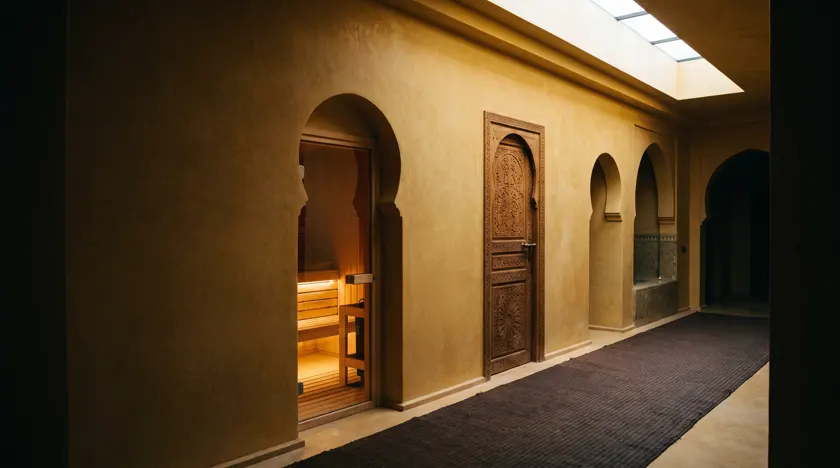
Saunas, steam rooms, hammams and ice baths for Casablanca, Rabat, Tangier and Fès: flats, clubs, villas and ri…
Read more →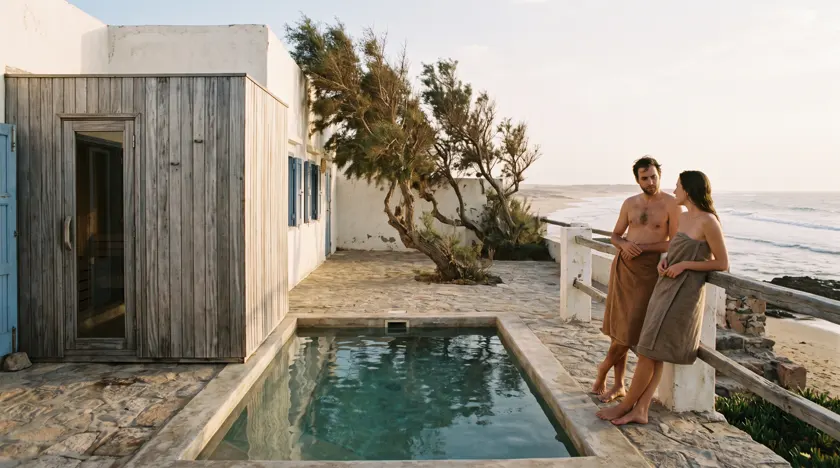
Saunas and cold plunges for Taghazout surf camps, Agadir hotels, Essaouira riads and Dakhla kite lodges: salt-…
Read more →