11 min
What a Sauna and Cold Plunge Cost Across Africa in 2026
An honest continental price breakdown: what a sauna and cold plunge cost in eight African countries, what move…
Read more →Morocco is the easiest country we work in to bring equipment into, and almost nobody building here treats that as an advantage worth planning around.
Morocco has free trade agreements with both the European Union and the United States. Goods of EU or US origin enter duty-free with a valid certificate of origin, against most-favoured-nation rates that otherwise start at about 2.5 per cent for industrial goods and run far higher for protected categories (trade.gov).
For our trade that is decisive. Finnish and German heaters, Scandinavian thermo-treated timber, Italian brassware and European steam generators — the equipment we would specify anyway — arrive without duty. In the other markets we work in, the same heater lands inside a regional external tariff and costs measurably more.
VAT is separate and still applies at 20 per cent on importation (PwC Tax Summaries). There is no way around that and anyone suggesting otherwise is describing a problem, not a saving.
Duty-free entry depends on documentation, not on where you bought the item. A European-branded heater manufactured outside the EU does not qualify. A genuine EU-origin product without a properly completed movement certificate does not qualify either, and sorting that out after the container has landed is slow and expensive.
We specify, order and clear equipment ourselves for this reason. When a client sources their own equipment online and asks us to install it, the commonest unpleasant surprise is a duty bill nobody expected because the paperwork was never requested at the point of sale.
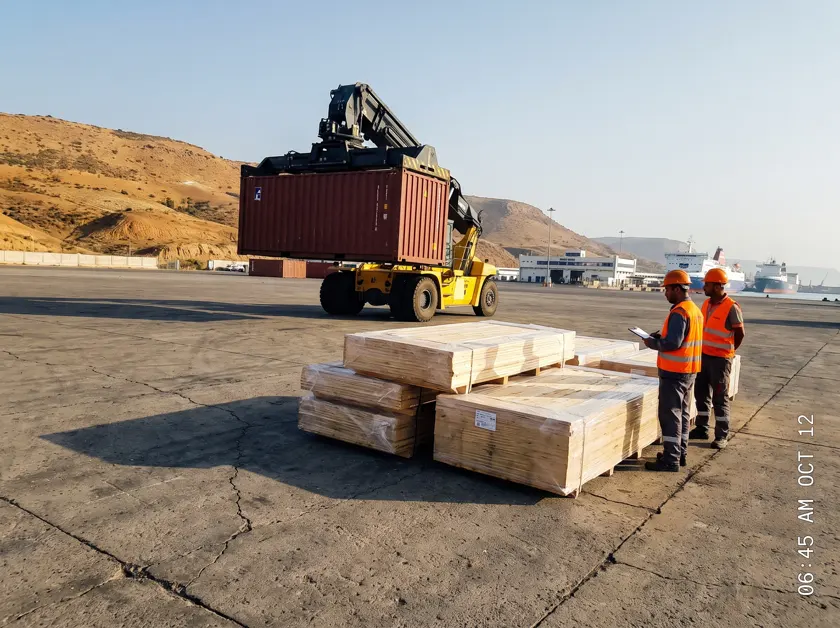
Tanger Med is the largest port in Africa and the Mediterranean, with capacity for around eleven million containers a year (Tanger Med). Standard clearance runs six to twenty-four hours under the port's expedited scheme (AJ Logistics).
Compare that with a landlocked project, where cargo lands at a foreign port and then spends five to ten days on the road plus a border crossing, and the practical difference is weeks. It means a Moroccan project can be planned in weeks rather than months, and it means a failed element in Tangier is a next-day problem rather than a fortnight's downtime.
It also means we can carry less stock and still respond quickly, which is part of why our service intervals here are realistic rather than aspirational.
Sea from a European port to Tanger Med is the default for anything with volume: timber, stone, tubs, generators. Road through Spain and across on the ferry is competitive for smaller consolidated loads and is often faster door to door for a single pallet.
Air is for a heater, a control board or a pump that has failed and is holding up a hotel opening. It is never sensible for timber and we will say so.
Whichever route, the planning principle is the same: order the long-lead items first, then run the wet trades and the electrical work while they travel. On a well-planned project the container arrives into a site that is already tanked, wired and waiting, and assembly is a week.
Zellige, tadelakt lime, marble, bejmat, brass and cedar are Moroccan and better bought here — not for cost reasons but because the supply chains are mature, the craftsmen are here, and lead times are short.
Steel for sub-frames is cut and welded in Sidi Ghanem. Glass and ironmongery come from Casablanca. The imported share of a typical project is concentrated in the heater or generator, the chiller and the thermo-treated bench timber — three items where buying cheap costs you twice.
For a private hammam: eight to fourteen weeks from signed drawing to first session. The pace is set by the tanking, which cannot be rushed, and by zellige if you have chosen it, which is cut by hand.
For a sauna: six to ten weeks, or three to four if we have the section in stock.
For a hotel suite: three to five months including plant, commissioning and training. If somebody quotes you a hotel thermal suite in six weeks, ask where the equipment is coming from and whether the tanking has been allowed to cure.
Buying equipment abroad without the origin paperwork. Ordering the timber last because it is 'just wood'. Quoting a programme that assumes clearance takes an hour because it sometimes does. And specifying a heater or generator on price alone from a supplier with no Moroccan presence, which is fine until it fails and there is no part in the country.
Take a private hammam with a sauna, in a Marrakech villa, ordered in early March. Here is how the weeks actually go.
Week one: site visit, survey, opening up to see what is inside the walls, structural check on the floor if a slab is going in. Week two: drawing agreed and signed, equipment ordered, zellige ordered with a signed sample retained.
Weeks three and four: demolition and first fix. The drain is formed and falls established, the extract duct is run, the cable is pulled back to the board. This is the fortnight that decides everything and it happens before any imported item has left Europe.
Weeks four to six: the container moves. Sea freight to Tanger Med, clearance in six to twenty-four hours under the expedited scheme (AJ Logistics), road to Marrakech. Meanwhile the tanking goes in on site, with a full day between coats and a day before anything is laid on it.
Weeks six to nine: the slab is built and the heating loop set, the screed goes in, zellige panels arrive and are set, tadelakt begins its passes. Nothing here can be compressed. Lime and hand-cut tile move at their own speed.
Weeks nine to eleven: sauna panels assembled, heater and generator installed and wired, plant connected, controls set. Week twelve: commissioning, water testing, a walk-through, the handover notes and the first session.
Twelve weeks, and only two of them were about shipping. That is the point of the port: in Morocco, logistics is rarely the thing holding up your project. The craft is.
The same project in a landlocked country runs sixteen to eighteen weeks on the same scope, because the container lands at a foreign port and then spends five to ten days on the road plus a border. Nothing about the building work changes; the calendar simply gets longer. It is worth knowing which of those two schedules you are being quoted.
Want this checked against your own room? Send us the dimensions and a photograph and we will come back with a drawing.
An honest continental price breakdown: what a sauna and cold plunge cost in eight African countries, what move…
Read more →
From Nairobi at 1,795 m to the Ngorongoro rim: why African highland saunas need a bigger heater, and why the s…
Read more →
An honest breakdown of private hammam prices in Morocco: what sits inside 60,000 dirhams, what takes a room pa…
Read more →