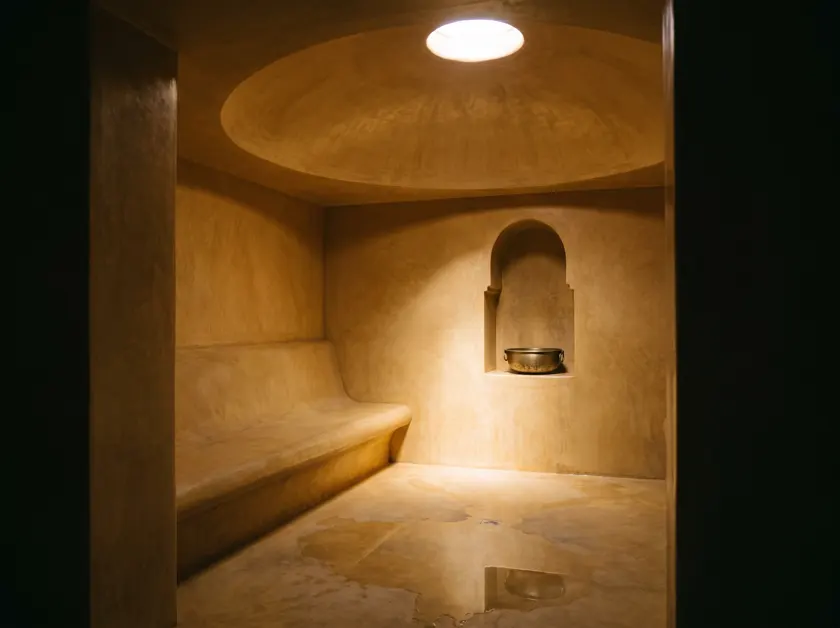
Tadelakt hammams
Tadelakt is the cheapest beautiful way to build a wet room in Morocco and the easiest to do badly. It is lime …
Read more →Everyone in Morocco knows what a hammam is, which makes this the hardest thing we build. You are not being sold a novelty — you are being asked whether ours is better than the one at the end of your street.
Indicative band: 95 – 260 thousand MAD, supplied and installed in Morocco.
Across the continent: Steam rooms & hammams in all eight countries →
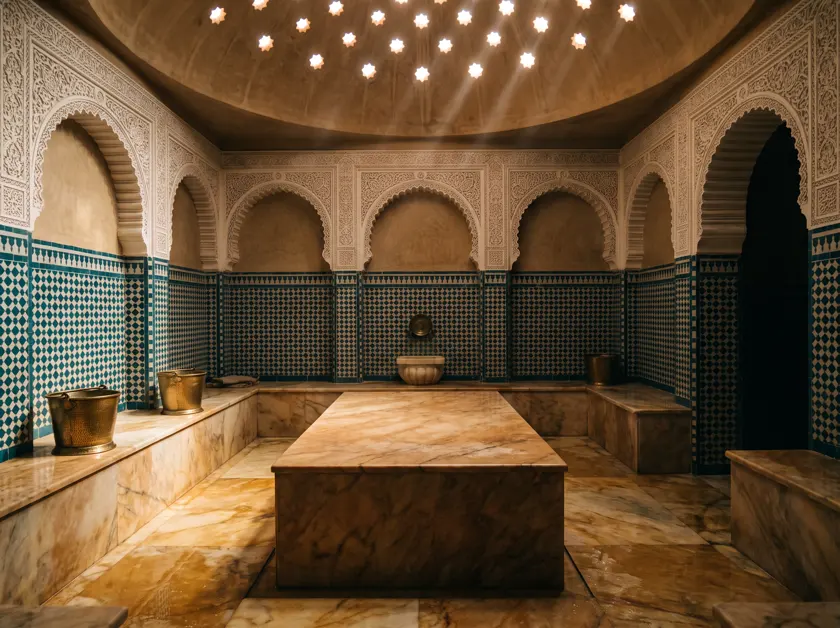
The heated marble slab is the room. It runs at 40-45 °C on the surface, heated from below by a water loop or an electric mat set into the screed, and the whole session happens on it. Getting the temperature even is the craft: the loop spacing tightens at the edges because the perimeter loses heat to the room, and a slab that is warm in the middle and cold at the rim is the commonest fault we are called to fix.
Around it the air sits at 40-50 °C and high humidity — warm, not scalding. That is why people stay an hour, and why a hammam works for a household where a 90 °C sauna would be used by one person.
Real zellige is glazed terracotta chipped to shape by hand, one piece at a time, and assembled face-down into a geometric pattern. It is slow, it is expensive, and it looks nothing like the printed tile sold as zellige. We buy from the same workshops in Fès and Marrakech we have used for years, and we show you the cut pieces before anything goes on a wall.
Where the budget will not carry full zellige, we use it as a band or a niche against tadelakt rather than spreading it thin. A small area of the real thing beats a whole room of the substitute.
A pierced dome throws the traditional points of light across the steam. In a Moroccan house we build it as a shallow dome with fibre optics rather than cutting holes in a roof that has to survive winter rain on the Atlantic coast or in the Atlas foothills.
The floor falls to a central drain at 1:50, the benches are warm, and every fitting is brass because it patinates instead of pitting. Chrome in a hammam looks tired in three years.
Scale, control and cleanliness. A public hammam is a big humid room heated by a shared furnace. Yours is a small room where you set the slab temperature, the humidity and who is in it, with a drain you can lift and a ventilation system that dries the room overnight.
Usually yes, and riads are the best building for it — courtyards, thick walls and drains already exist. The two questions are whether the floor can take the weight of a slab and stone, and where the plant can live where somebody can service it.
Eight to fourteen weeks. The tanking and the zellige are what set the pace — zellige is cut by hand and cannot be hurried, and the waterproofing needs a full day between coats.
Tadelakt is the cheapest beautiful way to build a wet room in Morocco and the easiest to do badly. It is lime …
Read more →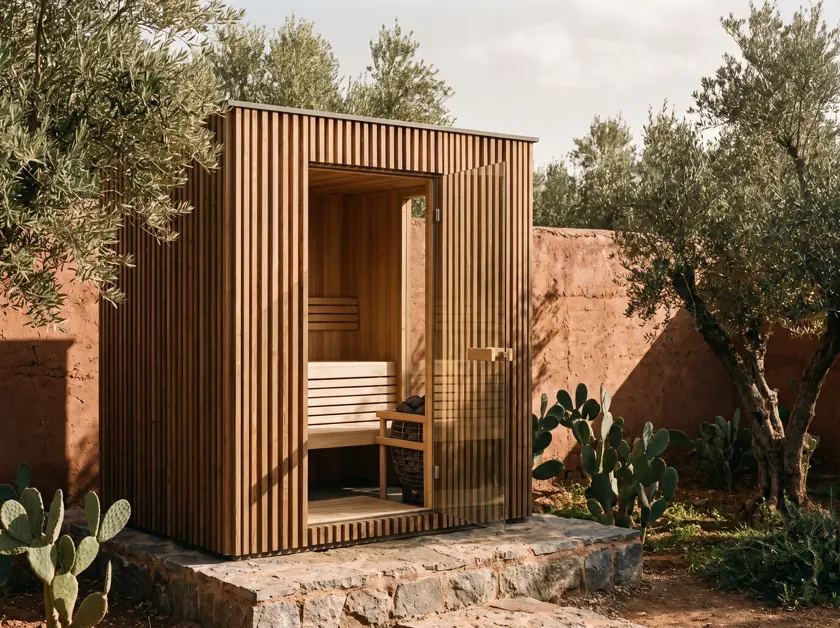
A sauna is the dry counterpart to the hammam, and in Morocco it is usually the second room rather than the fir…
Read more →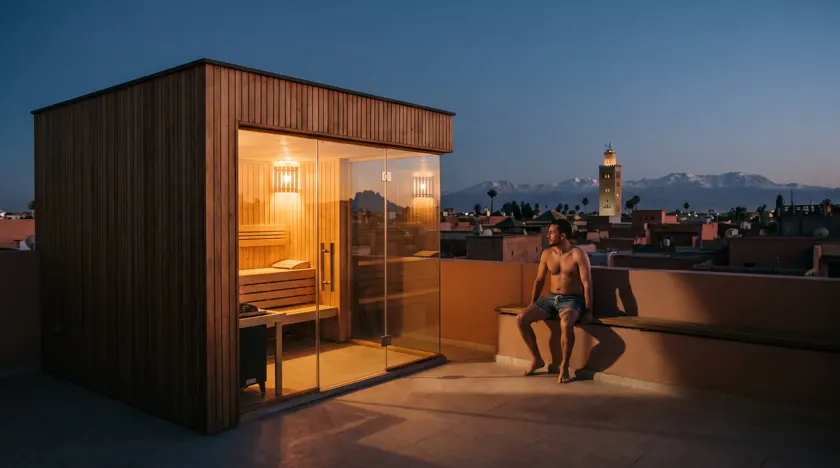
The flat roof is the most under-used room in a Moroccan house. It is also the easiest place to put a cabin, pr…
Read more →