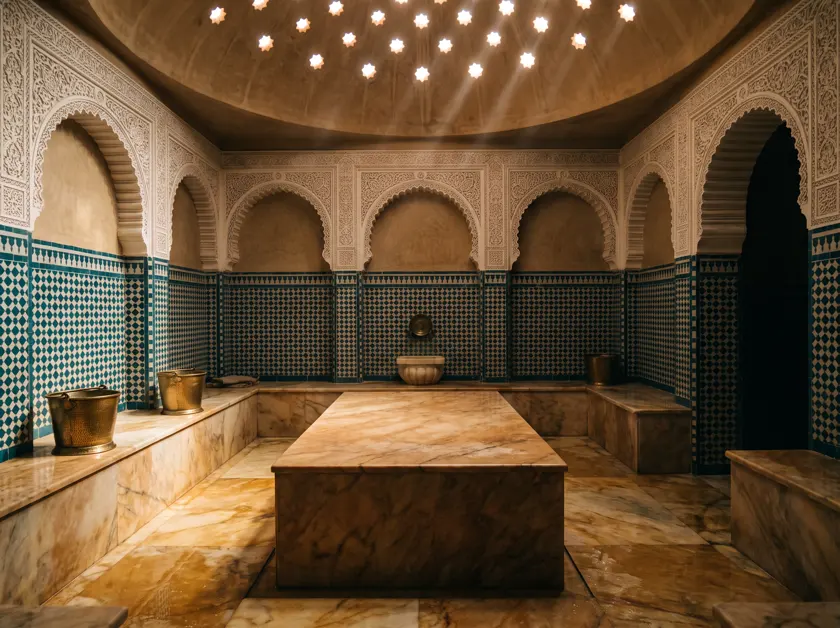
Traditional hammams
Everyone in Morocco knows what a hammam is, which makes this the hardest thing we build. You are not being sol…
Read more →Marrakech in July is the hardest cold-water environment we work in. Forty degrees of ambient and hard sun will beat any chiller attached to an uninsulated tub, so the insulation comes first and the machine second.
Typical project in Morocco: MAD 20k – 125k, supplied and installed · six to ten weeks per room after the drawing is approved, plus shipping.
Across the continent: Cold plunges in all eight countries →
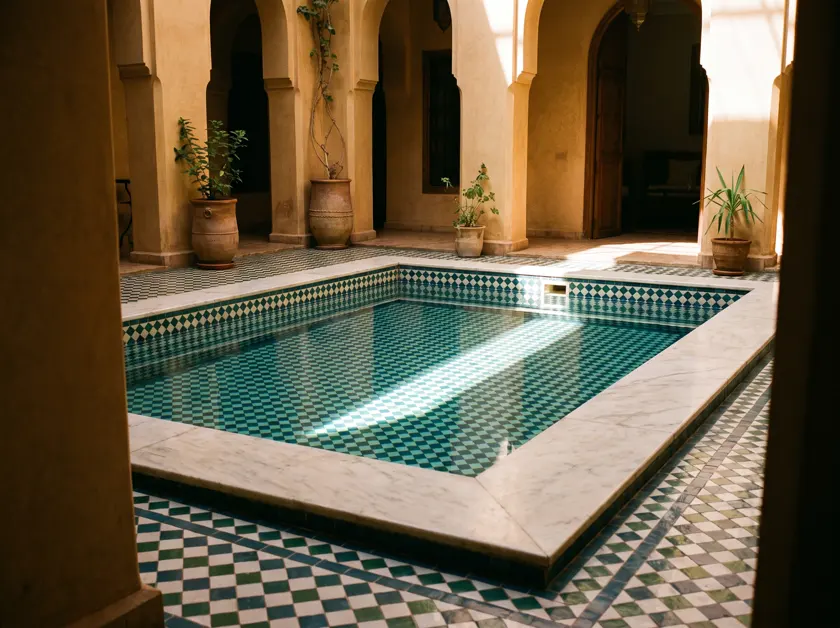
A chiller fights the gap between your target temperature and the air. In a Moroccan summer that gap is thirty degrees for much of the day, so an uninsulated basin is a bill with water in it.
We build the shell with closed-cell insulation in the cavity, insulate under the base as well as around it, and supply a fitted lid light enough that people actually use it. In shade, insulated and lidded, the same chiller does perhaps a third of the work it would do in the sun.
1 HP for tubs to about 260 litres, 2 HP to about 570, 4 HP to about 1,200 — then a step up, because our summers are not the temperate ones those figures assume. A tub in Marrakech doing 8 °C in August needs more machine than the same tub in Tangier.
Shade is worth capacity. A pergola or a north-facing bay saves more electricity than the next size of compressor.
A zellige-lined basin sunk into a courtyard is the most Moroccan thing we build and the most beautiful. Tadelakt is warmer, softer and cheaper. Timber is the movable option and the one that comes with you if you sell the riad.
All three need the same things underneath: insulation, a drain, circulation, cartridge filtration and an ozone or UV stage on anything more than one household uses.
| Format | Indicative, thousand MAD | What is inside |
|---|---|---|
| Timber tub, no chiller | 20 – 33 | Insulated shell and lid, filled from the mains |
| Tub with chiller, 1–2 HP | 36 – 78 | Filtration and ozone, holds 8–10 °C or colder |
| Zellige basin, built in | 66 – 125 | Mosaic-lined, marble rim, structure checked |
| Plunge pool, 6–8 person | 150 – 290 | Bench, ladder and its own plant room |
All bands are supplied and installed, and confirmed after a site survey. If you are comparing them with an ice bath for sale on a marketplace, check three things before you buy: the insulation under the base, the chiller's rated capacity at 35–40 °C ambient rather than at 25, and whether anyone in Morocco services it. The tubs and chillers we fit are built and tested in our Istanbul factory and carry a 24-month warranty.
Marrakech is the hard case: dry 40 °C afternoons from June to September and fine dust that settles on every condenser. A riad courtyard is actually the kindest place for a basin there — shaded most of the day, sheltered from wind — and a zellige basin set into the courtyard floor, with the chiller in a ventilated service niche, is the classic answer. On a Palmeraie terrace we add a pergola before we add compressor capacity.
Casablanca is the opposite problem. Air temperatures are mild, so the chiller works far less, but Atlantic humidity and salt attack fixings and electrics, and many buyers live in apartments. There we fit freestanding tubs in stainless-fixed timber or composite shells, check the floor loading, and keep the chiller where the salt air cannot reach its coil directly.
The chiller decides whether your plunge still works in year three. It is also what people buy blind off a marketplace listing, two sizes too small, and then blame.
For a riad basin or a villa tub we fit an outdoor-rated unit with a titanium heat exchanger — cold, ozonated water pits stainless steel — plus a circulation pump and insulated hoses that enter low in the basin wall, so nothing crosses a zellige rim.
It runs in cycles to a setpoint and lets the insulated lid do the overnight work. That is the difference between a compressor with a life expectancy and one with a warranty period.
A chiller needs air and shade. Boxed into a cupboard it runs hot, loses capacity and dies early. In the Haouz and anywhere near a piste, dust blankets a condenser in weeks — we fit washable pre-filters and shorten the service interval accordingly.
In a riad the usual place is a service niche off the courtyard with a grille; in a villa it is behind planting on the north side.
Six months in the city, three in dusty or coastal locations: clean the condenser, check pressures, replace the cartridge, test the ozone cell, check the hoses. An hour of work that decides whether the unit lasts eight years or three.
Chiller supply and installation on its own: indicative MAD 22k – 78k. How we size chillers across Africa →
Yes, in shade, insulated and lidded, with the chiller sized for it. In full sun with no lid, no — and we will say so rather than sell you a unit that cannot win.
Anything used by more than one household needs circulation, cartridge filtration and ozone or UV. Without it you are changing the water weekly and it still will not be pleasant.
Yes. It is glazed terracotta on a waterproof substrate, and cold water is gentler on it than a steam room. The grout is the part that needs the right specification.
A 1 HP chiller draws roughly 1 kW. On an insulated, lidded tub in shade it might run five to eight hours a day in July — about 150 to 250 kWh a month — and a fraction of that in winter. ONEE's domestic tranches run from about 0.90 to 1.60 dirhams per kWh (kherba.com, 2026). In full sun without a lid the same tub can double that.
With cartridge filtration and ozone, a household tub is drained every one to three months and topped up in between. Hard Moroccan water leaves scale on the heat exchanger and the ozone cell, so we set a descaling interval at handover and check it at each service.
Yes if parts are obtainable. Send us the model number before you buy — a unit that was never big enough for its tub is the most common chiller problem there is.
About the same as a domestic air-conditioning outdoor unit. In a riad, a service niche with a grille makes it inaudible from the courtyard.
Send us a photo of the spot and the rough size. Within one business day you get photos of comparable rooms we have finished and an itemised, position-by-position quote.
Everyone in Morocco knows what a hammam is, which makes this the hardest thing we build. You are not being sol…
Read more →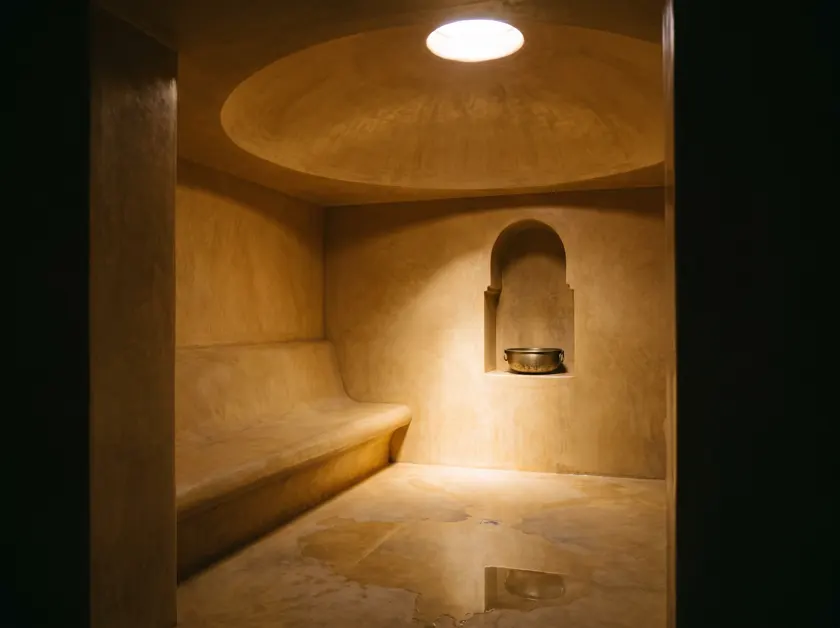
Tadelakt is the cheapest beautiful way to build a wet room in Morocco and the easiest to do badly. It is lime …
Read more →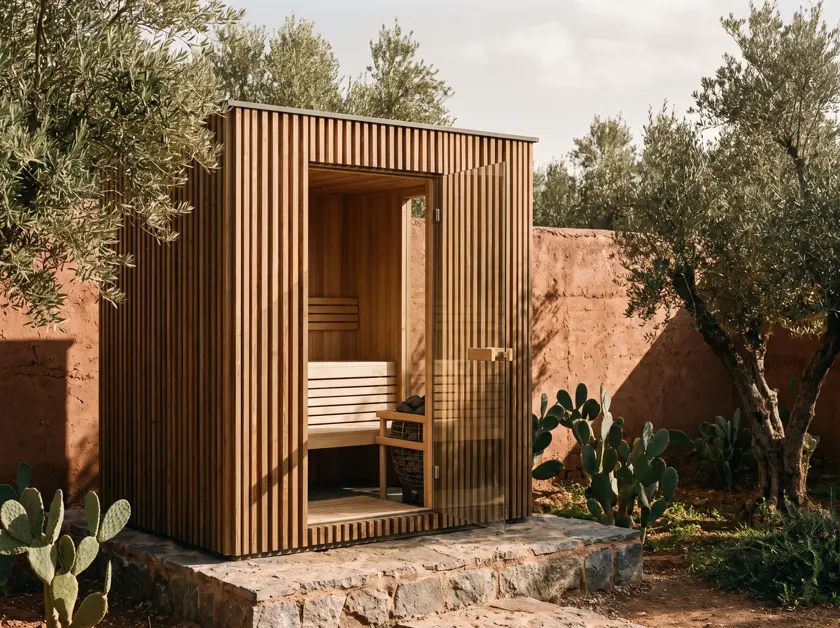
A sauna is the dry counterpart to the hammam, and in Morocco it is usually the second room rather than the fir…
Read more →