11 min
What a Sauna and Cold Plunge Cost Across Africa in 2026
An honest continental price breakdown: what a sauna and cold plunge cost in eight African countries, what move…
Read more →Almost every tile shop in Morocco will sell you something called zellige. Most of it is not. The difference matters, and it is easy to see once you know what to look at.
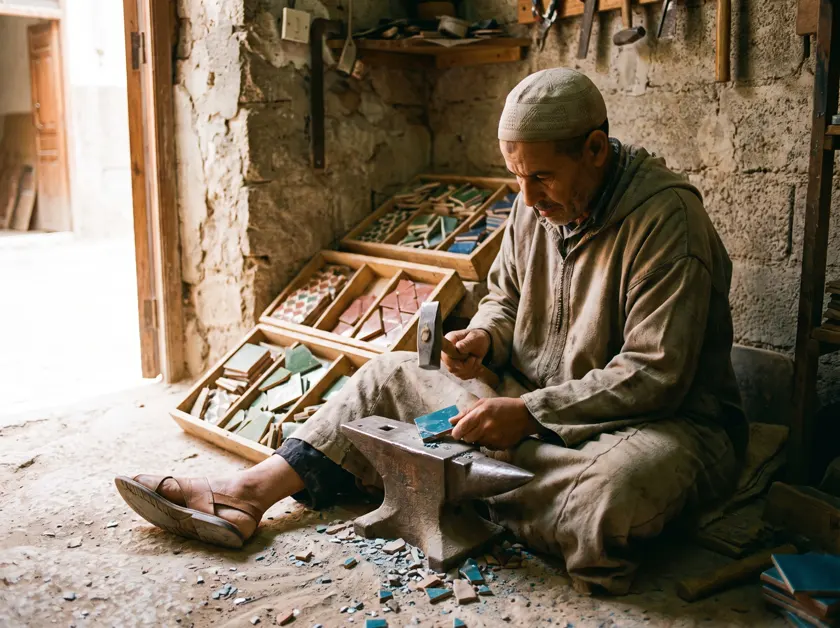
Zellige starts as grey clay from the plains around Fès. It is hand-formed into square tiles, dried in the sun, fired, glazed, and fired again. The resulting glazed square is then chipped to shape — by hand, one piece at a time, with a sharp-edged hammer, by a craftsman sitting on the floor of a workshop.
The shapes are geometric units with names: the eight-pointed star, the diamond, the hexagon, the elongated leaf. They are cut face-up but assembled face-down into a pattern, then backed with mortar and lifted into place as a panel. Nobody lays zellige piece by piece on a wall.
That process is why a real zellige panel has the qualities it has, and why nothing printed can imitate them.
Edges. Real zellige is chipped, so every edge is faceted and slightly irregular. Under a low light the joints have a fine shadow line that moves as you move. A pressed or printed tile has clean machine edges and uniform joints.
Surface. Traditional glaze is applied by hand and fired in a wood kiln, so it pools, varies in thickness and carries small imperfections — pinholes, crazing, variation in depth of colour across a single piece. That variation is the material. A uniform surface is a factory.
Colour across the panel. In a real panel, no two pieces of the same nominal colour are identical. The whole surface shifts slightly as the light moves. A printed imitation repeats — and once you have seen the repeat, you cannot unsee it.
Thickness and back. Real zellige is thick, heavy and has an unglazed terracotta back with mortar keying. Pick a loose piece up: it should feel substantial and unrefined on the reverse.
Because real zellige is slow. A craftsman cuts a limited number of pieces a day, and a complex panel is weeks of work before it reaches your wall. That labour is most of the price.
Printed and pressed imitations cost a fraction and go up in a day. For a large floor area in a commercial project where budget is fixed, that trade-off is sometimes the right one — but it should be a decision, not something that happens to you because a supplier used the same word for both.
It is at its best where it is seen close and where light rakes across it: the surround of a heated slab, a band at seat height, the inside of a washing niche, the wall behind a brass tap.
It is at its worst spread thinly over a large area because the budget had to cover everything. A small area of real zellige against tadelakt is more impressive, cheaper and more honest than a whole room of the substitute.
Technically it behaves well in heat and humidity — it is glazed terracotta on a waterproof substrate, and it has been doing this job in Moroccan hammams for centuries. The part that needs specifying properly is the grout and the substrate behind it, not the tile.
Go to the workshop if you can. In Fès you can stand in the room where it is cut, watch a piece being shaped and choose a glaze from what is coming out of the kiln rather than from a sample board. For a Fès project that also shortens the lead time on the component that usually sets the pace.
Ask to see cut pieces, not a finished panel photograph. Ask what the lead time is for the quantity you need, and be suspicious of an answer measured in days.
Expect variation and accept it in writing. A supplier who guarantees perfect colour consistency across a large order is either not selling you zellige or is going to disappoint you.
In our pricing, a private hammam in tadelakt sits in the 62 to 140 thousand dirham band and the same room with hand-cut zellige sits in the 95 to 170 band. The gap is the tile and the labour to cut and set it.
Within a project, the sensible way to control it is by area rather than by grade. Choose real zellige and use less of it. We would rather design a room with one superb zellige wall and tadelakt elsewhere than a room tiled throughout in something that will look tired in five years.
Clean with mild soap and water. Avoid acids and strong descalers, which attack both the glaze crazing and the grout. Expect the crazing — the fine web of lines in the glaze — because it is a characteristic of a hand-glazed fired surface and not a defect.
If a piece is damaged, it can be cut out and replaced, and a good craftsman will match it closely enough that you will have to be told where the repair is. That is another thing a printed tile cannot offer: it either matches the batch or it does not.
Most disputes about zellige come from a drawing that said the word and nothing else. A specification that will not cause an argument names six things.
The shape and the pattern, by name, with a sketch. Zellige geometry is a system with conventions, and 'star pattern' is not a specification.
The glaze colour or colours, chosen from fired pieces rather than a printed card, with a signed sample retained on site for comparison when the panels arrive.
The joint width and the grout colour. On real zellige the joints are tight and the grout is usually close in tone to the tile, because the pattern should read as a surface rather than as a grid.
The substrate and the waterproofing behind it, which is our responsibility rather than the tile supplier's and is where wet-room failures actually originate.
The acceptance criteria for variation, agreed in advance and in writing. Real zellige varies. The question is not whether it will, but how much variation both sides consider correct — and settling that before the order is placed removes the single most common cause of a stalled site.
Finally, the lead time and the delivery date for the panels, because zellige is the component that most often sets the critical path in a Moroccan hammam.
Want this checked against your own room? Send us the dimensions and a photograph and we will come back with a drawing.
An honest continental price breakdown: what a sauna and cold plunge cost in eight African countries, what move…
Read more →
From Nairobi at 1,795 m to the Ngorongoro rim: why African highland saunas need a bigger heater, and why the s…
Read more →
An honest breakdown of private hammam prices in Morocco: what sits inside 60,000 dirhams, what takes a room pa…
Read more →