11 min
What a Sauna and Cold Plunge Cost Across Africa in 2026
An honest continental price breakdown: what a sauna and cold plunge cost in eight African countries, what move…
Read more →Nobody publishes these numbers here, so every conversation starts from nothing. Here is the arithmetic we use, including the two lines that are specific to this country.
Cabin volume first, because it drives timber, insulation and heater together. A two-person cabin is roughly a third of the material of a six-person one and half the heater.
Glass second: a heavier frame, more careful sealing and a bigger heater to cover the loss. In Nairobi, where the view is often the garden rather than a landscape, it is worth asking honestly whether you want it.
Location third, and this is the Kenyan line. A cabin for Karen and a cabin for Diani are not the same cabin. The coastal one gets A4 stainless throughout, sealed plant enclosures and deeper cavities, and that is a real percentage on the price.
Services fourth: a three-phase run from the board, a drain with a fall, and the slab check for anything holding water on a suspended floor.
Nairobi sits at about 1,795 metres. Thinner air carries less heat per kilowatt, so a heater chosen from a sea-level chart underperforms and the cabin tops out below temperature.
We apply an altitude correction and show it as its own line. In practice that usually means one step up the heater range for a Nairobi cabin compared with the same cabin in Mombasa — a modest cost on day one and the difference between a room you use and a room you apologise for.
It cuts the other way on the cold side: the same altitude means cool nights all year, so the chiller does less work and costs less to run. Nairobi is one of the cheapest places in Africa to hold cold water, and almost nobody selling equipment here says so.
A four-person cabin with one glass wall and an insulated plunge with a chiller, in a Karen garden. Roughly: timber and insulation the largest block, glass and frame next, chiller and filtration a significant block of their own, then heater and controls, then the plinth and the electrical run.
Labour is the part people underestimate. Wiring a three-phase circuit properly, testing and certifying it is not an afternoon, and neither is tanking a wet room if there is one.
A plunge tub carved from a single block of Kenyan basalt. Corner glazing with no post. A charred exterior over a pale interior. Three tiers of benching. Any two and you are near the top of the band.
None of it is waste; it is where money goes when the cabin is also the view from the house. But it should be chosen with the number visible, which is why our quotes itemise it.
A 9 kW heater pulls full load for the twenty to forty minute heat-up, then cycles at a third to a half of nameplate. An evening session is closer to 4-6 kWh than to 9.
The chiller is where Kenya differs from itself. In Nairobi it cycles and the monthly figure is modest. In Diani or Mombasa the same tub costs meaningfully more to hold at the same temperature, because the nights never help.
Service is half-yearly inland and quarterly at the coast and in the bush. That is not an upsell — it is the difference between equipment that lasts eight years and equipment that lasts three.
Everything imported lands at Mombasa. For a coastal project there is no road leg at all; for Nairobi it is a day's haulage on a corridor that carries most of East Africa's freight anyway.
Compare that with a landlocked project, where cargo lands at Mombasa and then spends five to ten days on the road plus a border crossing, and Kenya looks straightforward. We plan programmes around one arrival and do the groundwork while the container travels.
Was the heater sized with an altitude correction, and can I see it? If the answer is a chart with no mention of elevation, the cabin will disappoint in Nairobi.
Does the specification change for the coast, and how? A national quote for a Diani project is a quote for the wrong building.
What grade are the fixings? A4 stainless anywhere near salt, and nothing less.
What is the service interval for my location and what does a visit include? Six months everywhere in Kenya is a manual answer rather than a local one.
Put the services in first — drain, conduit, cable to the board — while the ground is open. They are what costs multiples to retrofit; a cabin is not.
In Nairobi, build the plunge before the sauna if you have to choose: with the altitude doing the work, a well-insulated shaded tub is cheap to run and immediately useful. On the coast, do the opposite, because the cold water there is the expensive half.
That single reversal is the most useful piece of advice in this article, and it is the one that most often surprises clients.
When one number is far below the others, the saving is nearly always in four invisible places.
Insulation thickness and quality, which at altitude matters more than it does at sea level because the heater has less margin to waste.
The heater size, taken from a sea-level chart. It is the cheapest way to make a quote look competitive and the fastest way to produce a cabin nobody uses.
Fixing grade, which is survivable in Nairobi and fatal within a kilometre of the Indian Ocean.
And the electrical work: a dedicated, correctly rated, RCD-protected circuit with a certificate, rather than a spur off something convenient. If a quote does not mention a certificate, ask why not.
People compare purchase prices and then live with running costs, which is the wrong way round. Over a decade the numbers that matter are electricity, service and replacement.
Electricity: dominated by the chiller, and therefore by location. A Nairobi installation with a shaded insulated tub is dramatically cheaper to run than the same thing in Diani, and over ten years that gap is larger than most of the differences in purchase price.
Service: half-yearly inland, quarterly at the coast and in the bush. Budget it as a fixed annual line from day one.
Replacement: stones every two to four years, a cartridge every service, an element when it goes. A well-maintained cabin should not need anything structural in ten years; a badly maintained one needs a heater in four.
Add those up before comparing two quotes, because the cheaper cabin is frequently the more expensive decade.
Want this checked against your own room? Send us the dimensions and a photograph and we will come back with a drawing.
An honest continental price breakdown: what a sauna and cold plunge cost in eight African countries, what move…
Read more →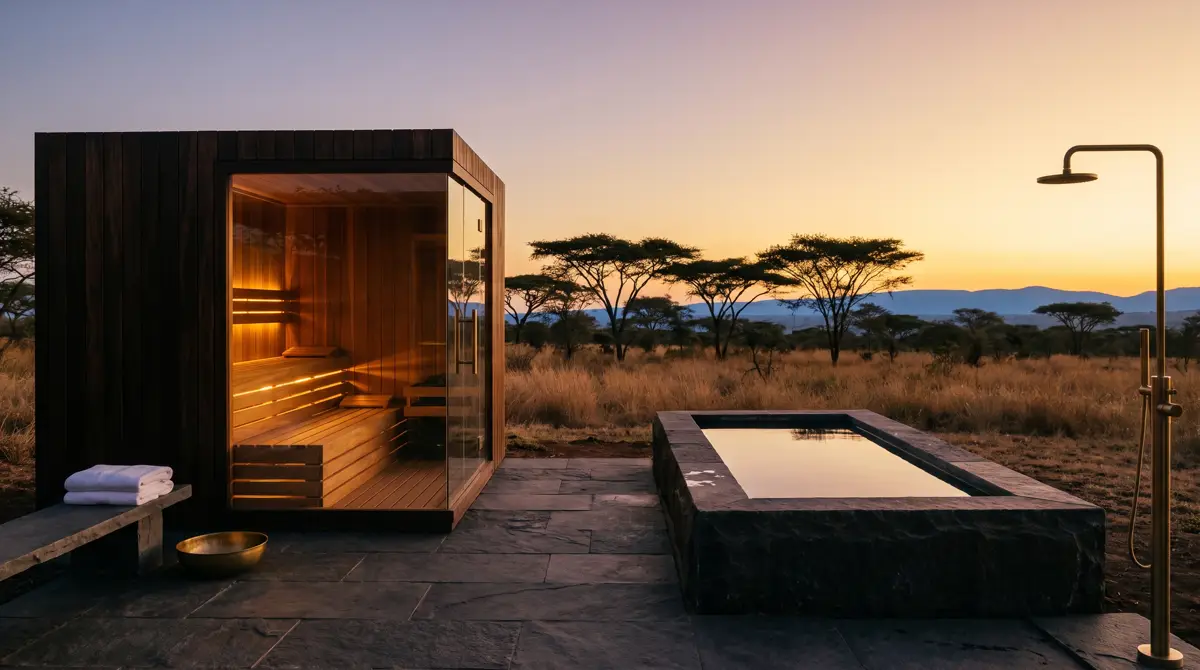
From Nairobi at 1,795 m to the Ngorongoro rim: why African highland saunas need a bigger heater, and why the s…
Read more →
Why the cold side is the difficult half of contrast therapy in Africa: chiller sizing for real tropical ambien…
Read more →