11 min
What a Sauna and Cold Plunge Cost Across Africa in 2026
An honest continental price breakdown: what a sauna and cold plunge cost in eight African countries, what move…
Read more →We will not hand you a return percentage. We will give you the market numbers with sources, the cost structure by location, and the arithmetic to run on your own figures.
Kenya recorded 7.9 million tourists in 2025 — 2.7 million international and 5.2 million domestic — generating around KSh 500 billion in earnings (Tourism Research Institute via ATTA; Citizen Digital).
International arrivals grew 9 per cent on 2024, more than double the global rate of 4 per cent (Xinhua). Africa is the largest source region at 47 per cent, ahead of Europe at 25 and the Americas at 14 (ATTA).
Two things matter in those numbers for a spa decision. First, the domestic and regional share is large and growing, and that guest books differently from a long-haul safari client. Second, growth is real rather than recovery, which means competition for it is about to intensify.
Rate and filter position. A property that can credibly list a sauna and cold plunge appears in more searches and competes in a higher bracket. Largest effect, hardest to isolate.
Treatment revenue, entirely dependent on staffing. A beautiful suite with nobody trained to sell treatments earns very little; a modest one with a good therapist earns steadily.
Reviews and repeat bookings. Wet areas appear in reviews disproportionately, and in the domestic and regional market — which is repeat-heavy — that matters more than it does for a once-in-a-lifetime safari guest.
A small hotel suite — sauna, steam, two plunge positions, rest — needs about 30 to 40 square metres plus 6 to 8 of plant, in our 3,000 to 6,500 thousand shilling band. A full safari lodge spa runs to 16,000.
Location changes the total meaningfully. A Nairobi property pays the least: modest corrections, cheap cold water, half-yearly service. A coastal property pays the marine premium and a larger chiller. A bush camp pays for dust packages, off-grid sequencing and quarterly service a long way from anywhere.
People. At minimum one trained person who owns the log. This is the cost most often omitted from the business case and the one most likely to decide whether the suite earns anything at all.
Take the annual running cost, add the build cost amortised over five years, and divide by your average achieved room rate. That is the number of additional room-nights a year the suite must produce to break even.
Compare with your current annual room-nights. A low single-digit percentage means build it. Ten per cent means be sceptical — then run the same sum for one excellent sauna and a properly built plunge, which in the camp and small-hotel segment frequently clears the bar when a full circuit does not.
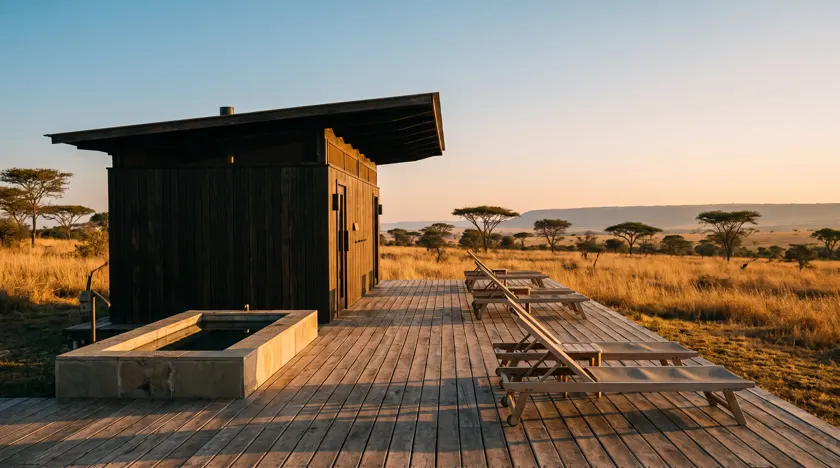
Camps have a narrow, intense peak — the ninety minutes after the afternoon drive — and a guest who is already having an extraordinary day. The spa does not have to be the reason they came; it has to be memorable in a way that reaches the review and the referral.
In practice that means a sauna and a plunge on a deck with a view, done beautifully, beats a small enclosed circuit. It also costs far less and it uses less water, which in the Mara is a genuine operating constraint rather than a talking point.
Specifying nationally. A coastal property built to a Nairobi specification will be replacing hardware in year two.
Ignoring altitude in the highlands, so the sauna never gets properly hot and guests describe it as weak.
Buying a chiller for a Nairobi property that would have been happy at 15 °C without one, then paying to run it. And, conversely, under-sizing one at the coast.
And staffing it as an afterthought, which turns a capital asset into a maintenance liability that generates nothing.
Many Kenyan hotels and lodges already have a spa room built a decade or more ago that no longer performs. Opening one up typically reveals an under-sized or absent chiller, a heater specified without an altitude correction, corroded coastal fixings and stones that were never turned.
Refurbishing is far cheaper than building new, the floor area already exists and the guest expectation is set. It is also the moment to fix the specification for the actual location rather than repeating the original mistake.
We survey before quoting a refit, because a refit priced from a walk-through is a refit whose price changes in week two.
One well-built sauna, sized for your altitude. One properly insulated and shaded plunge. A rest area with shade and water. And the drainage, extract and electrical capacity for whatever comes later.
In Nairobi that package may not need a chiller at all, which makes it cheaper again. It photographs well, it survives its climate and it moves the property into the same search filter as far more expensive suites.
Everything else can follow — provided the services went in at the start, which is the one thing we would insist on regardless of budget.
Decide before opening which four numbers you will track, and review them at six months with the first full service visit.
Treatment revenue per available room-night, rather than per treatment — it exposes a staffing problem faster than anything else.
The share of direct enquiries that mention the spa. One question on the booking form and a season of answers beats any projection.
Review mentions split positive and negative, because in a repeat-heavy domestic and regional market those mentions convert directly into next year's bookings.
Energy against occupancy. If consumption stays flat while occupancy falls, something is running that should not be.
Kenya's 5.2 million domestic travellers and the large regional share behave differently from a long-haul safari guest. They book shorter, closer to the date, and they return.
That makes a wet area unusually valuable in this market, because it is a reason to come back to the same property rather than a once-only novelty. It also means the suite has to survive high-frequency use rather than occasional use, which is a durability specification.
For a Nairobi city hotel or a lake property, we would design for repeat local guests explicitly: robust finishes, simple controls, a visible cleaning schedule and a temperature that is the same every single visit. Consistency is what a returning customer notices, and it is cheaper to deliver than luxury.
Want this checked against your own room? Send us the dimensions and a photograph and we will come back with a drawing.
An honest continental price breakdown: what a sauna and cold plunge cost in eight African countries, what move…
Read more →An honest breakdown of sauna and cold plunge prices in Kenya: what sits inside KSh 500,000, what pushes a proj…
Read more →
From Nairobi at 1,795 m to the Ngorongoro rim: why African highland saunas need a bigger heater, and why the s…
Read more →