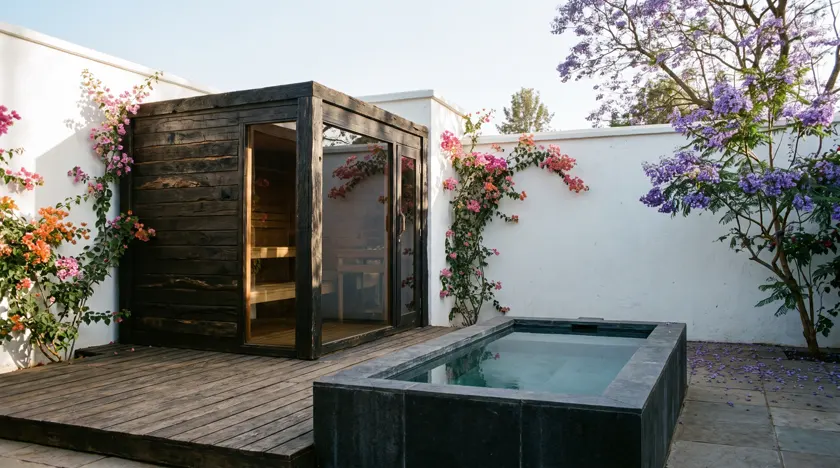
Nairobi
Nairobi
Custom saunas, steam rooms and cold plunges in Nairobi, heaters sized for 1,795 m. Factory-built since 1987, i…
Read more →A sauna in the Mara is built for a camp that has no grid, trucks its water and fills up in the ninety minutes after the afternoon drive. We design it as an East African safari-camp installation from the start: small loads, little water, a light footprint, and a team on site who can keep it running.
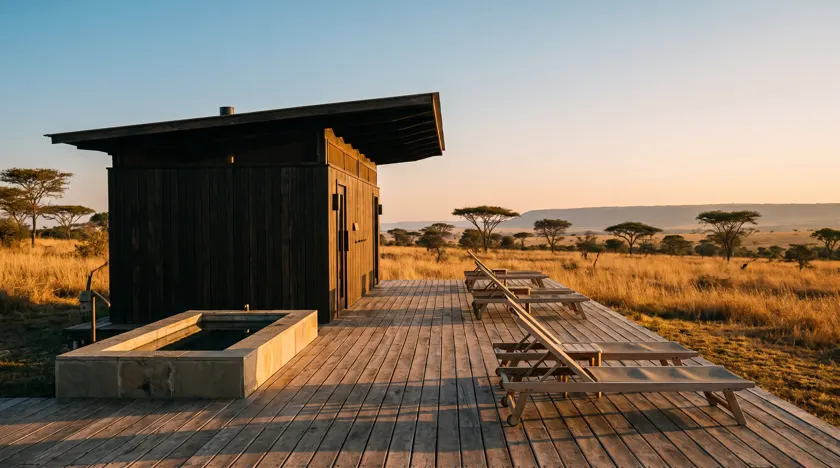
The order we follow on every camp project:
The cabin has already been put together once at our Istanbul factory and inspected there, so in camp the crew spends days, not weeks: assembly, commissioning, then training.
An eco sauna here is less about labels and more about loads and traces. Heat only when guests are due; hold the plunge under a lid instead of pulling it down every afternoon; treat the water with ozone so it drains cleanly into the camp's grey-water system; and build on a structure that can be removed without leaving concrete in a conservancy.
Guests pay Narok County's reserve fee of up to US$200 per adult per day in peak season (Narok County, 2024 tariff), and they expect the camp to match that standard quietly. A well-made cabin on a deck facing the plains does that without adding a generator run. It also photographs well for the agents who sell the camp, which is where much of a Mara lodge's marketing still happens.
| Camp item | Indicative, thousand KES |
|---|---|
| Two-person cabin for a small camp | 390 – 560 |
| Chilled tub for dry-season afternoons | 440 – 950 |
| Pre-filters, sealed plant housing, spares box | 120 – 290 |
| Complete camp spa, solar-sequenced | 6,800 – 16,000 |
The lodge and camp spa page covers larger thermal suites; for a single tub, see cold plunge prices in Kenya.
Crates clear at Mombasa and come via Nairobi and Narok, with the last stretch on murram that decides the delivery date in the rains. We send everything in one load, checked off in the factory, so nothing is waiting on a second truck. Tell us how the camp is powered and how many litres a day you can spare; within a business day a project manager answers with pictures of comparable installations and an opening budget.
In the Mara a sauna has to fit a camp's solar array, its water truck and the ninety minutes after the evening game drive, when every guest comes back at once.
Most camps bring water in by bowser or ration a borehole, so the tub's volume is set by what the camp can spare each day. An insulated tub with a lid loses a fraction of what an open one gives up to dry-season wind, and in the Mara that saving is measured in truckloads.
The heater and chiller are the camp's two largest electrical loads and they are never allowed to start together. We program the controls to stagger them and agree the numbers with the camp's solar installer instead of guessing. A 6 kW heater warmed up at midday, when the panels are producing most, can be carried by a mid-sized camp array; the same heater switched on at dusk drains the batteries the guests need for lights and fans overnight.
A condenser in the Mara is coated in dust within weeks of the grass drying out, so plant sits in a sealed, shaded housing with washable filters and a three-month check. A box of labelled spares stays on site, since a missing gasket otherwise means a long drive from Narok.
Game drives return within the same half hour, dusty and cold in the July wind. Two plunge positions for every eight sauna seats keeps the circuit moving; a shaded deck with water and blankets matters as much as the rooms themselves.
Where guests arrive in waves, we set the heater to reach temperature just before the vehicles are due back, so the batteries are not holding a hot cabin through an empty afternoon.
Many Mara conservancies expect camps to leave little permanent trace. A cabin on a raised timber deck or a bolted steel frame, with no poured foundation, can be lifted and moved at the end of a lease. Plunge water treated with ozone rather than chlorine is easier to drain responsibly into the camp's grey-water system.
Where firewood is restricted, a wood-fired heater can burn briquettes instead; where it is not, the stove still needs a spark arrestor under dry-season canvas.
There is no technician down the road, so handover is a proper training session: how to clean the pre-filters, read the chiller display, turn the sauna stones, and restart the sequence after a generator changeover. The written checklist stays in the camp store with the spares box.
A six-month maintenance visit is scheduled at handover, grouped with other properties along the Narok road where possible.
Yes — heat the cabin between late morning and mid-afternoon while the panels have spare output, and never let the chiller start in the same minute. With a small array, burn wood instead and the batteries are untouched.
Yes. In Uganda our team completed the sauna and wet areas of the Rock Classic Hotel in Tororo, and a large spa for a five-star hotel in Addis Ababa is currently in production.
A two-person tub holds roughly 700–900 litres. With filtration, ozone and a lid it is topped up rather than refilled, and drained every few weeks instead of daily.
Yes, with loads staggered and the tub sized to the water allowance.
Tell us the neighbourhood, send a photo of the space and the rough size. We reply within one business day with photos of comparable finished rooms and an itemised quote.
Custom saunas, steam rooms and cold plunges in Nairobi, heaters sized for 1,795 m. Factory-built since 1987, i…
Read more →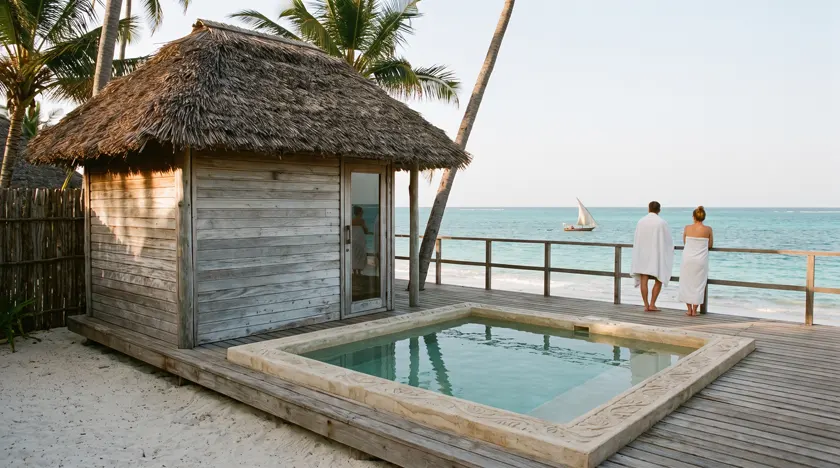
Saunas, steam rooms and cold plunges for Diani, Mombasa and Watamu villas and hotels: A4 stainless, sealed chi…
Read more →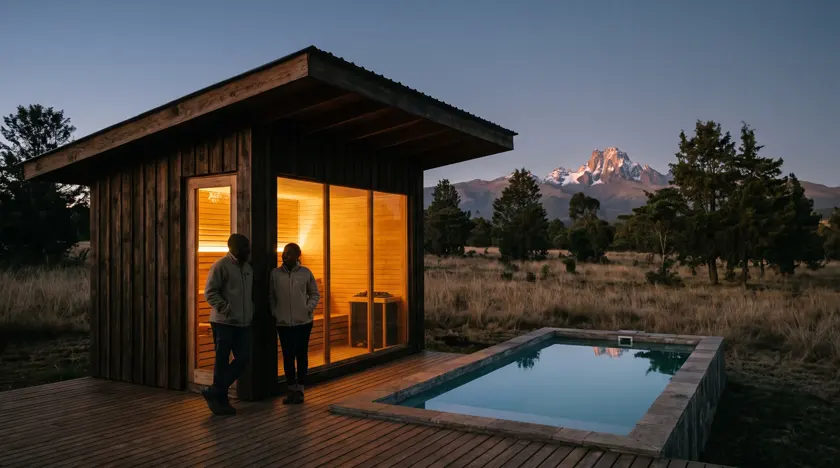
Saunas and cold plunges for Laikipia lodges, Nanyuki homes and Naivasha lake houses: altitude-sized heaters, w…
Read more →