
11 min
What a Sauna and Cold Plunge Cost Across Africa in 2026
An honest continental price breakdown: what a sauna and cold plunge cost in eight African countries, what move…
Read more →A national specification is wrong in at least two of the three places we work. Here is exactly what changes and why.
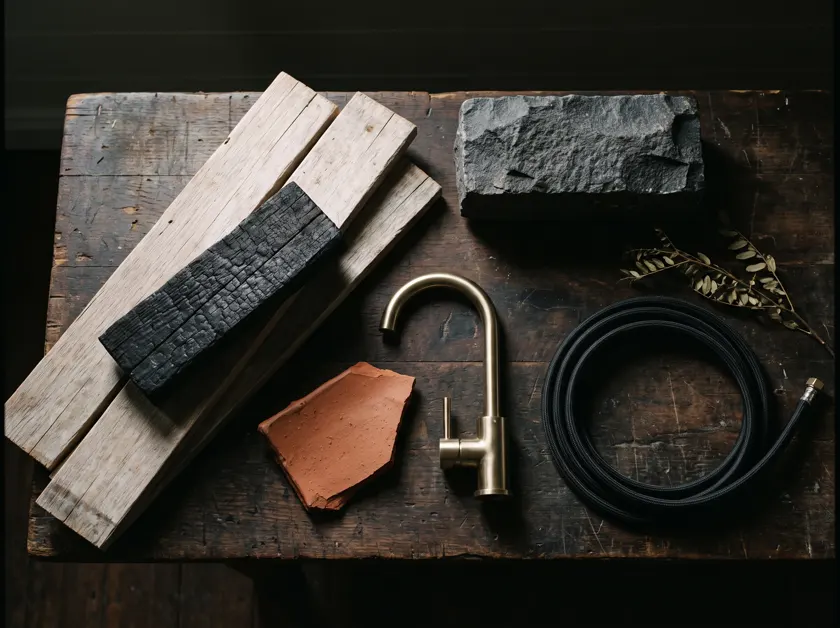
At 1,795 metres the air is thin, the nights are cool, the humidity is moderate and there is no salt. That produces the most forgiving specification in the country.
Heater sized up for altitude. A2 fixings are adequate. A run-on timer is sufficient ventilation for most rooms. Service half-yearly. Dust from murram roads is the only real nuisance, and washable pre-filters handle it.
This is also where cold water is cheapest, so a Nairobi installation often delivers more for less money than the same brief anywhere else in Kenya.
Sea level, hot, humid and salty every day of the year. The specification changes in five places at once.
A4 stainless throughout, including fixings nobody sees. Sealed and filtered plant enclosures. Deeper drained cavities behind cladding, with end grain sealed before assembly. Humidistat-controlled extract, because the room will not dry on its own. And a chiller a size up from the highland figure.
Service quarterly, with a corrosion inspection at every visit. Salt failures start at the smallest metal parts and they are visible from two metres away if somebody is asked to look.
Dust rather than salt, heat rather than humidity, and usually off-grid power. A different set of problems again.
Washable pre-filters on everything with a fan, sealed plant housings, shaded siting with real clearance, and a three-month service interval in the dry season. Heater and chiller sequenced in the controls so they never start together on a generator. And the plunge sized to the water budget, because most camps truck or borehole their water.
Laikipia adds altitude on top of all of that, which is the one combination that needs every correction at once.
The physics of the heater: volume, altitude, glazing, rounded up to a real product. The insulation standard, which is the highest-return decision in every climate for different reasons. The wet-room fundamentals: membrane, falls, pitched ceiling, serviceable plant, a drain that lifts and rods.
And the maintenance discipline: turn the stones, descale the generator, clean the condenser. The interval changes by location; the necessity does not.
Nairobi mains, a Naivasha borehole, a coastal supply and a bush borehole are four different chemistries. Hardness decides the steam generator's descaling interval; dissolved solids decide how often the tank needs dumping; some Rift Valley boreholes carry fluoride levels worth knowing about.
We test at the property before specifying a generator. It takes ten minutes and it is the difference between a ten-year item and a two-year one.
Kenyans move between these environments more than most, and we are regularly asked to relocate a cabin from Nairobi to the coast or vice versa.
It is usually possible if the cabin was built on a bolted frame, but the specification has to change: coastal fixings, deeper cavity and humidistat extract going one way; an altitude heater correction going the other.
We survey before promising, and we will say when a relocation is not worth it rather than hand you a cabin that will disappoint in its new climate.
If a supplier quotes the same cabin for Karen, Diani and the Mara, they are quoting the wrong building for at least two of them. The differences are not cosmetic and they are cheap to get right at build time.
Ask: what fixing grade for my location, what cavity and cladding, what ventilation control, what heater correction, what service interval. Five questions. Anyone who has genuinely worked across this country answers all five without pausing.
The cost difference between the correct specification and the generic one is a single-digit percentage of the project. The cost of getting it wrong is a rebuild.
Six questions, one location, and any builder who has genuinely worked across Kenya will answer all six without hesitating.
What fixing grade, for my location? What cladding and cavity detail? What ventilation control — timer or humidistat? What heater correction for my elevation, and can I see the calculation? What service interval, and what does a visit include? And what water test did you do before specifying the steam generator?
If the answers are the same regardless of where the project is, you are being quoted a catalogue rather than a building.
It is worth being clear about what does not change, because it would be easy to read this article as saying that coastal work is simply better built.
Every cabin we make, wherever it goes, gets the same insulation standard, the same vapour barrier discipline, the same bench detailing, the same heater arithmetic and the same commissioning routine with a thermometer and a stopwatch.
What changes is the interface with the environment: metal grade, cavity depth, ventilation control, plant enclosure, chiller size and service interval. The box is the same box. The armour around it is not.
That distinction matters when you are comparing suppliers, because a builder who changes the box for different markets is usually cutting something, and a builder who changes nothing at all has not thought about the coast.
There is a fourth case that does not fit neatly into highland, coast or bush, and it is Kisumu and the lake basin.
At around 1,130 metres it is well below Nairobi, so the altitude correction is small. But it is hot, low-lying and humid from the lake, which puts its cooling requirement closer to a coastal figure than a highland one.
What it does not have is salt, so fixings and plant enclosures can be specified inland-style. The result is an unusual combination: coastal cooling, highland metalwork, and ventilation that has to be as good as anything we do in Mombasa.
We mention it because it is the specification most often got wrong by suppliers working from a two-way highland-or-coast mental model. Naivasha sits in a similar gap, with lake humidity, valley dust and borehole water chemistry all at once.
Take three readings over a week in the season you expect to use the room most: air temperature at dawn, air temperature at three in the afternoon, and relative humidity at dusk.
Cool dawn and moderate humidity means you are in the highland case and cold water will be cheap. Warm dawn means you are in a coastal-style cooling case regardless of how far you are from the sea. High dusk humidity means you need a humidistat rather than a timer.
Send us those three numbers with your enquiry and we can size most of the installation before we visit. It is a better basis for a quote than the name of the town.
Want this checked against your own room? Send us the dimensions and a photograph and we will come back with a drawing.
An honest continental price breakdown: what a sauna and cold plunge cost in eight African countries, what move…
Read more →An honest breakdown of sauna and cold plunge prices in Kenya: what sits inside KSh 500,000, what pushes a proj…
Read more →
From Nairobi at 1,795 m to the Ngorongoro rim: why African highland saunas need a bigger heater, and why the s…
Read more →