
11 min
What a Sauna and Cold Plunge Cost Across Africa in 2026
An honest continental price breakdown: what a sauna and cold plunge cost in eight African countries, what move…
Read more →The commonest fault we are called to in Nairobi is a cabin that never gets properly hot. Nine times out of ten the heater is fine — it was simply chosen from a chart written for sea level.
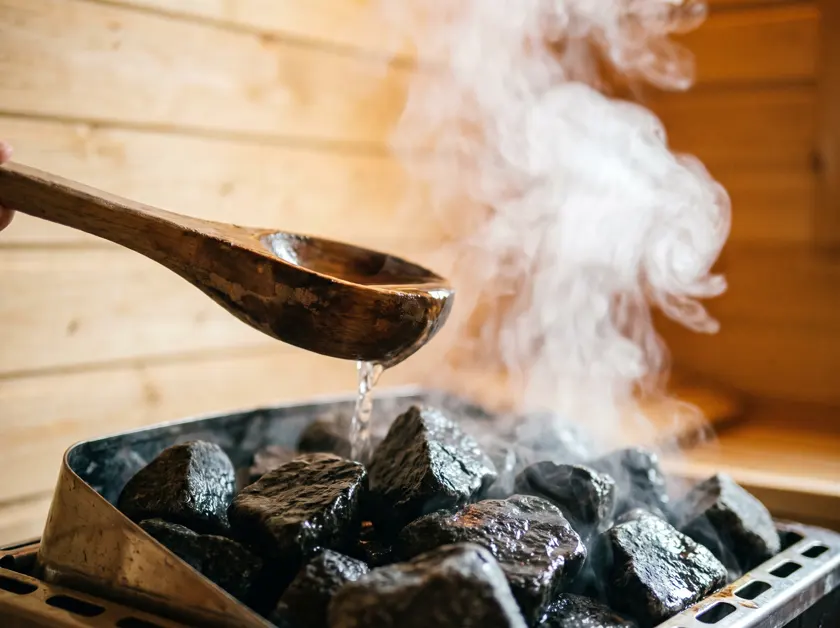
A convection sauna heats the room by heating air and letting it circulate. Air at 1,795 metres is meaningfully less dense than air at sea level, so the same heater is moving less mass of air per kilowatt and delivering less heat into the room per minute.
The cabin still reaches a temperature; it simply reaches a lower one, more slowly, and struggles more the moment the door opens or someone throws water on the stones.
Start with volume: roughly 0.85 kW per cubic metre of well-insulated cabin. A 2.0 by 2.4 metre cabin at 2.1 metres high is about ten cubic metres, so 8.5 kW before anything else.
Apply the altitude correction for the site's actual elevation. In Nairobi that takes the figure meaningfully above the sea-level number, and in Nanyuki or Laikipia it goes higher again.
Then add capacity for glazing at roughly 0.42 kW per square metre, because glass loses heat far faster than an insulated wall. Round up to the next heater in the range that we can actually buy.
We show all four steps in the quote. A client who can see the arithmetic can argue with it, which is the point.
The altitude correction frequently pushes a cabin from the 8 kW band into the 9 or 10.5 kW band, and that is where single-phase stops being sensible.
Kenya supplies 240 V single phase and 415 V three phase. Most established Nairobi properties have three-phase available or easily arranged; apartments frequently do not. That is worth establishing before you fall in love with a cabin size.
Where three-phase is genuinely unavailable, the honest answer is a smaller cabin correctly sized rather than a larger one that will disappoint.
At altitude, insulation does more work than it does at sea level, because the heater has less margin to waste. A well-insulated cabin at 1,795 metres will outperform a poorly insulated one with a larger heater, and cost less to run for its whole life.
If you have budget for exactly one upgrade on a Nairobi cabin, it is insulation, not size.
Here is the compensation, and it is substantial. A chiller fights the gap between target water temperature and surrounding air. Nairobi's nights are cool all year, so that gap narrows dramatically for a large part of every day.
A shaded, insulated, lidded tub in Karen spends the night losing very little. The compressor cycles rather than running, the monthly bill is modest and the unit lasts longer, because compressor wear tracks run hours far more closely than age.
The same tub in Diani has no such help. Sized and run identically, it costs materially more every month.
Nairobi at 1,795 m: meaningful correction, cheap cold water. Nanyuki and Laikipia, higher again: larger correction, cold water almost free. Kisumu at around 1,130 m: small correction, cooling closer to a coastal figure. Mombasa and Diani at sea level: no correction, and the chiller works all year.
One national specification gets at least two of those four wrong, which is why we quote by location.
Time it from cold. A well-specified four-person cabin should be at working temperature in twenty to forty minutes depending on insulation. If yours takes an hour, something is wrong.
Watch what happens after a ladle of water: the temperature should recover within a minute or two. If the room takes ten minutes to come back, the heater has no margin.
And check the top bench. If the difference between the top bench and the floor is small, the room is not circulating properly, which is usually a vent problem rather than a heater one — worth checking before spending money.
Replacing an under-sized heater in an otherwise sound cabin is a fraction of the cost of a rebuild and it transforms the room. We do several of these a year, usually on cabins built by somebody who quoted nationally.
Before we do, we check the insulation and the vents, because occasionally the heater is adequate and the cabin is simply leaking heat through a gap somebody never sealed. That fix is cheaper still.
The correction applies to wood-fired heaters too, and rather more bluntly: combustion itself is affected by thinner air, not just the convection.
At Nanyuki or Laikipia elevations a wood stove sized for a European cabin will be sluggish, smoky on start-up and slow to reach temperature. The fix is a larger firebox and a taller flue to get the draught working, both of which are decisions made when the cabin is drawn rather than afterwards.
It is worth the trouble at a remote lodge: the fire is part of the evening, the fuel is local and it works when the power does not. But it has to be specified for the elevation, not bought off a European catalogue page.
We commission every cabin from cold with a thermometer and a stopwatch, and we write the result in the handover notes: time from cold to working temperature, and recovery time after a ladle of water.
Those two numbers are the honest measure of whether the sizing was right, and they give you something to compare against in three years when somebody says the sauna feels weaker than it used to.
We also set the vents with the room hot rather than from a drawing. Inlet low, outlet high, adjusted until the air actually crosses the room instead of short-circuiting between two grilles. A correctly sized heater in a badly vented cabin still produces a disappointing room, and that is a ten-minute fix at commissioning and an annoying one later.
The heater is where altitude bites hardest, but it is not the only place it shows up.
Ventilation: thinner air means slightly less mass moved for the same volume flow, so we are marginally more generous with vent sizing in highland cabins than we would be at the coast. It costs nothing and it helps the room feel even.
Steam generators: boiling point falls with altitude, which sounds helpful and mostly is — the generator reaches steam faster. What it also means is that a unit set up for sea level can short-cycle at altitude, so we commission the controls on site rather than trusting a factory setting.
And the chiller, in the other direction entirely: thinner air is slightly less effective at carrying heat away from a condenser, which offsets a small part of the cool-night advantage. Not enough to change the sizing, but enough that we give the condenser generous clearance rather than a tight enclosure.
None of these are dramatic on their own. Together they are the difference between a highland installation that behaves exactly as specified and one that is subtly disappointing in three different ways at once.
Want this checked against your own room? Send us the dimensions and a photograph and we will come back with a drawing.
An honest continental price breakdown: what a sauna and cold plunge cost in eight African countries, what move…
Read more →An honest breakdown of sauna and cold plunge prices in Kenya: what sits inside KSh 500,000, what pushes a proj…
Read more →
From Nairobi at 1,795 m to the Ngorongoro rim: why African highland saunas need a bigger heater, and why the s…
Read more →