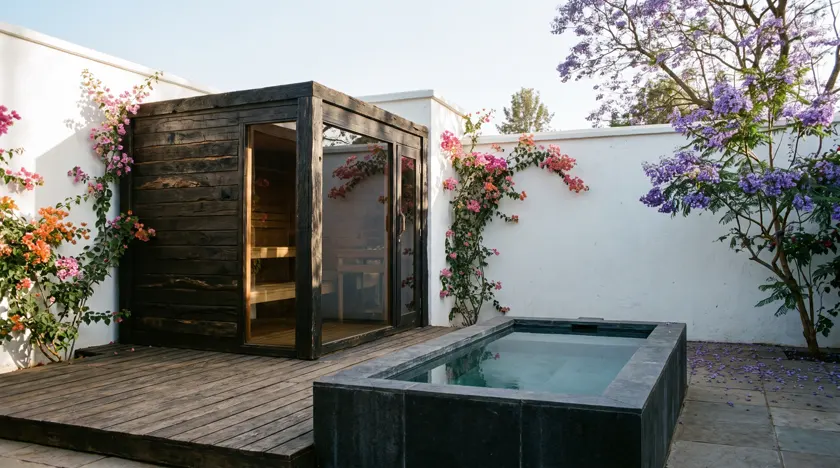
Nairobi
Nairobi
Custom saunas, steam rooms and cold plunges in Nairobi, heaters sized for 1,795 m. Factory-built since 1987, i…
Read more →North and west of Nairobi the land climbs again. Laikipia's conservancies, the ranches and hotels around Nanyuki under Mount Kenya, and the houses on Lake Naivasha all sit higher than or level with the capital, with colder nights, longer supply lines and, often, no grid at all.
In this guide: Laikipia conservancies · Nanyuki · Naivasha
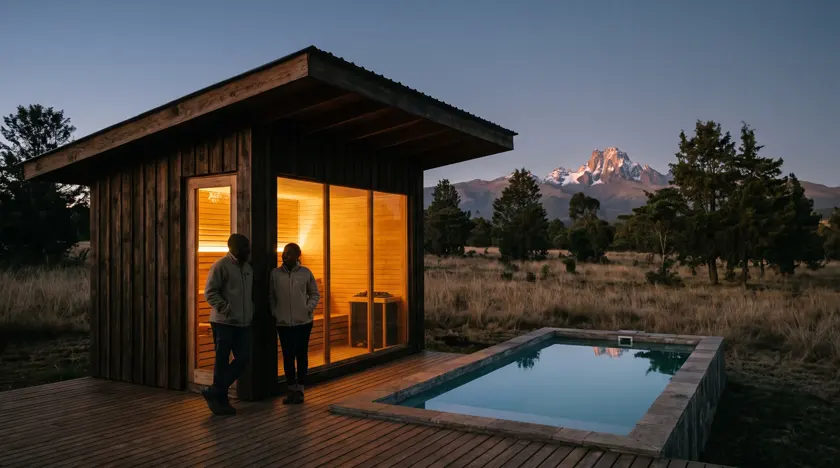
In Laikipia the client is usually a conservancy lodge or a private ranch house: a sauna for guests back from a walking safari, a plunge fed by cold mountain water. Around Nanyuki it is ranch houses and small hotels hosting climbers off Mount Kenya. At Naivasha it is weekend houses and small lodges an easy drive from Nairobi.
All three benefit from the same safari lodge spa approach — staggered loads, dust filtration, a spares box — and a sauna heater sized for altitude.
Nanyuki sits close to 1,950 metres and many Laikipia lodges are higher still, so the heater correction is at least Nairobi's and often more. The same thin, cold air means a lidded plunge may need only a small chiller, and pipework has to stay inside the insulated envelope on the coldest July nights.
Nanyuki and Naivasha towns have Kenya Power at 240 V and 415 V. Out on the conservancies most lodges run solar with a generator behind it, and a wood-fired heater often makes more sense than an electric one: no load on the batteries, local fuel, and a fire guests enjoy.
| Item | Indicative, thousand KES |
|---|---|
| Sauna, 4 person, one glass wall | 580 – 870 |
| Plunge tub, no chiller | 240 – 400 |
| Dust package for bush lodges | 120 – 290 |
| Full safari lodge spa | 6,800 – 16,000 |
Crates travel from Mombasa via Nairobi, then up the A2 to Nanyuki or out along the Naivasha road, in one consolidated load; manufacturing takes six to ten weeks a room once the drawing is agreed, before the sea and road legs. Tell us the elevation and the power setup, and we will send photos of lodge projects and a first budget.
Laikipia is bush and highland at the same time: wildlife conservancies on a plateau high above the sea, with cold nights, fierce dry-season dust, solar power and a long road from Nairobi.
The altitude calls for a bigger heater, the bush calls for dust protection, and the conservancy's off-grid power calls for load sequencing. In Laikipia all three apply together, and we specify for each separately rather than choosing one.
In return, the cold plunge almost looks after itself; nights up here do most of a chiller's job.
Laikipia has excellent building stone and lodges here already use it. Plinths, plunge surrounds and outdoor benches can be built by the lodge's own masons from local stone to our drawing, while the hot-room timber, the cabin and the equipment arrive crated from our factory.
The road from Nairobi is long. Everything is dry-assembled in the factory, packed to a checklist and sent up in a single load with spares. On site our crew is assembling rather than building, and it trains the lodge team during those days.
Many Laikipia properties draw from boreholes or from streams off the Aberdares and Mount Kenya. Stream water arrives cold and soft, which suits a plunge; borehole water can be hard and needs testing before a steam generator is chosen. A plunge filled from a cold source and kept under a lid may need only a small chiller for the warm dry-season afternoons.
Nanyuki straddles the equator on the north-west shoulder of Mount Kenya, higher than Nairobi and colder at night — the one Kenyan town where nobody needs persuading about a sauna.
Nanyuki's elevation means a larger heater correction than the capital's, and floors insulated as carefully as walls, because cabins here stand on cold ground.
The plunge benefits. Water from the mountain is already cold, so a basin needs little or no chiller; the pipework, though, must run inside the insulated shell because the coldest nights come close to frost.
This is where we most often suggest a wood-burning heater. Firewood is available locally, a fire suits guests coming in from a day on the mountain, and it keeps working through a power cut — which in rural Laikipia happens more than in Nairobi.
Many lodges outside town rely on solar backed by a generator, so the heater and chiller are never allowed to start together. Dry-season dust calls for washable filters and a three-month maintenance interval.
Nanyuki is where climbers come down from the Sirimon and Naro Moru routes on Mount Kenya, and where ranch houses and small hotels host them afterwards. A hot cabin and a cold tub after four days on the mountain is an easy thing to sell; the specification simply has to cope with a full group arriving at once.
Town supply is 240 V single phase with three-phase on larger properties, and outages are common enough that a wood-fired heater makes sense even on a connected site.
Naivasha is where Nairobi goes at the weekend: lake houses and small lodges busy from Friday night to Sunday afternoon and quiet the rest of the week, most of them drawing water from a borehole.
Rift Valley groundwater is often high in fluoride and dissolved minerals. For a steam generator that changes everything — the model, the pre-treatment and the descaling interval — so the water is tested at the property before anything is ordered.
Sometimes a softener in front of the generator solves it; sometimes the answer is a generator built for hard water.
A room used twice a week wants a schedule: the sauna warm when the car arrives on Friday, the plunge holding a setpoint all week rather than being switched off, and a drying cycle after the last session on Sunday.
In the dry months the valley is dusty; near the shore the air is humid. The equipment needs washable intake filters for the first and proper extract for the second, a combination that defeats plant specified for only one of them.
Naivasha is roughly ninety kilometres from Nairobi, so a lakeside suite can be installed in one crew visit without the camp-style logistics of the Mara. The houses around the south lake and the Kongoni side often have generous plots and three-phase supply, which makes a full-size cabin straightforward.
The water, not the distance, decides the programme here: the test result comes first, and the steam generator is ordered only once it is known.
Usually yes. We calculate on your lodge's actual elevation; above 2,000 m the correction is larger than Nairobi's.
Wood-fired in most off-grid cases. It needs no battery capacity and keeps working through a generator failure.
For a steady 8 °C in the dry-season afternoons, a small one. For 12–15 °C, a lidded tub fed with cold mountain water may manage without.
Both, and they are separate: altitude changes the heater, dust changes the service interval.
Yes. We recalculate for your plot's elevation, which is usually higher than the capital's.
Very much, especially for a steam room. We test the water before choosing the generator.
Tell us the neighbourhood, send a photo of the space and the rough size. We reply within one business day with photos of comparable finished rooms and an itemised quote.
Custom saunas, steam rooms and cold plunges in Nairobi, heaters sized for 1,795 m. Factory-built since 1987, i…
Read more →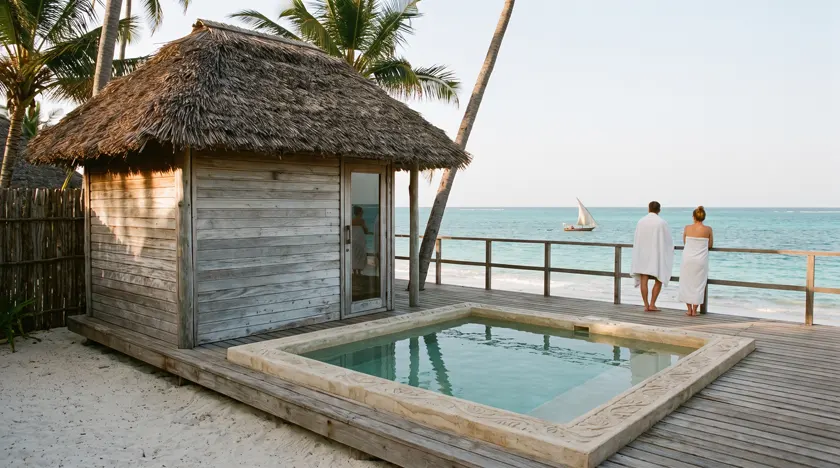
Saunas, steam rooms and cold plunges for Diani, Mombasa and Watamu villas and hotels: A4 stainless, sealed chi…
Read more →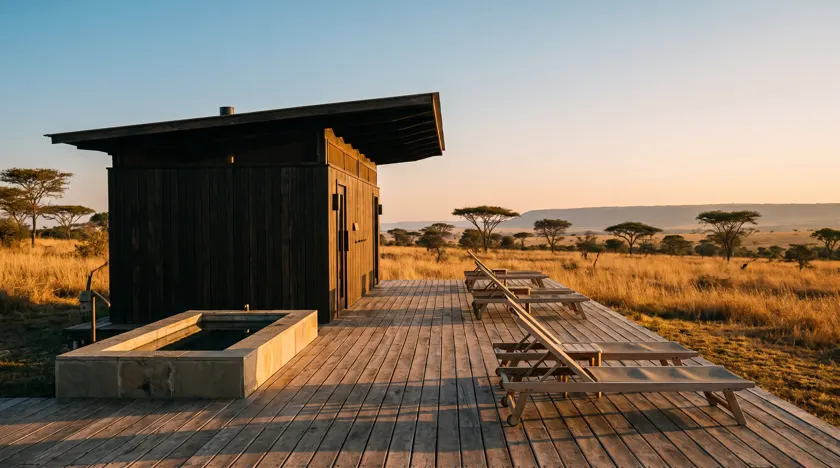
Off-grid saunas and plunge decks for Maasai Mara camps and conservancy lodges: solar-sequenced, dust-sealed, f…
Read more →