Saunas
Nairobi sits at about 1,795 metres, higher than Johannesburg. Thin air carries less heat per kilowatt, so ever…
Read more →A rugby fifteen comes off the pitch together, a padel ladder empties court by court, and a running group back from a long session in the Ngong Hills arrives in one bus. None of them fits a recovery corner built around one tub and a sign-up sheet.
Typical project in Kenya: KES 850k – 1,800k, supplied and installed · six to ten weeks per room after the drawing is approved, plus shipping.
Across the continent: Gym & club recovery zones in all eight countries →
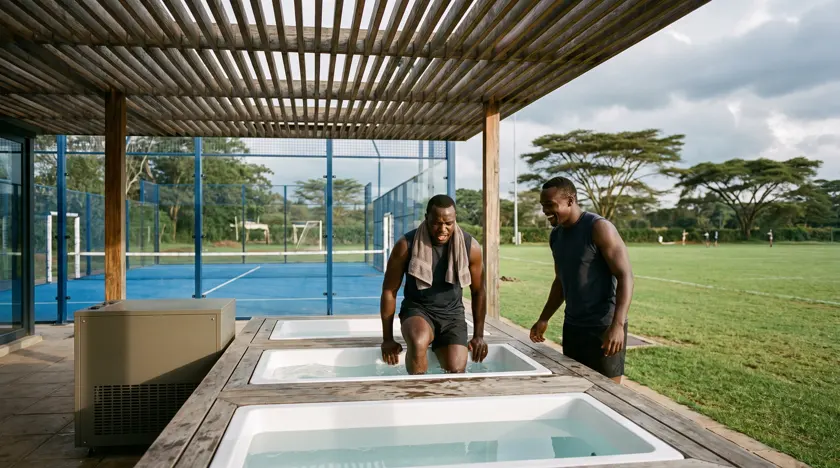
A cold plunge turns over one person every four to six minutes once you count getting in, three minutes in the water and climbing out, so each tub serves roughly a dozen bathers an hour. A rugby squad of twenty-five plus staff wants the same quarter of an hour after the final whistle, so a rugby club lands on four positions or accepts a queue that players stop joining.
Padel is gentler. Four players per court per ninety-minute slot means a six-court club sends about sixteen people an hour towards the water, and two tubs with a four-person sauna carry it. A Westlands gym is sized on the ninety minutes after the evening classes.
At 1,795 m shared water stays colder between sessions because the building never really warms up at night, so the chillers cycle rather than run and bacteria grow more slowly. It is a real running-cost advantage over a club at the coast or in Kisumu.
The sauna goes the other way. A commercial cabin gets its heater corrected for altitude and a door that closes itself, because a club sauna loses most of its heat to people holding the door open while they talk.
Fill a 900-litre tub and you have put nearly a tonne on the floor before a single player climbs in. In a Westlands or Upper Hill tower we ask for the slab detail and a structural engineer's confirmation before we quote; on a ground-floor clubhouse at Ngong Road we look at the drain run.
Floors slope to a channel drain, the tiles stay slip-resistant when wet with chlorinated water, and a towel point sits between the tubs and the gym floor so wet feet do not cross the weights area.
Every club tub has its own pump, a cartridge filter and ozone or UV dosing; players shower before they step in, and one named person signs the cleaning log each day. Drain intervals depend on use; a busy club tub is dumped far more often than a home one, and the plant room is laid out so that takes minutes, not an afternoon.
| Item | Indicative, thousand KES |
|---|---|
| Recovery zone: 2 tubs and a sauna | 850 – 1,800 |
| Additional plunge tub with chiller | 440 – 950 |
| Commercial sauna, 10–14 person | 1,400 – 2,900 |
| Three-phase supply work | 150 – 480 |
Everything is built in our factory, shipped through Mombasa and installed by our own crew, with a 24-month warranty. Send us the floor plan and your peak numbers, and a project manager will come back within one business day with a layout and an itemised quote.
Four for a full squad and staff. Two becomes a bottleneck and one becomes a queue nobody joins.
In the evening, yes — a four-person cabin next to two tubs gets steady use after late courts. We would not build a bigger sauna than that for a padel club.
Less than a club of the same size at the coast, because Nairobi's nights help the chillers. We give a monthly kWh estimate with the quote so you can price it against your own tariff.
Send us a photo of the spot and the rough size. Within one business day you get photos of comparable rooms we have finished and an itemised, position-by-position quote.
Nairobi sits at about 1,795 metres, higher than Johannesburg. Thin air carries less heat per kilowatt, so ever…
Read more →
A chiller fights the gap between the water and the air around it. In Nairobi that gap nearly closes overnight,…
Read more →
Steam rooms fail behind the finish. The tiles in a leaking room usually look perfect; it is the board, the joi…
Read more →