
11 min
What a Sauna and Cold Plunge Cost Across Africa in 2026
An honest continental price breakdown: what a sauna and cold plunge cost in eight African countries, what move…
Read more →Almost every coastal installation we are called to repair was built to an inland specification. The workmanship was usually fine. The specification was wrong from the first drawing.
Fixings go first. Zinc-plated screws and bolts in a salt-laden atmosphere begin to bleed rust within months, and because they are inside the structure nobody sees it happen. By the time a rust stain appears on the outside of a bench, the fixing behind it has lost a meaningful part of its section.
Heater elements and their terminals go next. Salt aerosol finds its way into any enclosure that is not sealed, and a corroded terminal is both a failure and a hazard. Door furniture, hinges and hardware follow. Then the chiller: the condenser fins collect salt, corrode, and lose their ability to reject heat, so the compressor runs longer to achieve the same water temperature and dies early.
Timber does not corrode but it does its own version. End grain that was cut on site and never sealed absorbs moisture, swells, and lets water travel into the panel. On this coast that process is continuous because the air never dries out enough to reverse it.
The single most cost-effective decision in a coastal build is specifying A4 (316) stainless steel for every fixing in the installation, not only the visible ones. A4 contains molybdenum, which is what makes it resistant to chlorides — that is precisely the attack it faces here.
A3 or A2 stainless looks identical and is materially cheaper, and it is the usual substitution. It survives inland and it pits on a beach. Since fixings are a small fraction of a project's cost and a large fraction of its failure modes, this is the easiest good decision available.
The same logic applies to anything in the water circuit. A titanium heat exchanger in a chiller is not a luxury when the water is cold, circulating and ozonated; it is the component that decides whether the machine has a five-year life or a fifteen-year one.
Timber absorbs water through its end grain far faster than through its faces. Sealing end grain after a cabin is assembled reaches perhaps half of it; the cut ends inside joints, where water actually collects, are unreachable.
We seal every cut end in the workshop as it is cut, before any panel goes together. It adds a day to fabrication and it is the reason our coastal cabins do not swell at the joints. It is also the step most often skipped, because it is invisible in the finished product and nobody inspects for it.
The related decision is the timber itself. Thermally modified softwood and properly dried hardwood both behave well here; ordinary construction softwood does not, whatever it is coated with.
A cabin sitting flat on a deck traps moisture between two surfaces, and on this coast that gap never dries. Every cabin we build sits on a ventilated void — a plinth, feet or a frame with genuine airflow underneath — and the void is designed to stay clear rather than becoming a leaf trap.
Inside the walls, cavities are drained and vented rather than sealed shut. The aim is not to keep moisture out, which is impossible here, but to give whatever gets in a route back out. This is ordinary marine and coastal building practice and it is why a correctly built cabin on an exposed beach plot outlasts a badly built one in a sheltered garden.
A chiller condenser breathing raw beach air is being sandblasted with salt. We house coastal plant in an enclosure with filtered intakes so that the air reaching the coil has been through a washable pre-filter, and we raise the unit off the ground away from splash and wind-blown sand.
Then we actually service it. A coastal visit includes a corrosion inspection and a filter clean, quarterly rather than half-yearly. That interval is not a sales tactic; it is the interval at which a coastal condenser stops being clean.
Nothing above argues against building with what the island builds with. Makuti thatch is an excellent shade material and looks correct, provided it is detailed against wind uplift rather than simply laid — a roof that lifts in a monsoon squall takes the cabin's weatherproofing with it.
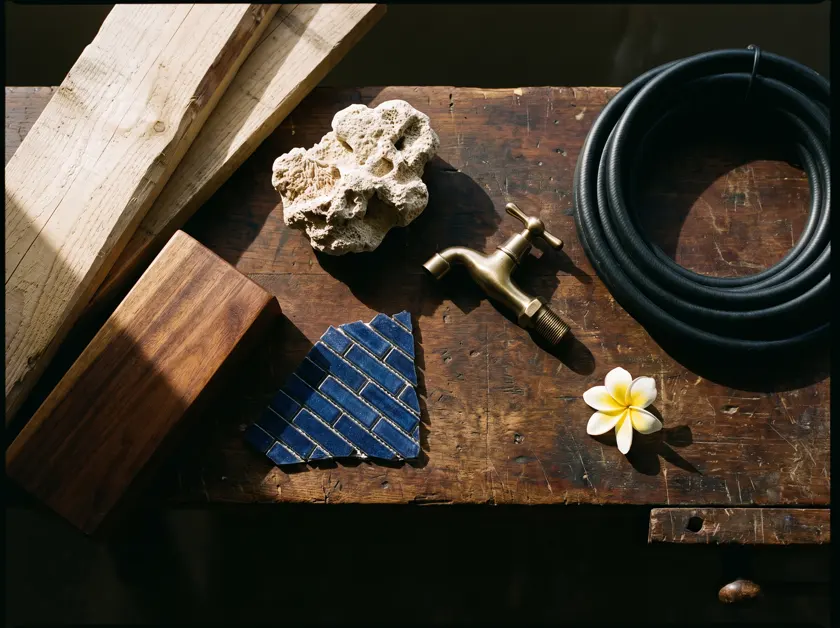
Coral rag makes a superb plunge basin and an even better plinth, on one condition: it is the finish, not the tank. There is a waterproof substrate behind it doing the actual work, and the stone is doing what stone does best, which is looking like it grew there.
Lime plaster, indigo mosaic and dark hardwood all behave well in this climate and all belong to the place. The specification above is about what holds the building together, not about making it look like it came from somewhere else.
If you already have a cabin built to inland specification on the coast, it is usually not a write-off. Replacing accessible plated fixings with A4, enclosing and filtering the plant, lifting a cabin onto a ventilated void, re-sealing what end grain we can reach and putting a quarterly service in place will typically double what is left of its life for a fraction of a replacement.
What we cannot retrofit is unsealed end grain deep inside assembled joints and a shell that has already swelled and opened. At that point the honest advice is to re-line the cabin on a sound frame, and we will tell you which case yours is after looking at it rather than before.
It is rarely dishonesty. It is that most equipment and most standard details are specified nationally, by suppliers whose reference installations are inland, and the coastal exposure is simply never asked about. A quote that says '''sauna cabin, 4 person, 6 kW''' is complete-looking and tells you nothing about whether it will survive on a beach.
The questions worth asking any contractor here are specific: which grade of stainless are the fixings, is end grain sealed before or after assembly, does the cabin sit on a ventilated void, is the plant enclosure filtered, and what is the service interval at this location. A contractor who has built on this coast answers those immediately. One who has not will answer about timber species and heater brands instead.
The cost difference between the right and the wrong specification is real but modest — typically a fifth of a project rather than a half. The cost difference in outcome is a cabin that lasts fifteen years versus one that looks neglected in three and needs replacing in six.
On the Tanzanian coast, specify A4 stainless for every fixing, seal end grain before assembly, sit the cabin on a ventilated void, drain and vent the cavities, house the plant in a sealed filtered enclosure with a titanium heat exchanger in the water circuit, and service quarterly with a corrosion inspection. Do those seven things and salt is a maintenance item. Skip them and it is a countdown.
Want this checked against your own room? Send us the dimensions and a photograph and we will come back with a drawing.
An honest continental price breakdown: what a sauna and cold plunge cost in eight African countries, what move…
Read more →
An honest breakdown of sauna and cold plunge prices in Tanzania: what fits inside 12 million TZS, what pushes …
Read more →
From Nairobi at 1,795 m to the Ngorongoro rim: why African highland saunas need a bigger heater, and why the s…
Read more →