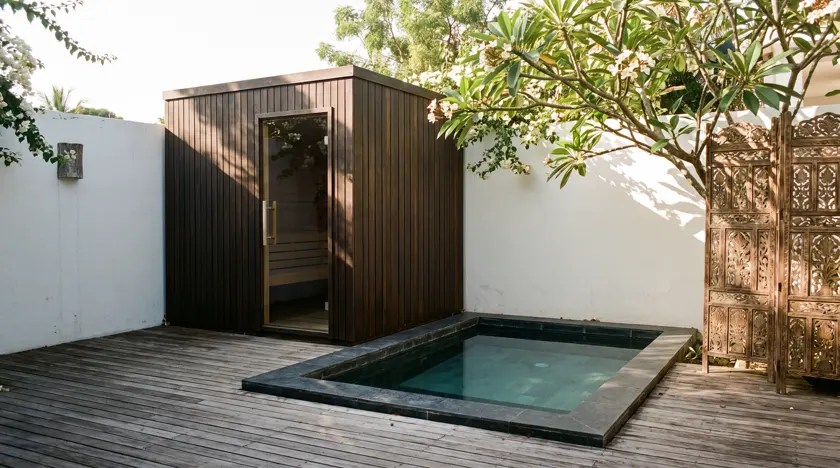
Dar es Salaam
Dar es Salaam
Saunas, cold plunges and steam rooms for Dar es Salaam villas, flats, gyms and hotels, landed at Dar port and …
Read more →Zanzibar sells sun, sea and slow evenings, and a sauna with a cold plunge fits that rhythm better than anyone expects: heat at sunset, cold water after, dinner on the deck. We build for east-coast villas, Nungwi resorts, Stone Town houses and Paje kitesurf lodges, all in salt air and all reached across the water.
In this guide: Stone Town · Michamvi · Nungwi & Kendwa · Paje · Pemba · Mafia Island
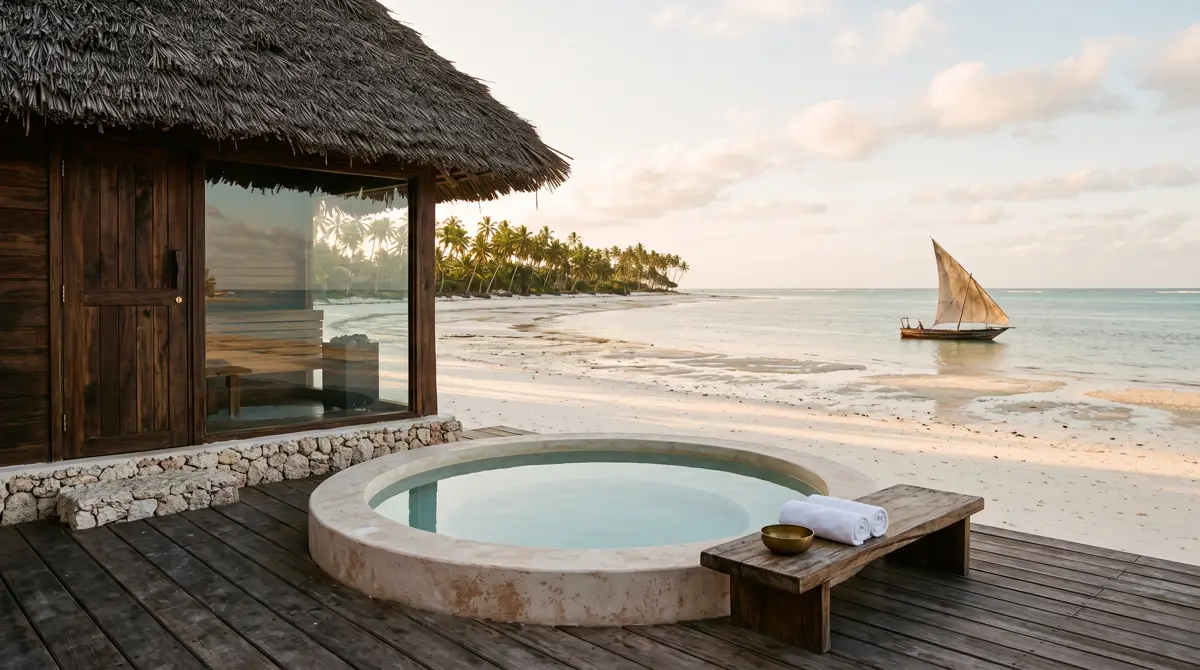
The island recorded 917,167 international arrivals in 2025, around a quarter more than in 2024 (The Citizen), and 92.9 per cent travelled purely for leisure (Bank of Tanzania). That makes the buyers easy to name: beach resorts along Nungwi, Kendwa and Kiwengwa competing for the same guests; villa owners at Michamvi, Jambiani and Matemwe letting their houses between visits; boutique hotels in Stone Town's restored merchants' houses; and guesthouses at Paje where kitesurfers queue for an ice bath.
Each brief has its page: a coral-stone cold plunge, a Stone Town hammam or steam room, a full resort thermal suite, and our island build specification for salt, sand and hand carry.
Unguja's electricity comes from the mainland by submarine cable and is distributed at 230 V and 400 V. When the old cable failed in December 2009 the island went without mains power until March 2010, as PRX's The World reported, and most villas and hotels have kept a generator ever since. We design for it: separate circuits for heater and chiller, a controller that never lets them start together, and a lidded tub that stays cold for hours when the power drops.
| Project | Indicative, million TZS |
|---|---|
| Sauna, 4 person, one glass wall | 11.5 – 17 |
| Coral-rag plunge basin, built in | 16 – 30 |
| Beach-house corner: sauna and chilled plunge | 21 – 44 |
| Marine specification package | 3 – 9 |
| Resort spa, duplicated plant | 140 – 380 |
Bands include supply and installation and are confirmed after a survey in person or by video; the crossing and any Stone Town carry appear as their own lines.
Cabins are made and test-assembled in our Istanbul factory, cleared at Dar es Salaam and carried across by cargo vessel to Malindi port in Stone Town; from there the east-coast villages are about an hour by road. The factory needs six to ten weeks for a single room once the drawing is approved, twelve to sixteen for a whole villa spa, before the voyage. Send photos of the deck or room and we will reply with pictures of island projects and a first budget.
Stone Town, inscribed by UNESCO as a World Heritage site, is a maze of lanes too narrow for cars, lined with coral-stone merchants' houses and their famous carved doors — and more and more of those houses are boutique hotels.
The crates arrive at Malindi port a few hundred metres away, but the last stretch is on foot. Before quoting we walk from the nearest drop-off to your door with a tape measure and a camera; the cabin is then made in panels that pass the tightest corner, and the carry is priced openly.
Chimneys, wall-hung condensers or altered rooflines — anything a passer-by would notice — need the conservation authority's agreement and is often refused, so we plan around it: electric heaters rather than wood stoves, plant inside a courtyard or service room, heat released into the court rather than onto the street.
Inside, the houses are generous hosts for wet rooms: thick walls, high ceilings, courtyards for air and light, and drainage that usually already exists. The carved doors and lime niches are the design reference, not something to copy in new joinery.
Coral rag and lime plaster are porous and survive because they breathe. A steam room against them needs waterproofing that stands on its own, sealed at every edge, so no moisture is pushed into the historic fabric.
Michamvi Kae sits at the tip of a peninsula on Zanzibar's south-east coast, and it is one of the few spots on the island where villas watch the sun go down over Chwaka Bay.
On most of the east coast the sea faces the sunrise; here the evening light lands on the water, so owners want the plunge where they can watch it. We set the cold tub on the bay side and turn the cabin's glass away from the low sun, so the room does not overheat or glare in the late afternoon.
The timing helps the machinery too: by the time the light goes, the air has cooled a few degrees and the chiller is no longer fighting the hottest part of the day.
The grid reaches Michamvi, but most villas keep a generator and many have added solar with batteries. We give the heater and chiller separate circuits, stop them starting in the same moment, and time the sauna's warm-up for the hours when the panels are producing.
Every villa here is effectively on the beach. The cabin gets A4 stainless throughout, factory-sealed end grain and a ventilated gap beneath; the chiller lives in a closed, filtered cupboard on the landward side of the house.
Nungwi and Kendwa, at Zanzibar's northern tip, hold the island's densest run of beach hotels, so most enquiries here come from resorts that cannot afford to close a wing.
Resorts here fill from July to October and again over Christmas. Refits are planned for the April–May rains or phased room by room behind hoardings, with noise hours agreed in writing, and the programme is counted backwards from the date the spa must reopen — including the time for crates to cross from Dar es Salaam.
Nungwi is a long way from any stockist. Steam generators and chiller pumps are doubled where the spa cannot close, each room can be isolated on its own valves, and a labelled box of spares stays in the hotel's engineering store.
The wind here comes straight off the ocean on two sides. Marine hardware is the rule, and every maintenance visit starts with photographs of the plant compared with those taken at handover, so a hotel engineer can see what is changing.
Paje's shallow lagoon and steady trade winds make it Zanzibar's kitesurfing centre, and here the ice bath is the main event while the sauna plays support.
Kiters spend hours on the water in wind and sun and come in with tired legs and burnt shoulders. A guesthouse tub here is used by a stream of people every afternoon in the season, so it is sized and treated like a club installation, not a villa one.
Every shared tub has a pump, a cartridge filter and ozone or UV, and a freshwater shower sits beside it; riders rinse off salt and sand before they get in.
Fine lagoon sand shortens a cartridge's life and wears pump seals. The rinse shower is the first line of defence, and the plant sits on a raised, enclosed base so blown sand does not reach it.
Most Paje properties are small. A single well-built plunge and a compact cabin with an honest running cost does more for bookings than a large suite that has to be recovered through the room rate.
Pemba, Unguja's green and hilly northern neighbour, is known for clove plantations, deep-water diving and a handful of remote lodges — and for being hard to reach.
Cargo for Pemba travels by boat on a schedule measured in days. The whole installation leaves our factory already assembled once and checked, then goes in a single consignment with a margin of fixings and consumables, because nothing can be bought on the island if something is short.
Lodges here run with a handful of maintenance staff. We choose simple, serviceable equipment, train the team properly during installation and leave a spares box — element, thermostat, cartridge, seals, stainless fixings — each part numbered.
Most Pemba properties generate their own electricity from solar and a generator. The heater is timed into the sunny hours, the plunge holds its temperature overnight under a lid, and the two loads never start together.
Mafia sits south of the Zanzibar archipelago inside a marine park famous for diving and, in season, whale sharks. Guests spend their days in the water, and that changes what they want afterwards.
After two or three dives people are chilled and waterlogged; a warm cabin near the dive centre is what they use. On a diving property we often build the sauna and leave out the plunge, or put a plunge on the accommodation side for guests who do not dive.
Mafia lodges are small and largely solar-powered. A compact, well-insulated cabin with a 4.5–6 kW heater fits into the daytime solar surplus; a large cabin plus a chiller usually does not, and we say so before quoting.
Everything ships in one consignment in full marine specification, and the equipment list is kept deliberately short so the whole installation can be kept running from a single box of spares.
Indicatively TZS 11.5–17 million for a four-person cabin with one glass wall, plus the marine specification and the crossing, which we show separately.
Yes — steam rooms and hammam-style rooms inside historic houses, with waterproofing that stands clear of the coral walls and every panel sized to be carried through the lanes.
They clear customs in Dar es Salaam and cross by cargo vessel to Malindi port, in one consolidated load with spares, so nothing waits on a second crossing.
Rarely. We size every panel to the carry route, and that is routine here.
Yes. The controls stagger the heater and the chiller, and we size both against the generator's real output rather than its label.
Yes, phased room by room behind screens, but the rainy months are faster and cheaper.
Yes. The lagoon and the air are too warm in every month for a tub to stay cold on its own.
Longer than on Unguja: factory time is the same, but the shipping and crossing add weeks.
Often not. Divers want warmth; a plunge makes more sense for non-diving guests.
Tell us the neighbourhood, send a photo of the space and the rough size. We reply within one business day with photos of comparable finished rooms and an itemised quote.
Saunas, cold plunges and steam rooms for Dar es Salaam villas, flats, gyms and hotels, landed at Dar port and …
Read more →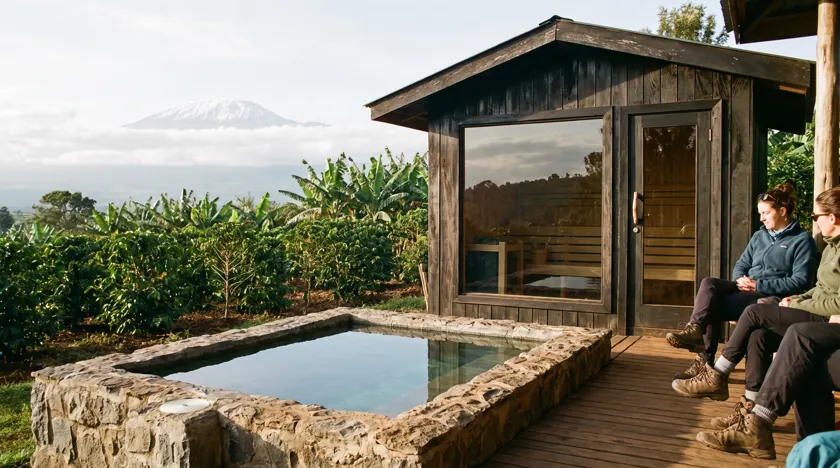
Safari lodge sauna installation in Tanzania: Arusha homes, Moshi trekking lodges, Ngorongoro and Serengeti cam…
Read more →