
11 min
What a Sauna and Cold Plunge Cost Across Africa in 2026
An honest continental price breakdown: what a sauna and cold plunge cost in eight African countries, what move…
Read more →Tanzania's north is the part of the country where a sauna needs no explanation at all — and where a heater chosen from a national chart will disappoint you.
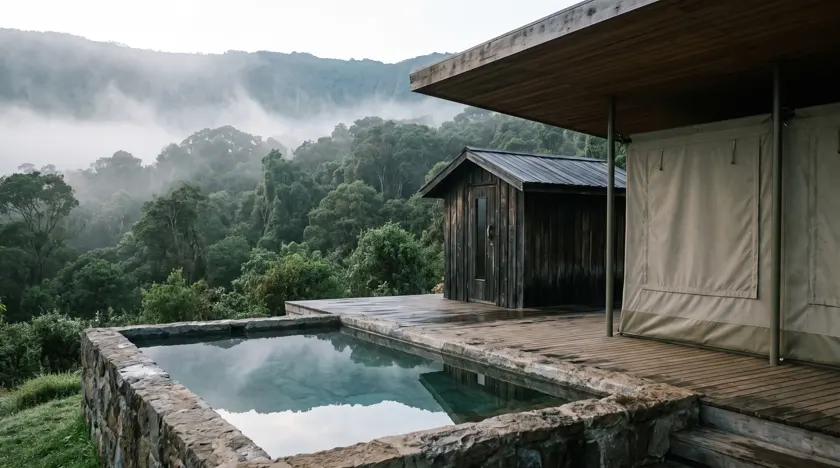
Air density falls with altitude, and a sauna heater works by heating air and stones which in turn heat the room. At sea level in Dar es Salaam our standard calculation gives a reliable result. At Arusha it is slightly optimistic. At the Ngorongoro crater rim, around 2,300 metres, it is optimistic enough to matter.
The practical consequence is a cabin that climbs to 75 °C and then stalls, in exactly the conditions — a cold highland evening — where guests most want 85 °C. The client concludes the cabin is bad. The cabin is fine; the sizing was done for the wrong country.
We apply a correction factor to the heater calculation based on your actual site elevation, not a regional average, and we show it as a separate line in the quote so you can see what it costs. It is usually one step up the heater range, occasionally two.
Highland lodges sit on ground that is genuinely cold, and a cabin floor is a large surface in direct contact with it. We insulate floors to the same standard as walls, which is not standard practice and is immediately noticeable in how fast the room comes up to temperature.
Pipework — supply, drain, any circulation run — stays inside the insulated envelope. On the crater rim, freezing is not a theoretical concern and an exposed run is a repair waiting for a cold night.
The payoff is that a well-insulated highland cabin reaches temperature quickly in the one hour it is actually wanted, rather than being left running all afternoon to be ready.
Everything that makes the hot side harder makes the cold side easier. Cold night air is exactly what a plunge wants, and an insulated, shaded, lidded tub at the crater rim will sit at plunge temperature on its own for most of the year.
We quote no chiller at all for many highland projects. For a true ice bath at 4–6 °C a small machine is still needed, but for a 14–16 °C plunge — which is what the majority of people actually use and enjoy — the climate does it. That removes a capital cost, a monthly bill and a machine that could fail.
Compare that with Zanzibar or Dar, where the same tub needs a chiller running every month of the year and sized a step above temperate figures because the nights never help. The same brief, in one country, produces two completely different quotes, and anyone quoting nationally is wrong in at least one location.
The Kilimanjaro lodges have a particular brief. Trekkers come down after five or six days, cold, filthy and sore, and they arrive together. A cabin sized for a household is useless when twelve people want it at once.
We size on group size, not on floor area, and we build for a fast heat-up because arrival times are approximate. The sequence here is heat first, cold optional — after a week on a mountain, very few people want an ice bath, and the lodges that understand this build a hot room and a hot shower and get the reviews.
Wood-fired heating suits this region genuinely well. Fuel is available, the character fits, and it takes the load off a stretched supply. It needs a correct flue, proper clearances, a spark arrestor and a fire-resistant floor plate — installed, not improvised — and then it is an excellent answer.
Arusha is cool in the evenings all year, which makes a domestic sauna an easy sell, and it is the logistics base for the whole circuit. Materials come up from Dar, teams go out to the crater, the Serengeti and Moshi, and most northern lodge projects stage through here.
For homes in Arusha the altitude correction is modest and the chiller is often unnecessary. The main design decisions are ordinary ones — where the cabin goes, how much glass, whether the plunge is in shade — which is a relief after the coast.
Ngorongoro is a protected conservation area with rules about works, noise, waste water and materials. Grey water from a plunge or a rinse shower cannot simply soak away where it falls, plant noise is regulated, and construction is scrutinised.
We design the grey-water route properly, specify quiet plant on anti-vibration mounts, and prepare the drawings the authority expects before anything is ordered. A lodge that has had a previous installation questioned by the authority will recognise why this comes first.
Highland lodges are not on mains water any more than bush camps are. The tub is sized against what the property can actually supply, filtration and ozone extend water life to a month or more, and the lid reduces evaporation — which at altitude, in dry air, is higher than people expect.
Wood-fired heating suits the northern circuit, and it also raises a question worth answering properly rather than avoiding. Firewood sourced badly is a real problem in this region, and a lodge that markets sustainability while burning uncertified timber has a contradiction on its hands.
The workable answers are sourcing from managed plantation timber with a paper trail, using an efficient closed stove rather than an open one — the difference in fuel consumption for the same heat is substantial — and treating the woodshed as part of the installation rather than an afterthought, so the fuel is genuinely dry. Wet firewood burns badly, produces smoke, tars a flue and consumes roughly twice the volume for the same result.
Where a property cannot source responsibly, electric with a solar schedule is the better answer and we will say so. We would rather build the right thing than the more characterful one.
A heavily insulated cabin with a correctly corrected heater, an insulated floor, glazing placed where the view is and paid for with insulation elsewhere, an insulated lidded plunge with little or no plant, a grey-water route that satisfies the authority, and a service interval of six months rather than three because there is no salt and less dust.
It is, frankly, the easiest good spa to own in Tanzania and the one with the lowest running cost. The hard part is the heater calculation, and that is arithmetic rather than luck.
Want this checked against your own room? Send us the dimensions and a photograph and we will come back with a drawing.
An honest continental price breakdown: what a sauna and cold plunge cost in eight African countries, what move…
Read more →
An honest breakdown of sauna and cold plunge prices in Tanzania: what fits inside 12 million TZS, what pushes …
Read more →
From Nairobi at 1,795 m to the Ngorongoro rim: why African highland saunas need a bigger heater, and why the s…
Read more →