Zanzibar
Zanzibar
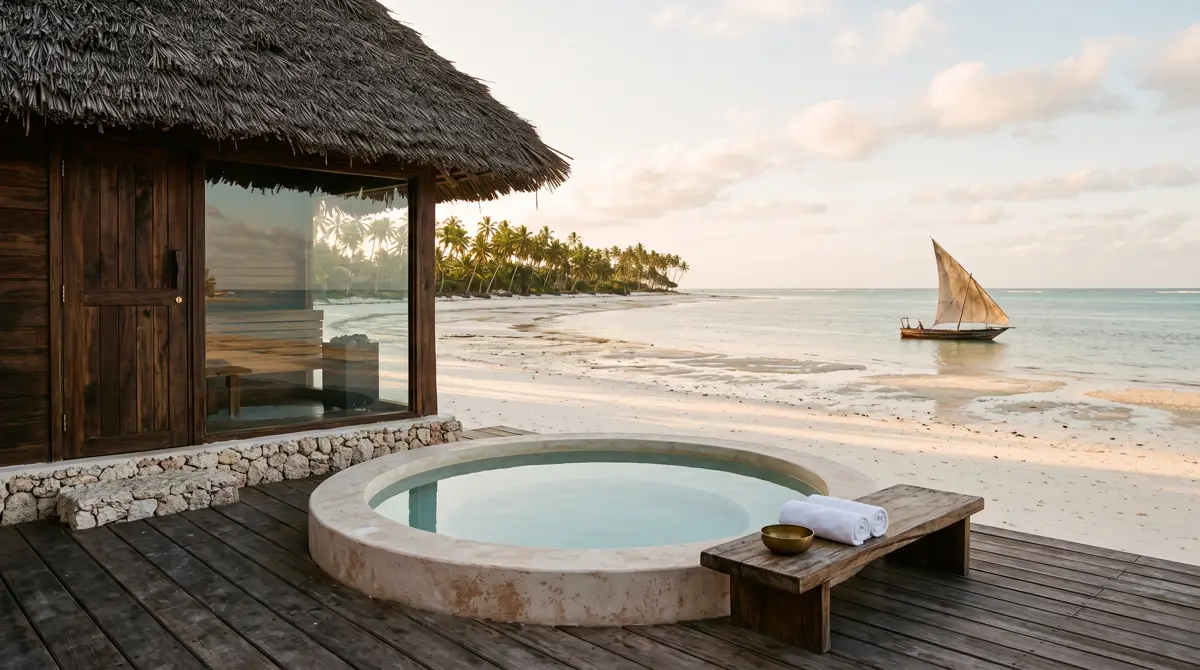
Saunas, steam rooms and coral cold plunges for Zanzibar villas and beach hotels: marine-grade, factory-built, …
Read more →The northern circuit is where Tanzania gets cold enough for a sauna to need no explanation: Arusha at 1,400 m, Karatu and the Ngorongoro rim near 2,300 m, and Kilimanjaro's lodges above Moshi. Further out, Serengeti camps and the southern parks bring dust, heat and no grid at all.
In this guide: Arusha · Moshi · Ngorongoro & Karatu · Serengeti · Nyerere & Selous
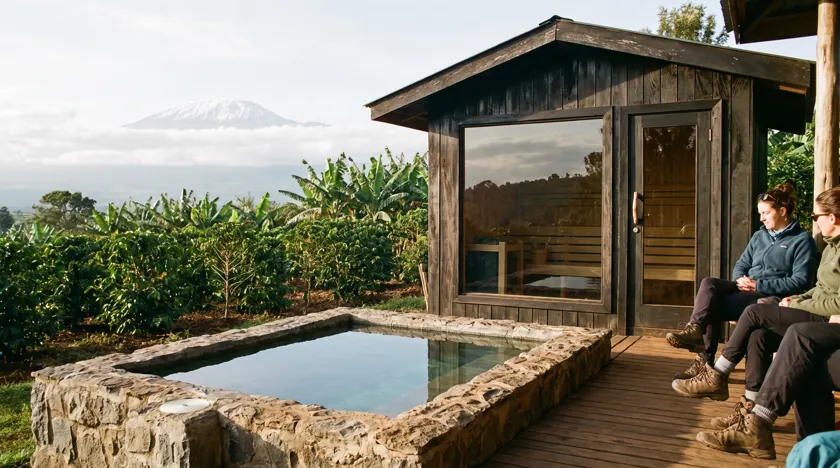
Homeowners and safari operators in and around Arusha; trekking lodges in Moshi receiving climbers off Kilimanjaro; crater-rim and Karatu lodges selling cold evenings; and camps across the Serengeti, Nyerere and Ruaha that run on solar. The last group has its own safari camp spa page, and a custom sauna covers homes and lodges with a grid connection.
Thin air carries less heat per kilowatt, so every heater here is corrected upwards for the site's elevation, modestly at Arusha and substantially on the rim. The same cold nights mean a lidded plunge often needs little or no chiller — one of the few parts of Africa where we regularly remove the machine from a quote.
Arusha and Moshi are on the TANESCO grid at 230 V and 400 V, with cuts common enough that lodges keep generators. Camps in the parks rely on solar, batteries and a generator; for them the heater is timed into the sunny hours or replaced by a wood-fired stove.
| Project | Indicative, million TZS |
|---|---|
| Sauna, 6 person, for a trekking group | 17.5 – 26 |
| Commercial sauna, 10–14 person | 28 – 58 |
| Bush dust and off-grid package | 3.5 – 10 |
| Resort or lodge spa, full | 140 – 380 |
Crates clear at Dar es Salaam and travel north by road through Arusha; fly-in camps receive panels designed around the aircraft. The factory time is six to ten weeks per room after the drawing is approved. Tell us the lodge's elevation, power system and water supply, and we will send photos of comparable lodge projects and an indicative budget.
Arusha lies at about 1,400 metres below Mount Meru. Its evenings are cool enough that a sauna needs no persuading, and it is the town every northern-circuit safari passes through.
Around Arusha and Usa River, clients are homeowners, safari operators and lodges on old coffee estates. The sauna is used all year, most in June to August when evenings turn chilly.
The same climate makes the plunge cheap: a shaded, lidded tub holds a cool temperature with a small chiller, or none if 14–16 °C is enough.
At Arusha's height the heater needs a small step up from a sea-level calculation. Higher up the circuit the correction grows, so we work from the site's actual elevation rather than a regional figure.
Crates for Ngorongoro, the Serengeti and Moshi come up the road from Dar es Salaam through Arusha, and installation trips for the northern circuit are planned from here.
Moshi lives off Kilimanjaro. Its hotels and lodges greet climbers coming off the mountain after five to eight days, and that moment sets the brief for everything we build here.
Trekkers come down cold, dirty and sore, and they want heat before anything else; a cold plunge is a bonus for the few who ask. Groups descend together, so a cabin for two is useless when a dozen arrive at once — we size on the group.
Moshi is lower than Arusha, but lodges on the mountain's lower slopes sit higher and colder. Floors are insulated like walls, pipework stays inside the insulation and the heater is corrected for the site's height, so the cabin heats quickly when the group walks in.
A wood-fired heater suits many Kilimanjaro lodges: local fuel, a fire at the end of a long trek, and no load on a stretched supply. It needs a correctly sized flue, clearances, a spark arrestor and a hearth plate, all fitted by our crew.
Lodges on the Ngorongoro crater rim stand at about 2,300 metres, with Karatu's farm lodges a little lower. Nights are cold enough for fires, and a sauna is the easiest thing in Tanzania to sell here.
At this height the heater needs a substantial upward correction, while the plunge barely needs a machine: a lidded, insulated tub on the rim stays cold on its own for most of the year. Floors are insulated like walls and pipework stays inside, because frost on the rim is a real possibility.
The Ngorongoro Conservation Area controls building works, noise, grey water and materials. We prepare the drawings the authority expects, route grey water to the lodge's treatment, and mount plant on anti-vibration feet so it cannot be heard from a guest tent.
A cabin facing the crater floor sells rooms by itself. We put the glazing on the view and pay for the heat loss with thicker insulation everywhere else.
Serengeti camps move with the migration or sit on kopjes far from any town. Their spa has to cope with dust, solar power, trucked water and a rush of guests after the afternoon game drive.
By the middle of the dry season a condenser left in the open is coated. Plant goes into a sealed, shaded housing with washable pre-filters, well away from the vehicle track, and the camp team cleans the filters between our visits.
Hinges, catches and seals are chosen to be cleaned rather than sealed for life, because dust reaches everything eventually.
Tub volume follows the daily water allowance and the lid stays on; the heater and chiller are never allowed to start together on the camp's batteries. Seasonal camps get a written shutdown routine — drain, cover, isolate — for the months they are closed.
A camp that relocates with the migration can still have a sauna: a compact cabin on a demountable deck, crated between moves. A tiled permanent suite is only for fixed lodges.
Nyerere National Park, carved from the old Selous reserve, is low, hot and river-fed. Many lodges are reached by light aircraft, and guests come back from boat safaris wanting cold water first.
Here the plunge is the main attraction and the sauna the second act. The tub is larger, properly shaded and chilled for warm nights; the cabin stays because the contrast is what guests remember.
For fly-in lodges the aircraft's door size and payload set the panel dimensions from the first drawing, and every piece is light enough for two people to carry. Where there is a road, one consolidated truck from Dar es Salaam carries the lot.
River lodges get humid air in the wet season and dust in the dry. Plant housings are sealed and filtered, enclosed wet rooms have humidistat extract, and the maintenance interval follows whichever season is harder on the equipment.
On the northern circuit, yes: we correct it for the lodge's altitude. In the hot, low southern parks no correction applies.
Often. A lidded, insulated tub stays cold on the rim's nights for most of the year.
One consolidated load by road from Dar es Salaam, or panels sized for a light aircraft, with a spares box and a trained camp team.
Not for 14–16 °C. For a true ice bath, a small one.
Sized for the group: eight to twelve seats is typical.
Usually not. The nights keep the plunge cold.
Yes, a compact cabin on a demountable deck. Not a permanent tiled suite.
Yes, with every component designed around the aircraft's limits.
Tell us the neighbourhood, send a photo of the space and the rough size. We reply within one business day with photos of comparable finished rooms and an itemised quote.
Saunas, steam rooms and coral cold plunges for Zanzibar villas and beach hotels: marine-grade, factory-built, …
Read more →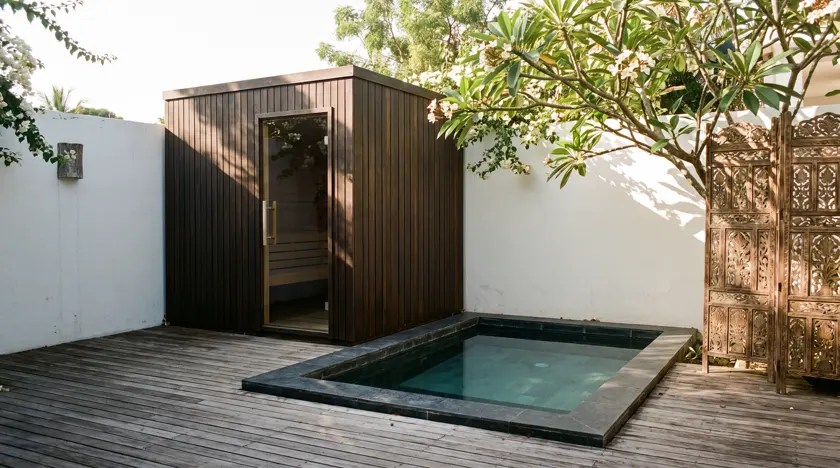
Saunas, cold plunges and steam rooms for Dar es Salaam villas, flats, gyms and hotels, landed at Dar port and …
Read more →