
11 min
What a Sauna and Cold Plunge Cost Across Africa in 2026
An honest continental price breakdown: what a sauna and cold plunge cost in eight African countries, what move…
Read more →Stone Town is a World Heritage site, a pedestrian one, and built of a material that drinks water. All three facts have to be designed for, not discovered.
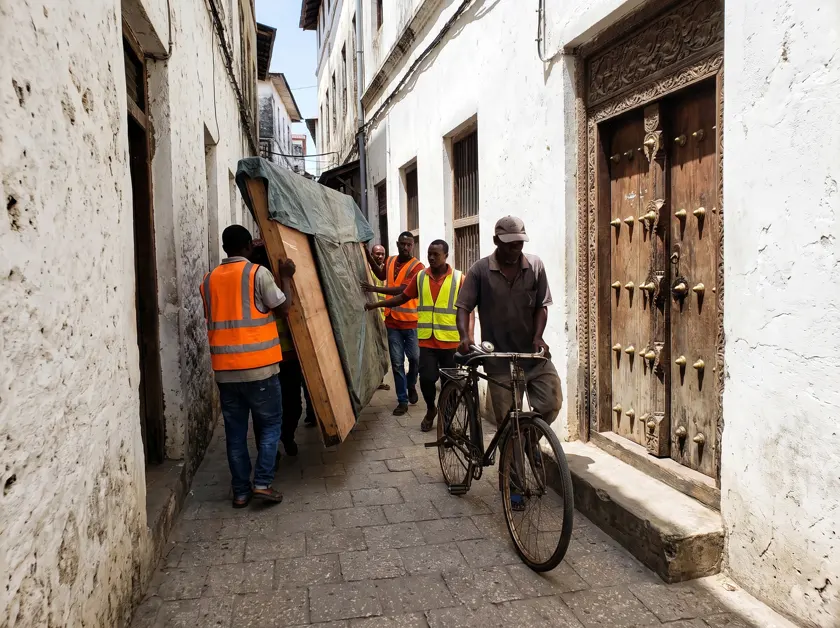
The lanes of the old town are narrow enough in places to touch both walls, and they turn. A vehicle cannot reach most addresses, which means every panel, every bag of sand, every stone and the plant itself arrives by handcart and on shoulders.
This is not an obstacle so much as a design input. Before we quote we walk the route from the nearest vehicle drop to your door, photograph every turn and measure the tightest one. Every component is then sized to pass it. A cabin that would ship as three large panels anywhere else ships as six smaller ones here, with the joints designed rather than improvised.
We price the carry as its own line. On a Stone Town job it is the difference between a two-week and a three-week programme, and a contractor who does not mention it has either not understood the job or intends to raise it later.
Externally, Stone Town is fixed. A new flue, an air-conditioning or chiller unit on a wall, a changed roofline or a new opening are all conversations with the conservation authority, and most of them are short conversations.
This rules out some things people expect. A wood-fired stove needing a new external flue is usually not achievable on a protected facade. A chiller condenser hung where it can be seen from the lane is not achievable either.
What works instead: plant inside a courtyard or a service room with ducted or grilled ventilation that reads as part of the building; electric heaters rather than anything requiring a flue; and cold-water plant sited internally with its heat rejected into a court rather than onto a street elevation. We prepare the drawings for anything that does need consent, and we start that conversation before ordering materials, not after.
The frustrations are all external. Internally, a Stone Town house is close to an ideal host for wet rooms. The walls are thick and thermally massive, ceilings are high, the courtyard gives natural ventilation and light, and drainage of some kind almost always exists already.
There is also a building tradition to draw on. The Persian-influenced bathing rooms of the old houses, the carved doors, the lime-plastered niches and the coral-stone benches are the reference material for what we build, and it is far better reference than anything imported. A hammam-style room here does not feel like an import; it feels like a restoration.
We do not imitate the carved doors in new joinery — they are protected, they are better than anything we would make, and copying them badly is worse than not copying them at all. We take cues from proportion, indigo, lime white and dark hardwood instead.
The single technical fact that governs everything is that coral rag and old lime plaster are absorbent. They are porous by nature and they have survived centuries precisely because they breathe. Put a modern steam room against them without a continuous membrane and the moisture goes into the wall, travels, and reappears as damage somewhere you were not looking.
Our approach is a liquid-applied membrane over the slab and up the walls past the ceiling junction, taped and detailed at every corner, and — the part that takes the time — detailed properly at every junction with the existing structure, including around any historic feature we are working past. The screed falls at least 1:50 to the drain and the ceiling is pitched three to five degrees or domed so condensate runs to the walls rather than dripping on people.
This detailing is most of the skill in a Stone Town job and a large part of the cost. It is also exactly where the installations we are called to repair have failed, usually because someone treated an old coral wall as though it were blockwork.
Zanzibar's outside air is humid most of the year, which means a steam room here cannot rely on opening a window. Mechanical extract, ducted to outside, sized for several air changes after a session and controlled by a humidistat rather than a timer.
The humidistat matters because outside conditions vary and a timer cannot know. A fan that runs for a fixed twenty minutes will sometimes stop with the room still wet, and a room that is left wet is a room that grows things.
The failure we find most often in other people's work is extract that terminates in a ceiling void rather than outside. That is not ventilation; it is moving the problem into the structure, and in a historic building it is genuinely damaging.
Many Stone Town properties are on borehole or rainwater rather than a reliable mains supply, and the two are very different for a steam generator. Rainwater is soft and easy on a generator but can be aggressive to certain tank materials. Borehole water on this island can be hard enough to scale a generator in months.
We test at the property before specifying, because the descaling interval follows from the result and because a scaled generator on an island is a long wait for a replacement rather than a Tuesday afternoon repair.
A large share of Stone Town's historic houses are now boutique hotels, and for them a hammam or steam room is not a comfort, it is a rate argument. A property with fifteen rooms and a genuine wet room in a restored courtyard sits in a different bracket from one without, and it has something to photograph that no beach resort can copy.
The commercial constraints follow the same pattern as the technical ones. The building cannot close, so we phase room by room behind screens and agree noise windows in writing. Plant is duplicated on critical items because a scaled generator in August cannot wait for a shipment. And a spares kit with part numbers sits on site from handover, because on this island that box turns a three-week wait into a ten-minute repair.
We also train the staff properly — two days at handover on operation, cleaning chemistry, water testing and the log book, then a return visit at six months to check the log is being kept. Hotel maintenance teams turn over, and a suite run by someone who was never shown how is broken by its second year.
A Stone Town project runs longer than the equivalent mainland job — typically three to five weeks on site rather than two to three — and the difference is carrying, careful work against historic fabric, and any consent required.
What you get for that is a room that belongs in the building rather than one installed into it, built out of the materials the town is made of, with a membrane behind them that means the building is no worse off for having it. That is the whole objective: a wellness room the house can host for the next fifty years without complaint.
Want this checked against your own room? Send us the dimensions and a photograph and we will come back with a drawing.
An honest continental price breakdown: what a sauna and cold plunge cost in eight African countries, what move…
Read more →
An honest breakdown of sauna and cold plunge prices in Tanzania: what fits inside 12 million TZS, what pushes …
Read more →
From Nairobi at 1,795 m to the Ngorongoro rim: why African highland saunas need a bigger heater, and why the s…
Read more →